Seasonal Care
What size cover you need, and the overlap that decides it
A cover sold as 24 feet measures 28. Buy by the size of your pool, not the size of the fabric, and the most common ordering mistake disappears.

Heads up: we earn a commission if you buy through the links on this page, at no extra cost to you. It never decides the ranking — here is how we pick and here is the full disclosure. Prices are checked automatically; last verified October 8, 2026.
The short version
- Order by pool size, never by cover size. A cover sold for a 24 ft round pool measures about 28 ft of fabric.
- Overlap is typically 3 to 4 feet, built in by the manufacturer rather than something you add.
- The extra material is for the water drop. Covers are designed to reach a surface that has been lowered for winter.
- Cable and winch first, clips second. The cable holds the cover on; clips and sealers stop wind getting underneath.
The one rule that prevents the common mistake
Winter covers are ordered by the size of the pool, not by the dimensions of the fabric. Pool Mate’s product line makes the convention visible: a cover for a 24 foot round pool is sold as a 24 foot cover and measures 28 feet, with a published 4 feet of overlap.
In The Swim publishes the same convention on its product pages, describing a 4 ft overlap that allows for water drop and easy installation. The Pool Factory puts the industry range at an additional three to four feet of material.
So if you own an 18 foot round pool, you buy an 18 foot cover. Measuring your pool and ordering fabric to match is the error, and it produces a cover that will not reach around the top rail once the water is down.
Why the extra material exists
Two reasons, and both are about winter rather than storage.
The water drop. A pool is lowered for winter, and the cover has to reach a surface that is now several inches below where it was. In The Swim’s winter cover category describes the overlap as accommodating an 18 inch water drop; INYO Pools states that most covers carry enough material for a level reduced up to 12 inches, and that a deeper drop means buying a larger cover.
Securing. The cover has to wrap the top rail and be held there, which consumes material all the way round. A cover cut exactly to the pool diameter has nothing left to grip with.
How far to lower the water is a separate decision, and it depends on your pool. Industry guidance for freezing climates is four to six inches below the skimmer and no further; Bestway specifies a few inches below the inlet or outlet valves for its year-round pools. Our winterizing guide and draining guide cover both cases.
What a 24 foot cover actually measures
- Pool diameter
- 24 ft
- Published overlap, each side
- 2 ft
- Total added material
- 4 ft
24 ft pool + 4 ft overlap = 28 ft of cover fabric
Order the 24 ft cover, not the 28 ft one
Measuring a pool that is not a neat circle
Round pools are straightforward: the nominal size on the box is the size to order. Where it gets awkward is ovals and anything that has been in the ground for a decade.
Measure the pool, not the cover you have
An existing cover may be the wrong size already, or may have shrunk and stretched. Measure the pool itself, outside edge to outside edge of the water.For ovals, take both dimensions
Ovals are sold by two numbers - length by width - and both have to match. An oval cover on an oval pool is not interchangeable with a round one of similar area.Measure twice, at right angles
Old pools settle out of round. If two diameters differ, order for the larger one; a cover slightly too big can be worked with, one slightly too small cannot.Check your top rail width
Wide top rails consume overlap. A pool with 7 inch rails uses more of the margin than one with 5 inch rails before the cover reaches anything to grip.Decide about the water drop first
If you plan to lower more than about 12 inches, published guidance says you need a larger cover than standard overlap allows.
What holds it on
The primary attachment on an above-ground winter cover is a cable and winch, and it usually comes in the box — The Pool Factory states that all of its winter covers include a cable and tightening device, and In The Swim lists winch and cable with its above-ground covers. The cable runs through the cover hem, round the pool below the top rail, and is tightened with a small ratchet.
Everything else is wind management, and it is supplementary rather than alternative:
| Hardware | What it does | When you need it |
|---|---|---|
| Cable and winch | Holds the cover onto the pool; usually included | Always - it is the primary fixing |
| Cover clips | Clamp the cover to the top rail, keeping it taut and reducing whipping | Windy sites; stops folds that trap water |
| Winter cover sealer | Wraps the top ledge so wind cannot get under the cover | Exposed sites where wind lifts the cover |
| Wall bags or weights | Weigh the cover down where a deck prevents a cable wrap | Pools with decking against the wall |
Wind is what destroys winter covers, not cold. A cover that lifts and whips tears at its grommets and its seams, and a cover with folds collects standing water — which is the failure our cover care guide is built around, and the reason a cover pump belongs on the closing list.
Leaf nets, and the second cover question
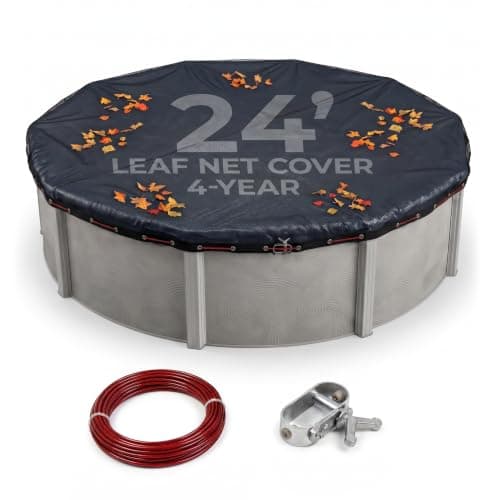
If your pool sits under trees, the cover sizing question has a companion: a leaf net goes over the winter cover, is sized the same way, and is lifted off with the leaves on it in late autumn. It is the difference between a manageable spring and a cover full of rotting leaf mulch, as our leaf season guide covers.
Order it to the same pool size as the cover. Like the cover, a net is sold to fit the pool rather than the fabric dimension, and it needs its own overlap to be secured over the top of an already-covered pool.
Taking it off again, and what that implies for sizing
A cover that was a struggle to fit is a cover that will be a struggle to remove, usually in April with a winter’s worth of water and leaf mulch on top of it. That is worth thinking about when you are choosing between a snug fit and a generous one.
The published overlap exists partly for this. Three to four feet of material means the cover can be loosened, walked round and drawn off in one direction rather than fought over the top rail. It also means a cover that still fits next year if the pool settles slightly or you lower the water a little further.
Two habits make spring easier. Pump the standing water off before you touch the cable — our cover pump roundup covers the tool for that — and take a leaf net off separately in autumn rather than leaving everything to be lifted at once. Our green pool opening guide covers what to do if the cover comes off and the news is bad.
What to buy
Scores are our own reading of published specifications. They are not test results — we have not tested these products and we do not claim to.
Five months of weather, not one night
Winter Cover for Above-Ground Pools
Various
A structural product, not a summer one. Its job is carrying snow and blocking light for a whole winter, and a solar cover pressed into that role will be in shreds by February.
Key specs
- Construction
- Woven polyethylene, weight published in mil or scrim count
- Securing
- Cable and winch, or wraparound straps
- Overlap
- Needs genuine overlap past the wall — check the stated size against your pool
- Not the same as
- A solar cover or a safety cover
How it scoresour reading of published specs, not a test result
- Retention
- 8.5
- Durability
- 8.0
- Handling
- 6.5
- Running cost
- 9.0
- Value
- 8.5
Overall 8.3 / 10
What works
- Blocks light for the whole winter, which is what stops algae in a closed pool
- Cable-and-winch securing survives wind that lifts a strapped cover
- Buying the heavier scrim genuinely doubles the number of winters you get
What doesn't
- Needs a way to shed or pump off standing water, or the weight tears it
- Bulky to store in summer
- Not a safety cover — it will not support a person and must not be treated as if it will
Skip it if: A pool you take down each autumn. If the pool comes apart, the cover is money spent on nothing.
What it costs to run: This is insurance rather than a saving. A torn cover in January means an opening in April that costs a full shock treatment and a week of filtration to fix, which is more than the better cover cost.
Several seasons: Buy-once. Built and warranted to come back out of the box for a few years, if you store it properly.
A cover that stays on the pool
Winter Cover Clips (Wind Guards)
Various
Plastic clamps that pinch the cover's overlap under the top rail. Two per rail section, and the difference between a cover that survives a February gale and one that ends up in the neighbor's garden.
Key specs
- Length
- Commonly 4.7 to 5.5 in
- Material
- ABS plastic
- Fit
- Steel-wall pools with a top rail
- Quantity
- Two per top rail section is the stated guidance
- Pack sizes
- 12 to 72 pieces
- Also used with
- Cover cable and winch, and wall bags
How it scoresour reading of published specs, not a test result
- Retention
- 8.5
- Durability
- 6.5
- Handling
- 9.5
- Running cost
- 10.0
- Value
- 9.0
Overall 8.4 / 10
What works
- Solves the actual failure mode of a winter cover, which is wind rather than weight
- Clip on by hand in seconds and come off just as fast
- Cheap enough to buy a pack that covers every rail section twice over
- Useful the rest of the year for towels, tarps and shade sails
What doesn't
- Only fit pools with a top rail — no rail, no clip
- ABS goes brittle in prolonged cold and the cheap ones snap
- They pinch the cover, and a pinched cover can tear at the clip point
- Easy to lose in the grass at opening
Skip it if: Holding down a cover that is already loaded with water. Clips manage wind; the weight problem is a cover pump and a leaf net.
What it costs to run: A pack against a replacement winter cover. Our cost of a bad close guide prices what happens when the cover comes off in January, and this is a rounding error against it.
Several seasons: Buy-once. Built and warranted to come back out of the box for a few years, if you store it properly.
Specs from: Above-ground winter cover clips and wind guards — Amazon listing
A pool under trees in October
Leaf Net Cover
Various
A fine mesh net that sits over the winter cover and lifts off with the leaves on it. On a treed yard it is the difference between dragging a loaded cover and rolling one.
#ad how this is funded · price as of October 8, 2026
Key specs
- Sizing
- Sold by pool diameter, typically with 3 ft overlap
- Material
- Polyethylene or nylon fine mesh
- Binding
- Around 1.75 in nylon binding with sewn loops
- Fixing
- Grommets, and cable and winch on some
- Position
- Over the winter cover, not instead of it
- Weight
- Light — one person can lift it loaded
How it scoresour reading of published specs, not a test result
- Retention
- 5.0
- Durability
- 8.0
- Handling
- 9.0
- Running cost
- 10.0
- Value
- 8.5
Overall 8.0 / 10
What works
- Lifts off with the whole leaf fall on it, so the winter cover underneath stays clean
- Removes the single largest source of standing water weight on a cover
- Cheap, and it lasts several seasons because nothing stresses it
- Works over a solar cover in autumn too, before the pool is closed
What doesn't
- Useless on a yard with no trees, which is most of the argument against it
- Has to come off before the leaves are wet and heavy, so timing matters
- Fine mesh still passes needles and small debris
- Another large item to dry and store
Skip it if: Being a cover. It stops debris, it does not block light, hold heat, or keep anything out of the water on its own.
What it costs to run: Set against a torn winter cover and a spring opening full of leaf tannin. On a treed yard the payback is one autumn; on a clear yard there is none.
Several seasons: Buy-once. Built and warranted to come back out of the box for a few years, if you store it properly.
Specs from: Above-ground pool leaf nets — current Amazon category listing
Questions people actually ask
What size winter cover do I need for an 18 foot pool?
How much overlap should a winter cover have?
How far should I lower the water before covering?
Do I need cover clips if the cover has a cable?
Can I use a solar cover as a winter cover?
Sources
- Pool Mate — above-ground pool covers, published overlap
- In The Swim — Ultimate 3000 winter pool cover, 24 ft round (4 ft overlap)
- In The Swim — winter covers category, water drop and included hardware
- INYO Pools — how to select the right size winter pool cover
- The Pool Factory — above-ground pool covers, choosing the best fit
Read next
- Closing, covering and opening againWinterizing, covers and spring opening - the four weeks of the year that decide whether you own a pool next summer.
- The best winter covers for an above-ground poolScrim weight, cable-and-winch versus straps, and the overlap you need - the three specs that decide whether a cover survives a winter.
- A winter cover fails from water on top of it, not from coldWhy standing water is what destroys winter covers, the mid-winter checks that prevent it, and how to store one so it lasts.
- Wind takes the cover off. Clips are what stop it.Winter cover clips and wind guards for above-ground pools — how many per rail, what the plastic does in cold, and what they cannot fix.
- The air pillow is structural, not paddingWinter air pillows compared on size, published vinyl gauge and pool ratings, with the inflation guidance that makes them work and the conflicts between listings.
- How to winterize an above-ground poolThe correct closing sequence, the freeze damage that ends pools, and why a cracked pump housing is entirely preventable.
- Solar cover or winter cover: they are not the same productWhat a solar cover does, what a winter cover does, why neither substitutes for the other, and which one to buy first.
- The leaf net is a yard purchase, not a pool purchaseHow a leaf net sits over the winter cover, what to check on sizing and mesh, and the yard test that decides whether it is worth buying.
- Mesh or solid: one keeps the water out, the other lets it throughSolid winter covers against mesh safety covers for above-ground pools: drainage, the ASTM load standard, what each needs to anchor, and where a leaf net fits in.