Seasonal Care
The cover pump exists because water is heavier than people think
An inch of rain on a 15-foot cover is over a thousand pounds. That load sits on your cover, your straps and eventually your pool wall.
Heads up: we earn a commission if you buy through the links on this page, at no extra cost to you. It never decides the ranking — here is how we pick and here is the full disclosure. Prices are checked automatically; last verified October 8, 2026.
Quick picks
Segmented before it is ranked — the right answer depends on which of these you actually are. Tap any row for the full write-up.
The pump
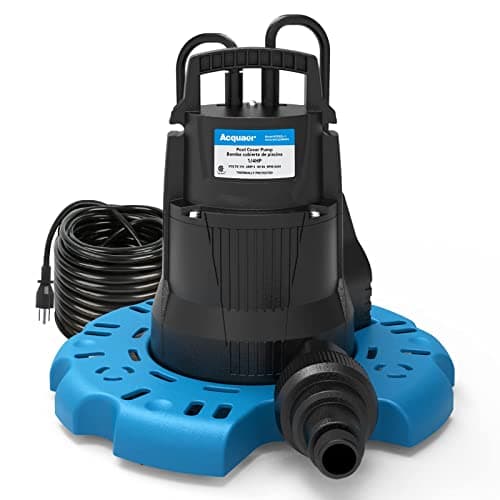
A submersible cover pump with automatic on-off. The automation is the point — nobody goes out to a cover in February.
| # | Product | Best for | Score | Price |
|---|---|---|---|---|
| 1 | Submersible Pool Cover Pump A small submersible pump that sits on the cover and clears the puddle. It exists because water weight is what destroys winter covers, and sweeping in January is nobody's idea of a Saturday. | Getting standing water off a winter coverSeveral seasons | 7.9out of 10 |
What it is protecting
The cover and the pillow are the load-bearing parts of a winter close, and standing water is what defeats both.
| # | Product | Best for | Score | Price |
|---|---|---|---|---|
| 1 | No image Winter Cover for Above-Ground Pools A structural product, not a summer one. Its job is carrying snow and blocking light for a whole winter, and a solar cover pressed into that role will be in shreds by February. | Five months of weather, not one nightSeveral seasons | 8.3out of 10 | |
| 2 | 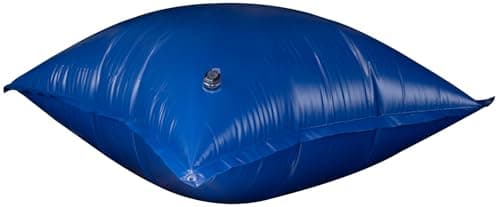 Winter Air Pillow for Above-Ground Pools A few dollars of inflatable that gives expanding ice something compressible to push against instead of your pool wall. In a freezing climate this is not optional. | Stopping ice from pushing on the wallOne honest season | 8.4out of 10 |
The short version
- Water weighs 8.34 pounds a gallon, and a winter cover collects it over its entire surface. The load adds up faster than any other seasonal risk.
- Automatic on-off is the whole feature. A manual pump only works if somebody goes outside, and in February nobody does.
- It costs almost nothing to run because it runs for minutes at a time, a few times a month.
- It must be off the cover before a hard freeze, or it freezes into the ice it was supposed to prevent.
The number that makes the case
One inch of rain on a 15-foot cover
- Cover area
- 15 ft diameter ≈ 176.7 sq ft
- Depth of water
- 1 inch = 0.0833 ft
- Gallons per cubic foot
- 7.48
- Weight of water
- 8.34 lb per gallon
176.7 × 0.0833 = 14.7 cu ft 14.7 × 7.48 = 110 gal 110 × 8.34 = 918 lb
About 918 pounds from a single inch of rain
That weight does three things, in order. It stretches the cover and pulls at the grommets and the cable. It drags the cover down into the pool, which lets debris and dirty water in over the edge. And on an above-ground pool it pulls inward and downward on the top rail, which is the part our cost of a bad close guide prices when it goes wrong.
Add leaves and the load is worse, because a wet leaf mat holds water rather than shedding it — the reason our autumn leaves guide treats leaf removal as urgent rather than cosmetic.
Automatic or manual
| Manual submersible | Automatic | |
|---|---|---|
| Starts | You plug it in | Float or sensor switches it on |
| Needs you present | Yes, every time | No |
| Realistic use in January | It stays in the shed | It works |
| Cost | Lower | Modestly higher |
| Failure mode | Forgotten | Sensor fouls with debris |
The honest read is that a manual cover pump is a false economy for most people. The situation it is needed in — a cold, wet, dark week in midwinter — is precisely the situation in which nobody walks to the far end of the yard to plug something in. An automatic pump that switches itself on at an inch of standing water is doing the job on the days that matter.
What it costs to run
- Typical draw
- Check the label — small submersibles are modest
- Runtime
- Minutes at a time, a few times a month
- US residential average rate, June 2026 [EIA]
- 18.34 ¢/kWh
100 W × 4 hours total per month ÷ 1,000 × $0.1834 ≈ $0.07/month
Effectively nothing across a winter
Placement and the things that go wrong
Put it at the low point. Water collects wherever the cover sits lowest, and on an above-ground pool that is usually the middle — which is where the air pillow is keeping the cover raised. The pump goes beside the pillow, not on it.
Keep the intake clear. The most common failure is a screen blocked by leaf debris, which stops the pump and defeats the automation silently. Check it when you check the cover.
Run the discharge hose away from the pool. Pumping cover water into the ground next to an above-ground pool softens the base, and a soft base under a loaded pool is how a wall goes out of level — the failure our leveling guide is about.
The freeze problem, which is the real limitation
A cover pump moves liquid water. It cannot do anything about ice, and if it is sitting in water that freezes solid it becomes part of the ice sheet — which usually ends the pump and can damage the cover when you pull it free.
So the seasonal pattern is: pump through the wet autumn and the wet spring, and take it off the cover before a sustained hard freeze. In a mild winter it can stay out all season. In a cold one it comes off, and the frozen surface is then doing the job the pillow was installed for — taking the expansion load inward rather than against the pool wall. Our unexpected freeze guide covers the short-notice version.
The other timing point is before a storm. A cover pump, its hose and its cord are three loose items on a cover in high wind, and our storm prep guide is clear about loose items near a pool. Check the cover afterwards rather than assuming, which is the routine in our winter cover care guide.
The picks, in full
Scores are our own reading of published specifications. They are not test results — we have not tested these products and we do not claim to.
Pick #1 · Getting standing water off a winter cover
Submersible Pool Cover Pump
Various
A small submersible pump that sits on the cover and clears the puddle. It exists because water weight is what destroys winter covers, and sweeping in January is nobody's idea of a Saturday.
#ad how this is funded · price as of October 8, 2026
Key specs
- Type
- Submersible, sits on top of the cover
- Operation
- Manual or automatic float switch, by model
- Discharge
- Garden hose thread on most models
- Requirement
- Outdoor-rated, GFCI-protected outlet
How it scoresour reading of published specs, not a test result
- Sizing fit
- 8.0
- Running cost
- 9.0
- Maintenance
- 7.0
- Build
- 7.0
- Value
- 8.5
Overall 7.9 / 10
What works
- Removes the single biggest cause of winter cover failure, which is accumulated water weight
- Automatic models handle rain you were not there for
- Cheap relative to a replacement cover
- Also useful for draining the last few inches of a pool at take-down
What doesn't
- It is an electrical appliance sitting in water outdoors, so the GFCI rules are not optional
- Automatic float switches are the part that fails, usually with debris under them
- Needs storing dry and drained or it freezes and cracks like any other pump
- Cheaper units struggle with the last half inch, which is where debris collects
Skip it if: Being left connected and forgotten all winter. It wants checking after storms, which is when you should be looking at the cover anyway.
What it costs to run: One purchase against the cost of a torn winter cover and the spring opening that follows it. On that comparison it is not a close call.
Several seasons: Buy-once. Built and warranted to come back out of the box for a few years, if you store it properly.
Specs from: Submersible pool cover pumps — current Amazon category listing
Pick #2 · Five months of weather, not one night
Winter Cover for Above-Ground Pools
Various
A structural product, not a summer one. Its job is carrying snow and blocking light for a whole winter, and a solar cover pressed into that role will be in shreds by February.
Key specs
- Construction
- Woven polyethylene, weight published in mil or scrim count
- Securing
- Cable and winch, or wraparound straps
- Overlap
- Needs genuine overlap past the wall — check the stated size against your pool
- Not the same as
- A solar cover or a safety cover
How it scoresour reading of published specs, not a test result
- Retention
- 8.5
- Durability
- 8.0
- Handling
- 6.5
- Running cost
- 9.0
- Value
- 8.5
Overall 8.3 / 10
What works
- Blocks light for the whole winter, which is what stops algae in a closed pool
- Cable-and-winch securing survives wind that lifts a strapped cover
- Buying the heavier scrim genuinely doubles the number of winters you get
What doesn't
- Needs a way to shed or pump off standing water, or the weight tears it
- Bulky to store in summer
- Not a safety cover — it will not support a person and must not be treated as if it will
Skip it if: A pool you take down each autumn. If the pool comes apart, the cover is money spent on nothing.
What it costs to run: This is insurance rather than a saving. A torn cover in January means an opening in April that costs a full shock treatment and a week of filtration to fix, which is more than the better cover cost.
Several seasons: Buy-once. Built and warranted to come back out of the box for a few years, if you store it properly.
Pick #3 · Stopping ice from pushing on the wall
Winter Air Pillow for Above-Ground Pools
Various
A few dollars of inflatable that gives expanding ice something compressible to push against instead of your pool wall. In a freezing climate this is not optional.
#ad how this is funded · price as of October 8, 2026
Key specs
- Function
- Absorbs ice expansion; centers the load away from the wall
- Inflation
- Inflate to roughly 60% — a fully inflated pillow bursts
- Placement
- Centered under the winter cover
How it scoresour reading of published specs, not a test result
- Retention
- 8.0
- Durability
- 6.5
- Handling
- 9.0
- Running cost
- 10.0
- Value
- 9.0
Overall 8.4 / 10
What works
- Extremely cheap relative to the wall or liner it protects
- Also stops rainwater and snowmelt pooling in the center of the cover
- Reusable for several winters if it survives one
What doesn't
- Cheap ones deflate mid-winter, which is when it matters
- Must be tethered or it drifts to the edge and does nothing
- Over-inflating is the most common mistake and it destroys the pillow
Skip it if: Climates that do not freeze. If your water never ices over, this is solving a problem you do not have.
What it costs to run: The cheapest insurance in this entire site against the most expensive winter failure. Inflate to about 60% and tether it.
One honest season: The cheapest setup that genuinely works for a season of real swimming. Nothing spare, nothing missing.
Questions people actually ask
Do I need a pool cover pump?
Automatic or manual cover pump?
How much does a pool cover pump cost to run?
Can you leave a cover pump on the cover in freezing weather?
Sources
Read next
- Closing, covering and opening againWinterizing, covers and spring opening - the four weeks of the year that decide whether you own a pool next summer.
- A winter cover fails from water on top of it, not from coldWhy standing water is what destroys winter covers, the mid-winter checks that prevent it, and how to store one so it lasts.
- The best winter covers for an above-ground poolScrim weight, cable-and-winch versus straps, and the overlap you need - the three specs that decide whether a cover survives a winter.
- How to winterize an above-ground poolThe correct closing sequence, the freeze damage that ends pools, and why a cracked pump housing is entirely preventable.
- A freeze is forecast and the pool is still openWhat to protect first when a cold snap arrives before closing day, why the equipment is at risk before the pool is, and when to just close early.
- Before the storm: secure it, do not empty itThe pre-storm checklist for an above-ground pool, why draining it makes things worse, and what to deal with afterwards.
- Leaf season, and the three weeks that decide next AprilHow to keep a pool usable through autumn leaf fall, and why what you let sink now decides how your spring opening goes.
- The bill a bad close sends you in AprilThe spring bill produced by a bad autumn close, priced line by line, and the three cheap items that prevent nearly all of it.
- The electrical side, which is the one part of a pool you should not improviseGFCI protection, extension cords, timers and heater circuits - what is a homeowner job around a pool and what is not.