Seasonal Care
Solar cover or winter cover: they are not the same product
One is a heat and evaporation control for the season. The other is five months of weather protection. Using either in the other's role is how people end up buying both twice.
Heads up: we earn a commission if you buy through the links on this page, at no extra cost to you. It never decides the ranking — here is how we pick and here is the full disclosure. Prices are checked automatically; last verified October 8, 2026.
The short version
- A solar cover is a season tool. It floats on the water, cuts evaporation and holds heat, and it is on and off the pool daily.
- A winter cover is a weather tool. It sits over the pool, secured, from close to open, and its job is keeping five months of debris and light out.
- Neither substitutes for the other. A solar cover left on all winter tears; a winter cover on a swimming pool blocks the sun you want.
- Neither is a safety cover. Safety covers are a separate, rated product category and nothing on this page should be treated as one.
Two products, two entirely different jobs
They are sold in the same aisle, they are both large sheets of material shaped like your pool, and the similarity ends there. A solar cover is bubble sheet that floats directly on the water surface. A winter cover is woven polyethylene that sits over the whole pool and is secured against wind for months at a time. They are made of different materials, they are fitted differently, and they fail in different ways.
| Solar cover | Winter cover | |
|---|---|---|
| Job | Reduce evaporation, retain heat | Keep debris and light out for months |
| Where it sits | Floating on the water | Over the pool, secured to the wall |
| Material | Bubble sheet, thickness in mil | Woven polyethylene, weight in mil or scrim |
| When it is on | Overnight and when unused, all season | From closing to opening |
| Fitting | Cut to size — buy oversize and trim | Needs genuine overlap past the wall |
| Secured by | Nothing — it floats | Cable and winch, or wraparound straps |
What the solar cover is actually doing
Two things at once, and both of them are about the surface. It stops evaporation while it is on, which matters twice: evaporation is the largest route by which a pool loses heat, and it is also the largest route by which it loses water. Then it lets sunlight through to the water beneath, so the pool keeps gaining heat while covered.
The practical requirements are the ones people get wrong. Bubbles face down, toward the water — the most common installation mistake in the category. Buy oversize and trim to your pool, because these are sold to be cut. And buy a reel with it, because a wet cover wrestled off by hand twice a day stops being used within a month, at which point it is heating nothing. Our solar cover roundup covers thickness and fit, and extending the season covers what it does for temperature.
What the winter cover is actually doing
Keeping the pool closed. Through the off-season a covered pool has no light reaching it, so algae cannot photosynthesize, and no leaves landing in it, so there is nothing to decompose into next spring’s problem. That is the entire job, and it is the difference between an opening that takes a morning and one that takes a fortnight.
The specification that matters is overlap. A winter cover has to extend genuinely past the wall so it can be secured all the way round, and the stated size needs checking against your actual pool rather than against the nominal diameter. Then it is secured — cable and winch, or wraparound straps — because an unsecured cover in a winter gale is gone, and it takes some of your pool with it. Our winter cover roundup covers construction and securing.
On a pool that stays up, the cover works with an air pillow rather than alone. The pillow sits centered under the cover and absorbs ice expansion, moving the load away from the wall. Inflate it to roughly 60 percent — a fully inflated pillow bursts. Our winterizing guide has the full sequence.
Why swapping them fails
Solar cover used as a winter cover. Bubble sheet is thin, it is not made to be secured, and it is not made to carry the weight of wet leaves, snow or standing water. Left on through winter it tears, and you spend spring fishing pieces of it out of the pool.
Winter cover used as a solar cover. It blocks the light, which is exactly the opposite of what you want in July, and it is far too heavy to take on and off daily. It also does not float, so it does not sit against the surface where evaporation happens.
You will genuinely use both on most pools, at different times of year. If the budget only stretches to one this season, buy the solar cover first: it earns its money every week of the summer, whereas the winter cover earns its money once, at the end.
The buying order that makes sense
Solar cover and reel in the spring, sized to your pool and cut to fit. Winter cover and, if the pool stays up, an air pillow in the autumn, checked for genuine overlap before you need them. Both are inexpensive relative to what they protect, and both are frequently missing from pool kits — check what is actually in the box before assuming you have either. Our kit versus separate guide covers what kits typically omit.
What to buy
Scores are our own reading of published specifications. They are not test results — we have not tested these products and we do not claim to.
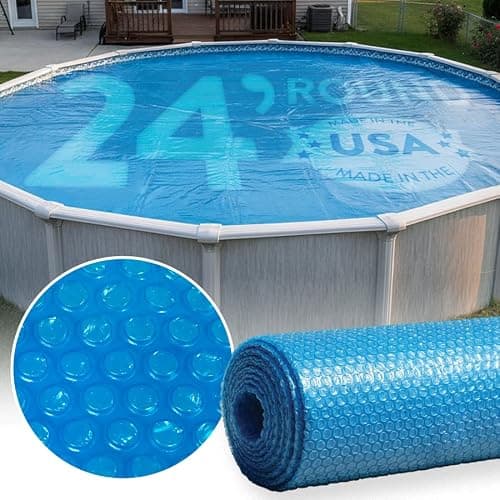
The single highest-return accessory here
Bubble Solar Cover for Above-Ground Pools
Various
It cuts evaporation, and evaporation is simultaneously your water bill, your chemical bill and your heat loss. Nothing else on this site reduces three costs at once.
#ad how this is funded · price as of October 8, 2026
Key specs
- Construction
- Bubble sheet, thickness published in mil
- Thickness
- Higher mil lasts longer — 12 mil and 16 mil are common
- Fit
- Cut to size; buy oversize and trim
- Orientation
- Bubbles face down, toward the water
How it scoresour reading of published specs, not a test result
- Retention
- 9.0
- Durability
- 7.0
- Handling
- 6.0
- Running cost
- 9.8
- Value
- 9.5
Overall 9.0 / 10
What works
- Reduces evaporation, which is the mechanism behind the water, chemical and heat savings all at once
- Cheap relative to everything it saves
- Can be cut to fit any pool shape, so sizing is forgiving
What doesn't
- Awkward to get on and off without a reel, and awkward is how covers end up unused
- Degrades in UV like every vinyl product
- Not a safety cover and will not support weight — this is important
Skip it if: Being a safety barrier. A solar cover looks solid and is not; a child or pet on it goes through and under.
What it costs to run: The one accessory with a clear payback. Every gallon that does not evaporate is a gallon you do not replace at the EPA WaterSense national average of $6.06 per 1,000 gallons, and it is chlorine you do not re-dose. If you buy one thing from this hub, buy this.
Several seasons: Buy-once. Built and warranted to come back out of the box for a few years, if you store it properly.
Specs from: EPA WaterSense — cost per 1,000 gallons
Five months of weather, not one night
Winter Cover for Above-Ground Pools
Various
A structural product, not a summer one. Its job is carrying snow and blocking light for a whole winter, and a solar cover pressed into that role will be in shreds by February.
Key specs
- Construction
- Woven polyethylene, weight published in mil or scrim count
- Securing
- Cable and winch, or wraparound straps
- Overlap
- Needs genuine overlap past the wall — check the stated size against your pool
- Not the same as
- A solar cover or a safety cover
How it scoresour reading of published specs, not a test result
- Retention
- 8.5
- Durability
- 8.0
- Handling
- 6.5
- Running cost
- 9.0
- Value
- 8.5
Overall 8.3 / 10
What works
- Blocks light for the whole winter, which is what stops algae in a closed pool
- Cable-and-winch securing survives wind that lifts a strapped cover
- Buying the heavier scrim genuinely doubles the number of winters you get
What doesn't
- Needs a way to shed or pump off standing water, or the weight tears it
- Bulky to store in summer
- Not a safety cover — it will not support a person and must not be treated as if it will
Skip it if: A pool you take down each autumn. If the pool comes apart, the cover is money spent on nothing.
What it costs to run: This is insurance rather than a saving. A torn cover in January means an opening in April that costs a full shock treatment and a week of filtration to fix, which is more than the better cover cost.
Several seasons: Buy-once. Built and warranted to come back out of the box for a few years, if you store it properly.
Making sure the cover actually gets used
Solar Cover Reel for Above-Ground Pools
Various
A cover that takes two people and ten minutes to move gets left off. A reel makes it a one-person, one-minute job, which is the difference between owning a cover and using one.
Key specs
- Function
- Rolls the solar cover on and off
- Fit
- Must match pool diameter and wall type
- Mounting
- Freestanding or wall-mounted depending on model
How it scoresour reading of published specs, not a test result
- Retention
- 7.0
- Durability
- 7.5
- Handling
- 9.5
- Running cost
- 8.5
- Value
- 7.0
Overall 7.7 / 10
What works
- Turns cover use from a chore into a habit, which is where all the savings actually are
- Keeps the cover off the ground, which is what shortens its life
- One-person operation
What doesn't
- Frequently costs more than the cover it handles
- Takes up permanent space beside the pool
- Sizing must match the pool exactly, and returns are awkward
Skip it if: A small pool. Under about 12 feet the cover is light enough to handle by hand and the reel is a solution to a problem you do not have.
What it costs to run: Only justified on larger pools. The value is not the reel, it is the cover getting used every night instead of most nights — quantify it by how often you would actually bother otherwise.
Several seasons: Buy-once. Built and warranted to come back out of the box for a few years, if you store it properly.
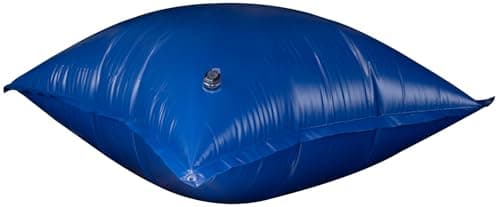
Stopping ice from pushing on the wall
Winter Air Pillow for Above-Ground Pools
Various
A few dollars of inflatable that gives expanding ice something compressible to push against instead of your pool wall. In a freezing climate this is not optional.
#ad how this is funded · price as of October 8, 2026
Key specs
- Function
- Absorbs ice expansion; centers the load away from the wall
- Inflation
- Inflate to roughly 60% — a fully inflated pillow bursts
- Placement
- Centered under the winter cover
How it scoresour reading of published specs, not a test result
- Retention
- 8.0
- Durability
- 6.5
- Handling
- 9.0
- Running cost
- 10.0
- Value
- 9.0
Overall 8.4 / 10
What works
- Extremely cheap relative to the wall or liner it protects
- Also stops rainwater and snowmelt pooling in the center of the cover
- Reusable for several winters if it survives one
What doesn't
- Cheap ones deflate mid-winter, which is when it matters
- Must be tethered or it drifts to the edge and does nothing
- Over-inflating is the most common mistake and it destroys the pillow
Skip it if: Climates that do not freeze. If your water never ices over, this is solving a problem you do not have.
What it costs to run: The cheapest insurance in this entire site against the most expensive winter failure. Inflate to about 60% and tether it.
One honest season: The cheapest setup that genuinely works for a season of real swimming. Nothing spare, nothing missing.
Questions people actually ask
Can I use a solar cover as a winter cover?
Do I need both a solar cover and a winter cover?
Is a winter cover the same as a safety cover?
How much bigger than the pool should a winter cover be?
Sources
Read next
- Closing, covering and opening againWinterizing, covers and spring opening - the four weeks of the year that decide whether you own a pool next summer.
- The best solar covers, and why this is the one thing to buyBubble covers compared on thickness and sizing, plus the arithmetic that makes this the highest-return purchase in the hub.
- The best winter covers for an above-ground poolScrim weight, cable-and-winch versus straps, and the overlap you need - the three specs that decide whether a cover survives a winter.
- How to winterize an above-ground poolThe correct closing sequence, the freeze damage that ends pools, and why a cracked pump housing is entirely preventable.
- Adding weeks to the season, starting with the cheapest thing firstCover, placement and timing before hardware, plus the kilowatt arithmetic that shows what running an electric heater actually costs.
- What it costs to fill a pool, and to keep it fullOne fill priced for four common pool volumes at the national average water rate, plus why every gallon you add has to be re-balanced.
- What size cover you need, and the overlap that decides itWhy winter covers are ordered by pool size, how much overlap manufacturers build in, what the water drop is for, and how cable, clips and sealers work together.