Pool Equipment · Best Inflatable Repair Kit
Inflatable hot tub repair kits, ranked by what their labels refuse to do
Buy the brush-on sealant that names hot tubs if you want one product that works, and the peel-and-stick patch if the leak is tonight. The spec that decides a repair is not the strength claim - it is the line further down saying which materials the adhesive will not touch.
Heads up: we earn a commission if you buy through the links on this page, at no extra cost to you. It never decides the ranking — here is how we pick and here is the full disclosure. Prices are checked automatically; last verified November 5, 2026.
Quick picks
Segmented before it is ranked — the right answer depends on which of these you actually are. Tap any row for the full write-up.
Best overall: names hot tubs and publishes the method
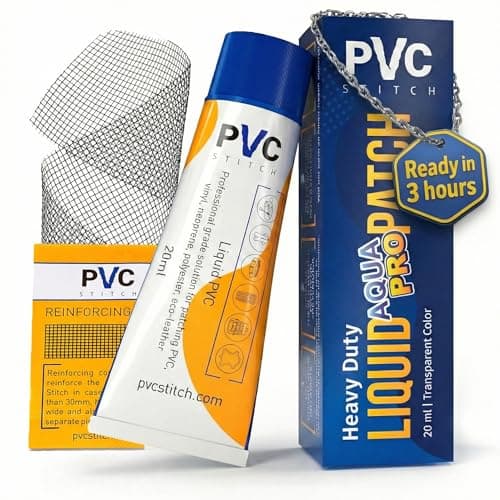
A 20 ml brush-on sealant with a published four-step method, a two-hour cure and a mesh cord for larger tears. It also publishes the exclusion: not for nylon.
| # | Product | Best for | Score | Price |
|---|---|---|---|---|
| 1 | AquaPro Liquid Patch Repair Kit, 20 ml A brush-on sealant that lists inflatable hot tubs by name and publishes a four-step method, a two-hour cure and a two-year shelf life. It also publishes the sentence that matters most in this category: it will not work on nylon-based materials. | The one that names hot tubs on the label and publishes the methodA few weekends | 8.3out of 10 |
If the leak is tonight
Peel-and-stick patches with alcohol prep pads in the box and no cure time at all. Get the letter right: Type B is the vinyl one.
| # | Product | Best for | Score | Price |
|---|---|---|---|---|
| 1 | 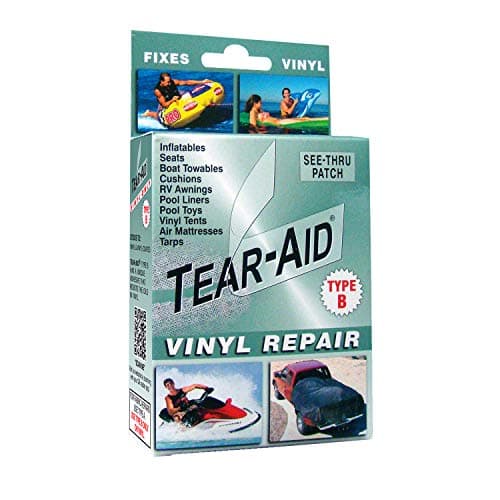 TEAR-AID Type B Vinyl Repair Kit Peel-and-stick patches for vinyl-coated materials, with alcohol prep pads in the box and nothing to wait for. The thing to get right is the letter: Tear-Aid sells Type A and Type B as different products for different materials, and vinyl is Type B. | A repair you can make in minutes, with no cure time at allA few weekends | 8.1out of 10 |
The clearest label in the category
Publishes what it works on, what it does not work on, and that it seals damage rather than joining parts. Three-hour cure, no separate patch needed.
| # | Product | Best for | Score | Price |
|---|---|---|---|---|
| 1 | 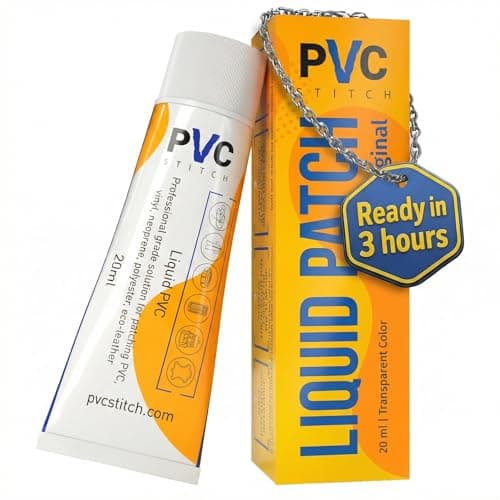 PVC Stitch Liquid Patch A liquid patch that cures into a PVC layer over the damage, published at three hours and explicitly rated for hot tubs. Its material-compatibility bullet is the most honest in the category: it tells you what it will not bond to, and that it seals damage rather than joining parts. | The clearest published statement of what it is and is not forA few weekends | 8.1out of 10 |
Repairing in the cold, or underwater
The only product here publishing an application temperature range - 35 to 95 °F - and the only one claiming it can be applied underwater.
| # | Product | Best for | Score | Price |
|---|---|---|---|---|
| 1 | 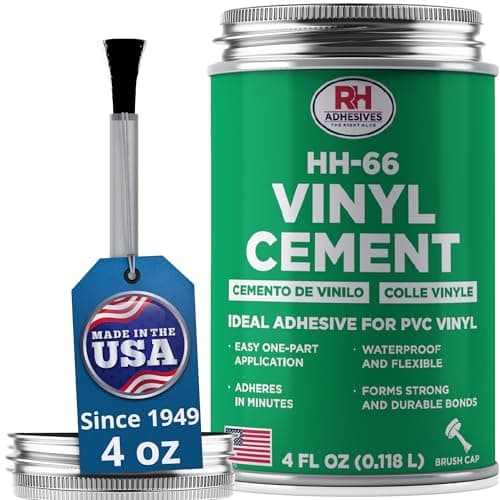 HH-66 Vinyl Cement, 4 oz The industrial vinyl cement the trade uses, and by a distance the best-documented product here: it publishes an application temperature range, a service temperature range, a long materials list, two exclusions and a pair of IAPMO listings. If you are repairing in November, it is the only one telling you whether it is too cold. | The professional adhesive, and the only one publishing a temperature windowSeveral seasons | 8.6out of 10 |
If the hole is in a pool liner, not a spa
Different job, different product. A liner patch is designed to go on underwater without draining the pool.
| # | Product | Best for | Score | Price |
|---|---|---|---|---|
| 1 | 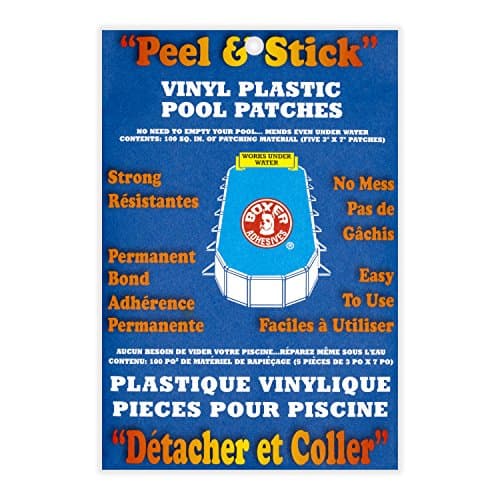 Boxer Adhesives Peel-and-Stick Vinyl Pool Patch No tube, no brush, no cure time worth the name: cut it, round the corners, press it on. Thirty minutes undisturbed and the pool is usable. | A fix that holds in half an hourOne honest season | 8.3out of 10 |
The short version
- Read the exclusion, not the strength claim. Three of these four publish a material they will not bond to, and that sentence decides the repair.
- Only one publishes a temperature window. HH-66 gives 35 to 95 °F for application. In November that is the spec that matters.
- Spa repair and liner repair are opposite procedures. Liner kits cure underwater; the spa methods start with deflating and drying.
- A seam is not a puncture. One label says outright it seals damage and is not a glue for joining parts. Diagnose first.
Buy the AquaPro sealant if you want one product that names inflatable hot tubs and tells you how to use it, and the Tear-Aid Type B patches if the tub is leaking tonight and you have no time to cure anything. If you are working outdoors in the cold, HH-66 is the only product here that publishes whether the temperature is workable.
This site already covers patching a vinyl pool liner and a pool float. An inflatable spa wall is a third material with a third procedure, and in November it is the one most likely to be holding water.
What we are scoring
Not adhesion strength, which nobody publishes in any comparable form. Four things that are on every label if you look for them:
What it will not bond to
The most useful sentence on the package, and always the one in the smallest type. Nylon and polyethylene are the common exclusions, and both turn up in backyard gear.Cure time, and at what temperature
A two-hour cure specified at room temperature is not a two-hour cure on a 40-degree patio. Only one product here publishes the temperature its figures assume.Whether it seals or joins
A sealant closes a hole. It does not reattach a seam or a fitting. One label states this explicitly and the rest leave you to find out.What is actually in the box
Adhesive only, or adhesive plus patches plus surface prep. Prep is what decides whether the repair holds, and most kits that include alcohol wipes are telling you something true.
The exclusions, side by side
Put the four labels next to each other and the category stops looking interchangeable:
| Product | Published compatibility | Will NOT bond | Cure time |
|---|---|---|---|
| AquaPro Liquid Patch | PVC and PU inflatables, hot tubs named | Nylon-based materials | 2 hours at room temperature |
| PVC Stitch Liquid Patch | PVC, vinyl and PU, hot tubs named | Nylon-based materials | 3 hours |
| TEAR-AID Type B | Vinyl-coated materials | Type A covers other fabrics - wrong letter, wrong product | None - peel and stick |
| HH-66 Vinyl Cement | PVC vinyl, vinyl-coated fabrics, canvas, neoprene, leather and more | Polyethylene and polypropylene | Not published; 35-95 °F to apply |
Every row has something in the third column. That is the finding: this is a category where the makers are unusually honest about limits, and buyers skip straight past it to the word “waterproof”.
The polyethylene exclusion on HH-66 is the one that catches people out in a backyard, because it rules out most cheap blue tarps — the listing says so in those words. And the nylon exclusion shared by both liquid patches rules out a lot of camping and watersports gear that lives in the same shed.
The temperature window nobody else publishes
It is November. If your tub is running through winter — and our winter hot tub guide argues that is the point of owning one — then any repair you make is an outdoor repair in the cold, and the cure figures on these labels quietly assume otherwise.
Only HH-66 addresses it. It publishes an application range of 35°F to 95°F and, separately, a service range of −30°F to 150°F once cured. Those are two different numbers doing two different jobs: the first tells you whether you can make the repair today, the second tells you whether it survives the winter after you have.
The other three publish neither. AquaPro specifies its two-hour cure “in room temperatures”, which is an acknowledgment that temperature matters without telling you where the limit is. For a cold repair, that is the difference between a specification and a hope.
Spa repair is not liner repair
This is worth separating clearly, because the products sit next to each other in search results and solve opposite problems.
| Vinyl pool liner | Inflatable spa wall | |
|---|---|---|
| Can you drain it? | Not realistically - a liner needs the water | Yes, and the published methods require it |
| Published procedure | Apply underwater, cure wet | Deflate, clean, dry, then apply |
| Typical product | Underwater vinyl cement and peel-and-stick patch | Brush-on PVC sealant or vinyl-coated patch |
| Pressure on the repair | Static water pressure | Air pressure that cycles every time you inflate |
| Our page | Pool liner patch kits | This one |
The last row of that table is the one people underestimate. A liner patch sits under steady pressure; a spa wall patch is flexed every time the tub is inflated and deflated, which is why the labels that mention staying flexible after curing are making a claim worth having rather than filler.
If what you actually have is a pool leak rather than a spa leak, start with diagnosis instead of adhesive — our guide to telling evaporation from a leak has the bucket test, which is free and rules out the most common false alarm.
Find the hole before you buy anything
Confirm it is losing air, not heat
A tub that feels soft in the morning after a cold night may simply have cooler air in it. Check it at the same temperature twice before concluding anything.Inflate fully and listen
The cheapest leak detector is a quiet evening. Run a hand slowly over the seams and the area around fittings, which is where inflatable walls fail first.Use soapy water on the suspect area
Dilute dish soap, wiped on, foams at the escape point. This is the same method our float repair page uses, and it works the same way on a tub wall.Decide whether it is a hole or a seam
A puncture is a repair. A failed seam or a leaking fitting usually is not — PVC Stitch publishes that it is “not a glue for joining separate parts”, and that limitation applies across the category.Clean and dry properly before the patch
Two of these kits include alcohol prep pads for a reason. Chlorinated water leaves residue, and residue is the most common cause of a patch that lifts a week later.
When it is not worth repairing
Honest limits, because the cost of being wrong is a weekend and a ruined tub.
A leaking pump or heater housing is not a patch job. That is a part, and on most inflatable tubs it is a sealed unit. Sealing around an electrical component with a solvent adhesive is not a repair, it is a hazard.
A long tear through a drop-stitch panel is usually terminal. The wall holds its shape because thousands of internal threads keep two surfaces a fixed distance apart under pressure; a tear that compromises that structure is not restored by a surface seal, whatever the patch holds.
And a tub that has frozen is a different problem entirely. Our winter guide is organized around the one failure that ends these tubs — a full tub that stops heating in freezing weather can crack its own plumbing — and no adhesive on this page addresses a cracked heater block.
What we are not claiming
That any of these will fix your tub. We have not patched one, nobody publishes a comparative adhesion test for inflatable spa walls, and the strength language on all four listings is adjectival rather than measured. Any page ranking these on holding power is ranking them on nothing.
What is checkable is everything above: which materials each one publishes as compatible, which it publishes as excluded, what cure times are stated and at what temperature, which products name hot tubs explicitly, and which single product tells you whether it is too cold outside to try. In a category where the common failure is buying the wrong chemistry for the material, that is the part worth getting right.
The picks, in full
Scores are our own reading of published specifications. They are not test results — we have not tested these products and we do not claim to.
Pick #1 · The one that names hot tubs on the label and publishes the method
AquaPro Liquid Patch Repair Kit, 20 ml
PVC Stitch
A brush-on sealant that lists inflatable hot tubs by name and publishes a four-step method, a two-hour cure and a two-year shelf life. It also publishes the sentence that matters most in this category: it will not work on nylon-based materials.
#ad how this is funded · price as of November 5, 2026
Key specs
- Materials
- PVC and PU inflatables, published — boats, rafts, kayaks, SUPs, air mattresses, above-ground pool liners, inflatable pools, hot tubs
- Will NOT bond
- "Will not work on nylon-based materials", published
- Cure time
- "Ready to use - 2 HRS in room temperatures", published
- Method
- Published in four steps, beginning "Deflate your inflatable completely... The repaired part should be dry & clean"
- Contents
- One 20 ml tube plus a PVC mesh cord, published; cord only needed for larger tears
- Shelf life
- 2 years, published
- Resistance
- Published as UV resistant, and heat and cold resistant
How it scoresour reading of published specs, not a test result
- Sizing fit
- 9.0
- Running cost
- 8.5
- Maintenance
- 8.0
- Build
- 7.5
- Value
- 8.5
Overall 8.3 / 10
What works
- Names inflatable hot tubs explicitly rather than leaving you to infer compatibility
- Publishes a complete method, including the detail people skip — deflate first, repair dry
- Publishes a cure time you can plan an evening around
- Includes a mesh cord for tears too big for sealant alone, which most cheap kits do not
What doesn't
- Twenty milliliters is a small tube; a long tear will use a meaningful share of it
- The published cure assumes room temperature, which an outdoor November repair is not
- Requires full deflation, so the tub is out of action for the evening either way
- Will not touch nylon, and some inflatable gear in the same shed is nylon
Skip it if: Cold-weather field repairs. The published two-hour cure is specified at room temperature, and the tub has to be deflated and dry — which in practice means bringing the work indoors or waiting for a mild day.
What it costs to run: The cost that matters here is not the tube, it is the alternative. A failed seam on an inflatable spa wall is not a repairable part on most models, so the realistic comparison is a sub-twenty-dollar sealant against replacing the tub.
A few weekends: Fine for a heatwave and a toddler. Treat it as consumable, not as a pool — it will not survive a winter in the yard.
Pick #2 · A repair you can make in minutes, with no cure time at all
TEAR-AID Type B Vinyl Repair Kit
TEAR-AID
Peel-and-stick patches for vinyl-coated materials, with alcohol prep pads in the box and nothing to wait for. The thing to get right is the letter: Tear-Aid sells Type A and Type B as different products for different materials, and vinyl is Type B.
#ad how this is funded · price as of November 5, 2026
Key specs
- Type
- Type B — published as "for Vinyl-Coated Materials". Type A is a separate product for other fabrics
- Application
- Peel and stick, published; no cure time stated because there is none
- Contents
- One 3 in x 12 in patch, one 7/8 in x 7/8 in, one 1 3/8 in, a 12 in reinforcement filament and 2 alcohol prep pads, published
- Published uses
- Towable tubes, boat covers, tents, awnings, air mattresses, pool liners, rafts, kiteboard bladders
- Warranty
- "One year warranty if purchased from an authorized reseller", published
- Maker
- Airhead Sports Group, published
- Hot tubs
- Not named on the listing — vinyl-coated material is the published compatibility claim
How it scoresour reading of published specs, not a test result
- Sizing fit
- 7.5
- Running cost
- 8.0
- Maintenance
- 9.5
- Build
- 8.0
- Value
- 8.0
Overall 8.1 / 10
What works
- No cure time, which is the entire argument for it when the tub is leaking now
- Alcohol prep pads included, and surface prep is what decides whether a patch holds
- Three patch sizes plus a reinforcement filament in one box
- Publishes a warranty term, which almost nothing in this category does
What doesn't
- Type A and Type B look similar in listings and are not interchangeable — buying the wrong letter is the common error
- Does not name hot tubs; you are relying on the vinyl-coated compatibility claim
- A stick-on patch is visible in a way a liquid sealant is not
- Peel-and-stick wants a genuinely clean dry surface, which a wet tub wall resists
Skip it if: Irregular or stretched damage. A flat adhesive patch wants a flat surface; a tear on a curved seam or around a fitting is where a brush-on sealant does better.
A few weekends: Fine for a heatwave and a toddler. Treat it as consumable, not as a pool — it will not survive a winter in the yard.
Specs from: TEAR-AID Type B — current Amazon listing, published Type B material claim, kit contents and warranty wording
Pick #3 · The clearest published statement of what it is and is not for
PVC Stitch Liquid Patch
PVC Stitch
A liquid patch that cures into a PVC layer over the damage, published at three hours and explicitly rated for hot tubs. Its material-compatibility bullet is the most honest in the category: it tells you what it will not bond to, and that it seals damage rather than joining parts.
#ad how this is funded · price as of November 5, 2026
Key specs
- Materials
- "Works on compatible PVC, vinyl and PU surfaces", published
- Will NOT bond
- "Not for nylon-based materials", published
- Not a glue
- Published: "it is not a glue for joining separate parts or attaching accessories"
- Cure time
- "Ready in 3 hours", published
- Patch needed?
- "Most repairs need no separate patch", published
- After curing
- Published as forming a PVC layer that withstands freshwater, saltwater and direct sun
- Named uses
- Inflatable SUPs, kayaks, hot tubs, bounce houses, air mattresses
How it scoresour reading of published specs, not a test result
- Sizing fit
- 8.5
- Running cost
- 8.5
- Maintenance
- 8.0
- Build
- 7.5
- Value
- 8.0
Overall 8.1 / 10
What works
- Names hot tubs on the listing and publishes a specific compatibility bullet rather than a vague claim
- Says plainly what it is not for, which is rarer and more useful than another claim about what it is
- No separate patch needed on most repairs, so there is nothing to peel off later
- Published as staying flexible, which matters on a wall that inflates and deflates
What doesn't
- Three hours is the longest published cure of the liquid options here
- Not a structural adhesive — it seals, so a detached fitting is outside its job
- Same nylon exclusion as the rest of the category
- Transparent finish still shows as a glossy patch on a matte tub wall
Skip it if: Reattaching anything. The listing is explicit that it seals damage and is not a glue for joining separate parts, which rules out a popped seam between two panels or a loose fitting.
A few weekends: Fine for a heatwave and a toddler. Treat it as consumable, not as a pool — it will not survive a winter in the yard.
Pick #4 · The professional adhesive, and the only one publishing a temperature window
HH-66 Vinyl Cement, 4 oz
RH Adhesives
The industrial vinyl cement the trade uses, and by a distance the best-documented product here: it publishes an application temperature range, a service temperature range, a long materials list, two exclusions and a pair of IAPMO listings. If you are repairing in November, it is the only one telling you whether it is too cold.
#ad how this is funded · price as of November 5, 2026
Key specs
- Application temperature
- "bonds in temperatures from 35 °F to 95 °F", published
- Service temperature
- "remains flexible and serviceable from -30 °F to 150 °F", published
- Underwater
- "can even be applied underwater", published
- Bonds
- Published: PVC vinyl, vinyl-coated fabrics, canvas, fiberglass, neoprene, leather, EVA and nitrile foams, cork, wood
- Will NOT bond
- "Not for polyethylene or polypropylene (such as most blue tarps)", published
- Also excluded
- "Not for ASTM/NSF-listed PVC plumbing pipe use", published
- Listings
- IAPMO UES UEL-5070 and UEL-5071, published; made in Acton, Massachusetts since 1949
How it scoresour reading of published specs, not a test result
- Sizing fit
- 8.0
- Running cost
- 9.5
- Maintenance
- 7.0
- Build
- 9.0
- Value
- 9.0
Overall 8.6 / 10
What works
- The only product here publishing an application temperature range, which is the spec that decides a cold-weather repair
- Publishes a service range too, so you know the repair survives a winter on the tub
- Can be applied underwater, which no other option here claims
- Brush cap built in, and a materials list long enough to cover the rest of the yard
What doesn't
- A solvent cement rather than a kit — no patches, no prep pads, nothing but adhesive
- The exclusions are real: polyethylene and polypropylene are common in cheap tarps and covers
- Solvent fumes mean ventilation, which complicates an indoor winter repair
- Overkill for a pinhole that a peel-and-stick patch would close in a minute
Skip it if: Being a complete repair on its own. It is the adhesive half; you supply the patch material. For a first-time repair with nothing in the drawer, a kit is the easier purchase.
What it costs to run: Four ounces is a great many repairs, and the published two-year-plus usefulness of a sealed tin makes it the cheapest per repair of anything here — provided you have patch material. The real saving is having it before the leak rather than after, the same argument our patch kit page makes about liners.
Several seasons: Buy-once. Built and warranted to come back out of the box for a few years, if you store it properly.
Pick #5 · A fix that holds in half an hour
Boxer Adhesives Peel-and-Stick Vinyl Pool Patch
Boxer Adhesives
No tube, no brush, no cure time worth the name: cut it, round the corners, press it on. Thirty minutes undisturbed and the pool is usable.
Key specs
- Underwater
- Rated for use underwater or on dry surfaces
- Adhesive
- None separate — pre-applied to the patch
- Patch supplied
- Five rectangles, 3 x 7 in — 100 sq in total
- Set time
- Do not disturb for a minimum of 30 minutes; longer bonds better
- Sizing
- Cut about 3/4 in larger than the hole, with rounded corners
- Shelf life
- Not published
How it scoresour reading of published specs, not a test result
- Sizing fit
- 7.5
- Running cost
- 9.0
- Maintenance
- 9.0
- Build
- 7.5
- Value
- 8.5
Overall 8.3 / 10
What works
- The fastest repair here by a wide margin — 30 minutes rather than days
- No solvent adhesive to open, spill, or store half-used
- Small patches suit the pinholes that make up most liner leaks
- Works on inflatables, so it covers the floats as well as the pool
What doesn't
- Only 100 square inches of material, the least here
- Pre-glued patches have a finite life in the packet, and shelf life is not published
- A peel-and-stick patch on a moving wall seam is a temporary answer, not a permanent one
- Fixed 3 x 7 in rectangles mean waste when the tear is long and thin
Skip it if: Big tears. Five small rectangles cover pinholes and short splits; a foot-long tear in a liner wall wants a liquid-adhesive kit, or a new liner.
What it costs to run: The cheapest way to stop losing water tonight. Water loss is a running cost — our cost-to-fill guide prices a top-up, and a slow leak quietly repeats it all season.
One honest season: The cheapest setup that genuinely works for a season of real swimming. Nothing spare, nothing missing.
Specs from: Sunplay — Boxer peel-and-stick vinyl repair patches, published contents, Waterworks Pools — Boxer peel and stick vinyl pool patches, published instructions
Questions people actually ask
Can you patch an inflatable hot tub?
What glue works on an inflatable hot tub?
Can I use a pool liner patch kit on my hot tub?
How long does an inflatable hot tub patch take to cure?
Is it too cold to repair a hot tub in winter?
Sources
- AquaPro Liquid Patch - published material list, nylon exclusion, cure time and four-step method
- TEAR-AID Type B - published Type B vinyl-coated material claim, kit contents and warranty wording
- PVC Stitch Liquid Patch - published material compatibility bullet, nylon exclusion and not-a-glue statement
- HH-66 Vinyl Cement - published application and service temperature ranges, underwater claim and exclusions
- CPSC — Pool Safely
Read next
- Equipment, sized to your pool and costed by the wattPumps, filters, vacuums, heaters and ladders - matched to your gallons and priced by what they draw.
- The patch kit is the difference between a hole and a new linerUnderwater vinyl repair kits compared on cure time, patch material supplied and what each maker actually publishes — plus the one that sets in thirty minutes.
- Finding the hole, and making the patch actually holdHow to locate a slow leak, tell a puncture from a failing valve, and patch vinyl so the repair survives the season.
- Inflatable hot tubs, judged on the bill rather than the bubblesThe two inflatable hot tubs worth shortlisting, compared on insulation and cover rather than jet count, plus the running cost nobody publishes.
- An inflatable hot tub in winter: never let it freeze, cover everything elseWhat changes when an inflatable hot tub runs through the cold months - the loss-side purchases that pay for themselves, and the freeze failure that ends the tub.
- Hot tub water change: the arithmetic says two weeksWhy an inflatable hot tub needs its water changed in weeks rather than months, the arithmetic behind it, and what to do at each change.
- Intex PureSpa against Coleman SaluSpa: each publishes what the other withholdsThe two inflatable hot tubs this site tracks, compared only on what their current listings publish - including the compliance claim that decides it outright in twelve states.
- Pool losing water: the bucket test answers this for freeHow to tell evaporation from a leak using a bucket and published evaporation rates, then how to find the hole if it is a leak.
- How long pool floats last, and why yours did notWhat actually destroys a pool float, the four-step routine that roughly triples its life, and when to patch versus replace.