Pool Care & Chemistry
Hot tub water change: the arithmetic says two weeks
Take your gallons, divide by the number of people who use it daily, divide by three. That is roughly how many days the water lasts. On a 200-gallon inflatable tub with four regular users it works out at about two weeks, and no amount of chemistry extends it much.
Heads up: we earn a commission if you buy through the links on this page, at no extra cost to you. It never decides the ranking — here is how we pick and here is the full disclosure. Prices are checked automatically; last verified October 11, 2026.
The short version
- Gallons ÷ daily bathers ÷ 3 = days. On a 200-gallon tub with four users that is about 16 days.
- Four people in a tub is ninety in a 15-foot pool. Per gallon, at twice the temperature.
- Flush the lines before you drain. Biofilm lives in the plumbing; afterwards is too late.
- Balance cold, then heat. Heating locks in whatever scale chemistry you filled with.
The arithmetic, and why it is so much shorter than you think
Our hot tub chemistry page opens by saying a hot tub is not a small pool. This is the most concrete version of that: the water in it has a life measured in weeks.
How long your tub's water actually lasts
- A typical inflatable hot tub holds
- about 200 gal
- People using it most days
- 4
- Industry rule of thumb
- gallons ÷ bathers ÷ 3 = days
- A hard-shell tub, for comparison
- 400 to 500 gal
200 ÷ 4 ÷ 3 ≈ 16 days
About two weeks on a well-used inflatable tub
The number that drives everything is volume per person. A hot tub is a bathtub that four adults share for an hour without draining it, repeatedly, at 102 degrees. Compare that with the same four people in our 15-foot pool at roughly 4,400 gallons and the concentration difference is about twentyfold.
What builds up that you cannot filter out
| What accumulates | Where it comes from | Removed by filtration? | Removed by chemicals? |
|---|---|---|---|
| Body oils and lotions | Everyone who gets in | Partly - a cartridge cleaner helps | Enzymes help; they do not clear it |
| Total dissolved solids | Every chemical you have ever added | No | No |
| Spent sanitizer byproducts | Chlorine or bromine doing its job | No | Shocking converts some, not all |
| Biofilm | Plumbing surfaces, not the water | No | Only a dedicated line flush |
| Calcium and scale chemistry | Fill water, concentrated by evaporation | No | Sequestrants delay, not remove |
Three of those five rows have “no” in both columns. That is the whole argument: beyond a certain point you are not managing water chemistry, you are managing an accumulation, and the only tool for an accumulation is replacement.
The practical signal most owners recognize is water that stops responding. You add sanitizer and the reading barely moves; you shock it and it is cloudy again by the next evening; the water feels slightly slick no matter what the test says. That is not a dosing problem to solve, it is a change to schedule.
Doing it properly
Flush the lines while the old water is still in
This is the step almost everyone skips and the only one that reaches biofilm. A line flush product circulates through the heater and jets, lifts the film, and then leaves with the water you are about to dump. Done after refilling, you are flushing into clean water.Deal with the cartridge before the refill, not after
Fit a fresh one, or clean the existing one properly with a degreaser rather than a hose — our spa cartridge roundup covers both and the Type S1 versus Type VI distinction that catches people out. New water through a loaded filter is a wasted water change.Power down at the socket, then drain
Unplug the control unit rather than switching it off. Use the drain fitting and a garden hose, and run it well clear of the tub base - a few hundred gallons will soften whatever the tub is standing on, which matters more on an inflatable than on a hard-shell.Wipe the shell while it is wet
The scum line is a two-minute job wet and a twenty-minute one dry. Soft cloth only; anything abrasive is a puncture risk on an inflatable liner.Balance on cold water before you heat
Get pH and total alkalinity into range first, following the same order our pH and alkalinity guide sets out for a pool. Heating water locks in its scaling tendency, and correcting a hot tub at 102 degrees is slower and less predictable than correcting it at 60.Sanitize, then wait for a reading - not a clock
Same principle as our when can you swim page: the label gives you a target number, not a waiting time. Get sanitizer into range and confirm it before anyone gets in.
The hygiene side, which is not optional
Hot water, lots of people and a small volume is the combination public health guidance is most concerned about, and the CDC's advice for pools applies with more force to a tub: shower for at least 1 minute before you get into the water and stay out entirely if anyone has diarrhea.
A one-minute rinse before getting in is the single highest-return habit for a hot tub, because most of what shortens your water's life arrives on skin. It will not change the arithmetic above, but it is the difference between the top and the bottom of the range.
What a change costs
Two hundred gallons every two weeks across a six-month season is roughly 2,600 gallons, which at typical municipal rates is single-digit dollars — genuinely not the issue. The costs that matter are the reheat and the chemicals, and our hot tub running cost page prices both, because bringing 200 gallons from cold to 102 degrees is the expensive part of a water change, not the water.
That is also the honest argument for draining less often by using it with fewer people rather than by dosing harder. Chemistry cannot buy you more days than the volume allows.
What to buy
Scores are our own reading of published specifications. They are not test results — we have not tested these products and we do not claim to.
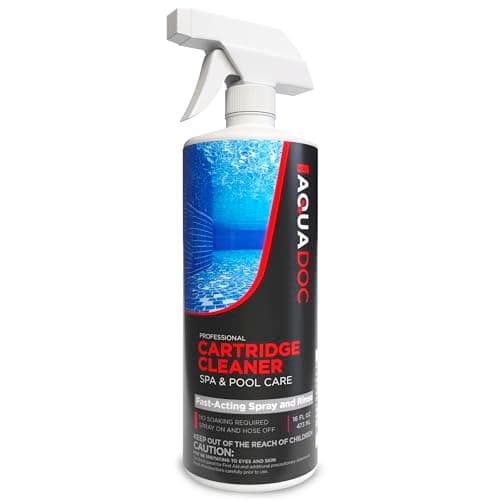
Getting oils out of a cartridge a hose cannot touch
AquaDoc Hot Tub and Pool Filter Cleaner Spray, 16 oz
AquaDoc
A hose rinses grit off a cartridge; it does nothing about the body oils and lotions that clog the pleats. On a hot tub that distinction matters far more than it does on a pool.
#ad how this is funded · price as of October 11, 2026
Key specs
- Volume
- 16 oz, published
- Form
- Spray-on degreaser for cartridges, published
- Use
- Published for hot tub and pool cartridges
- Contact time
- Not published on the listing
- Dilution
- Ready to use as a spray
How it scoresour reading of published specs, not a test result
- Sizing fit
- 8.0
- Running cost
- 9.0
- Maintenance
- 8.5
- Build
- 7.0
- Value
- 8.5
Overall 8.2 / 10
What works
- Targets the thing a hose cannot: oils and lotion residue pressed into the pleats
- Spray format means no bucket soak, which is the step people skip
- One bottle covers many cleanings, so cost per clean is small
- Extends cartridge life, which on a tub chewing through Type S1 or VI is the real saving
What doesn't
- No contact time or dilution published, so technique is left to you
- A degreaser is not a substitute for replacement — pleats still break down
- Does nothing about calcium scale, which needs an acid rinse instead
- Cleaned cartridges must dry fully before reuse, and nothing on the bottle says so
Skip it if: Rescuing a dead cartridge. Once the pleats are gray through and no longer spring back, no cleaner brings filtration back; that is a replacement, and the multipacks on this page exist for that reason.
What it costs to run: The case for it is cartridge life. If a bottle doubles how long a pack of cartridges lasts on a heavily used tub, it pays for itself in one pack.
A few weekends: Fine for a heatwave and a toddler. Treat it as consumable, not as a pool — it will not survive a winter in the yard.
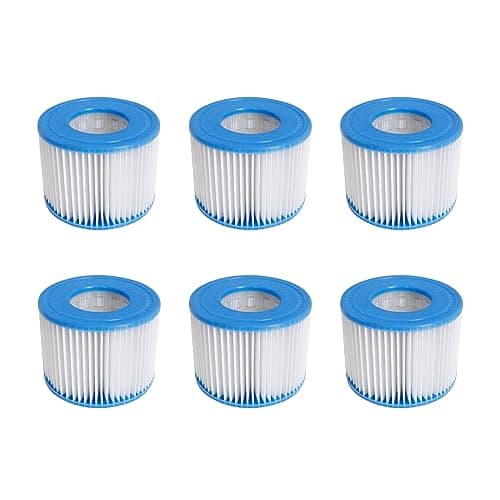
Anything that is not an Intex — the other half of the market
Type VI Spa Filter Cartridge for Bestway, Lay-Z-Spa and Coleman SaluSpa
Generic
Type VI is the Bestway family's cartridge and it is not interchangeable with Type S1. Getting this wrong is the most common spa parts mistake there is, and the two look similar enough to make it easy.
#ad how this is funded · price as of October 11, 2026
Key specs
- Type
- Type VI, published
- Fits
- Published for Bestway, Lay-Z-Spa and Coleman SaluSpa inflatable hot tubs
- Does NOT fit
- Intex PureSpa, which uses Type S1 — different housing, different cartridge
- Quantity
- Sold from 2-packs up to 12-packs across listings
- Media
- Pleated paper
- Micron rating
- Not published
How it scoresour reading of published specs, not a test result
- Sizing fit
- 8.5
- Running cost
- 8.5
- Maintenance
- 7.5
- Build
- 6.5
- Value
- 8.5
Overall 8.0 / 10
What works
- Covers the entire Bestway/Coleman/Lay-Z-Spa family with one part number
- Widely stocked in several pack sizes, so cost per cartridge can be optimized
- Cheap enough that replacing rather than rinsing is a realistic habit
- The listing names the three brand families explicitly rather than claiming universal fit
What doesn't
- No micron rating published, same as every cartridge in this category
- Easily confused with Type S1 — they are not interchangeable and the tub will not tell you
- Third-party only in most pack sizes; Bestway's own part is harder to find in quantity
- Paper media with the usual short rinse ceiling
Skip it if: Fitting an Intex tub. If your hot tub is a PureSpa this is the wrong cartridge, and no amount of pushing will make it seal. Check the tub brand before the pack size.
What it costs to run: Same arithmetic as the Intex side: divide by count. Pack sizes here run from 2 to 12 at headline prices that look similar, so cost per cartridge varies by more than three times across the listings.
A few weekends: Fine for a heatwave and a toddler. Treat it as consumable, not as a pool — it will not survive a winter in the yard.

An Intex PureSpa, bought from the brand that made the tub
Intex Type S1 Spa Filter Cartridge, 3-Pack
Intex
The genuine Type S1 in the smallest sensible quantity. A hot tub eats cartridges far faster than a pool does, and buying one at a time is how people end up running a dirty filter.
Key specs
- Type
- Type S1, published
- Fits
- Published for Intex PureSpa inflatable hot tubs
- Quantity
- 3-pack, published
- Media
- Pleated paper, published as Dacron paper on Intex's heavy-duty variant
- Micron rating
- Not published — no spa cartridge in this category publishes one
- Washable
- Rinseable between changes; not indefinitely reusable
How it scoresour reading of published specs, not a test result
- Sizing fit
- 9.5
- Running cost
- 6.0
- Maintenance
- 7.5
- Build
- 7.0
- Value
- 7.0
Overall 7.6 / 10
What works
- Genuine part, so the fit in the Intex housing is not a question
- Three at a time matches how fast a tub actually loads a cartridge
- Sold alongside Intex's own heavy-duty Dacron version if you want to step up
- The cheapest way to stop running a hot tub on a gray filter, which is the single most common cause of cloudy spa water
What doesn't
- No micron rating published, which is true of the whole category and means filtration cannot be compared at all
- Three cartridges is a few weeks of heavy use, not a season
- Paper media degrades with every rinse, so "washable" has a short ceiling
- Costs more per cartridge than the generic multipacks that fit the same housing
Skip it if: Running a tub used by a crowd. At four people in 200 gallons the cartridge is the bottleneck, and no cartridge fixes a bather load problem — that is a water-change question.
What it costs to run: Cost per cartridge is the number to compare, not pack price. Genuine Intex runs well above the generic six and twelve packs; whether that is worth it is a fit-confidence question, because nothing about filtration is published either way.
A few weekends: Fine for a heatwave and a toddler. Treat it as consumable, not as a pool — it will not survive a winter in the yard.
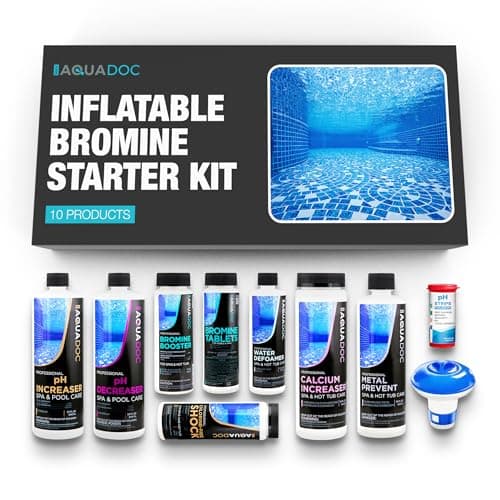
A spa, which is not a small pool
Inflatable Hot Tub Chemical Kit
Various
A bromine or chlorine kit packaged for the 200-to-300 gallon world. The reason it exists is that hot tub chemistry moves far faster than pool chemistry and the pool products are dosed wrong for it.
#ad how this is funded · price as of October 11, 2026
Key specs
- Sanitizer
- Bromine tablets or chlorine granules — pick one
- Typically includes
- Sanitizer, booster, pH up and down, calcium increaser
- Also includes
- Chlorine-free shock, defoamer, metal prevent, test strips
- Delivery
- A floater is usually in the box for bromine kits
- Volume
- Dosed for a few hundred gallons, not a few thousand
- Testing
- Strips included; test far more often than a pool
How it scoresour reading of published specs, not a test result
- Effectiveness
- 8.5
- Ease
- 9.0
- Water impact
- 7.5
- Cost per season
- 7.0
- Value
- 8.0
Overall 8.0 / 10
What works
- Dosed for spa volumes, so you are not measuring fractions of a pool scoop
- Bromine is more stable than chlorine at hot tub temperatures
- Chlorine-free shock means the tub is usable again quickly after treatment
- Defoamer is in the box, which every new spa owner needs within two weeks
What doesn't
- Small volume means chemistry swings fast and needs testing every few days
- Bromine and chlorine kits are not interchangeable mid-season without a drain
- A starter kit is a season at most on a well-used tub
- Metal prevent and calcium increaser are only needed on some water supplies
Skip it if: Being used on a pool. The dosing is wrong by an order of magnitude and you will spend far more than buying pool chemistry.
What it costs to run: Cheaper per unit than buying the eight components separately, and the components you do not need are the waste. On a tub you refill every few weeks, this is a recurring line, not a one-off.
One honest season: The cheapest setup that genuinely works for a season of real swimming. Nothing spare, nothing missing.
Specs from: AquaDoc inflatable hot tub chemical kit with bromine — Amazon listing
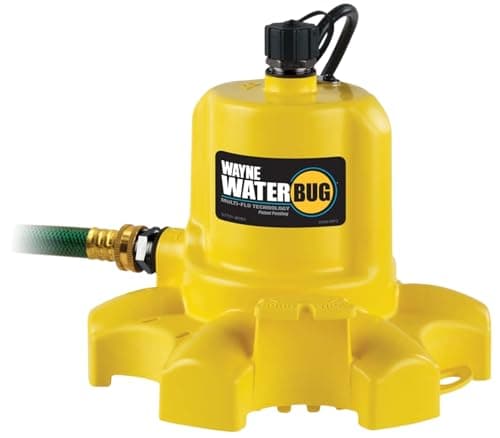
Getting the last inch out, which is the whole job at closing
WAYNE WaterBUG Submersible Water Removal Pump
WAYNE
Published as removing water down to 1/16 inch with a choice of top or side discharge. On a vinyl above-ground pool the last inch is the part that matters, and this is the pump that publishes a figure for it.
#ad how this is funded · price as of October 11, 2026
Key specs
- Motor
- 1/6 HP, published
- Flow
- 1,350 GPH maximum, published; 1,010 GPH at 10 ft of lift
- Published elsewhere as
- 1,300 and 1,257 GPH — retailer listings disagree on the headline figure
- Drains down to
- 1/16 in, published
- Needs to start
- 3/16 in, published on one listing
- Discharge
- Multi-Flo — top or side, published
- Max head
- 30 ft, published
- Cord
- 10 ft, 120V, published
- Outlet material
- Listings conflict — some publish brass, others thermoplastic
How it scoresour reading of published specs, not a test result
- Sizing fit
- 9.0
- Running cost
- 9.0
- Maintenance
- 8.0
- Build
- 8.5
- Value
- 7.0
Overall 8.3 / 10
What works
- A published drain-down figure of 1/16 in, which is the spec that decides whether you finish the job with a shop vac or not
- Side discharge is the genuinely useful feature in a shallow pool where a top-discharge hose kinks
- Fits a standard garden hose, so there is nothing else to buy
- Published flow at a stated lift, not just a headline maximum
What doesn't
- Retailer listings publish three different maximum flow figures, which is not confidence-inspiring on a spec sheet
- Outlet material is published inconsistently across listings — brass on some, thermoplastic on others
- Manual only; no float switch, so it must not be left running unattended
- The most expensive of the three here by a wide margin
Skip it if: Being left alone. Run dry, a submersible utility pump damages its seal, and none of these has an automatic cutoff. This is a pump you stand next to.
What it costs to run: Bought once, used twice a year. Against a pool service draining for you it pays back on the first closing, and our DIY-versus-paying page is where that comparison belongs.
Several seasons: Buy-once. Built and warranted to come back out of the box for a few years, if you store it properly.
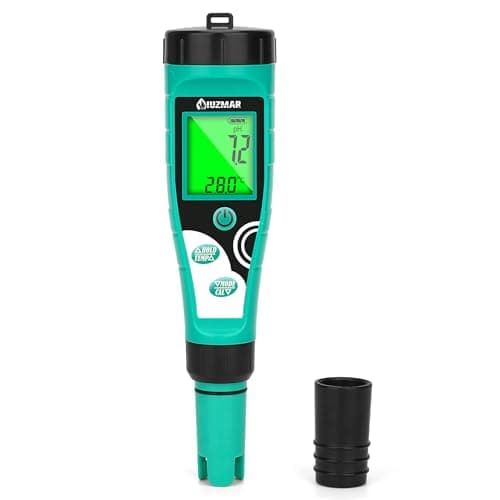
A number instead of a color band, without reagents
Digital Pool Water Tester
Various
A probe-based reader that gives you a figure on a screen. Useful for tracking a trend day to day; not a replacement for a reagent kit when a reading has to be right.
#ad how this is funded · price as of October 11, 2026
Key specs
- Typical parameters
- pH, ORP, salinity, EC, TDS and temperature, by model
- Free chlorine
- Inferred from ORP on most units, not measured directly
- Power
- Rechargeable; many float and report to an app
- Calibration
- Required periodically — check what the model needs
How it scoresour reading of published specs, not a test result
- Accuracy
- 7.0
- Ease
- 8.5
- Coverage
- 8.0
- Cost per use
- 5.5
- Value
- 6.5
Overall 7.0 / 10
What works
- Gives a number rather than a color judgment, which removes the reading error
- Trend tracking is genuinely useful — you see drift before it is a problem
- No reagents to expire or store
- Salinity readout is the one genuinely hard thing to test by strip
What doesn't
- Most units infer sanitizer from ORP rather than measuring free chlorine directly
- Probes need calibration and eventually replacement — this is not a buy-once item
- App dependence means a dead phone or a dropped connection is a dead test
- Costs many times a bottle of strips for readings you may not act on
Skip it if: Being the only test you own. Keep strips or a reagent kit for the readings that decide whether people swim.
What it costs to run: The unit is the visible cost; probe calibration solution and eventual probe replacement are the recurring one. On a pool that is up for four months a year, that is a hard payback against a $10 bottle of strips.
Several seasons: Buy-once. Built and warranted to come back out of the box for a few years, if you store it properly.
Specs from: Digital pool water tester — current Amazon listing and published parameters
Questions people actually ask
How often should you change inflatable hot tub water?
Why does a hot tub need changing so much more often than a pool?
Can chemicals make hot tub water last longer?
Do you need to change hot tub water in winter?
What is the slimy film in my hot tub?
Sources
Read next
- Pool care, from someone who assumes you have never done thisThe weekly routine, the four numbers that matter, and the fix for the week the water turns.
- A hot tub is not a small poolBromine against chlorine for an inflatable hot tub, what a starter kit actually contains, and why the testing cadence is the thing that changes.
- Spa filter cartridges: check the type before the priceType S1 against Type VI, which tub takes which, and the cost-per-cartridge arithmetic that pack prices hide.
- Inflatable hot tubs, judged on the bill rather than the bubblesThe two inflatable hot tubs worth shortlisting, compared on insulation and cover rather than jet count, plus the running cost nobody publishes.
- An inflatable hot tub in winter: never let it freeze, cover everything elseWhat changes when an inflatable hot tub runs through the cold months - the loss-side purchases that pay for themselves, and the freeze failure that ends the tub.
- Inflatable hot tub running cost: the bill is a winter billThe electricity arithmetic for an inflatable hot tub held at temperature through winter, built from published heater wattage and current published rates.
- Bather load: the variable that explains your worst weeksWhy gallons per swimmer is the number that matters, what a busy afternoon costs you in chlorine, and the routine that absorbs it.
- Draining an above-ground pool, and the two ways it goes wrongWhen a partial drain is the only fix, why liner makers say never to empty a vinyl pool, and the discharge rules that decide where the water may legally go.
- Draining a pool: buy on how low it goes, not how fastSubmersible utility pumps ranked on published drain-down depth and flow at lift - the two specs that decide a pool drain, and the ones listings bury.