Seasonal Care
The solar cover reel solves a behavior problem, not a water problem
Solar covers save more money than anything else you can buy. They only do it on the nights you put them on, and the reel is what decides that.
Heads up: we earn a commission if you buy through the links on this page, at no extra cost to you. It never decides the ranking — here is how we pick and here is the full disclosure. Prices are checked automatically; last verified October 8, 2026.
Quick picks
Segmented before it is ranked — the right answer depends on which of these you actually are. Tap any row for the full write-up.
The reel
Sized to your pool's diameter, freestanding rather than deck-mounted, with a tube that comes apart for winter storage.
| # | Product | Best for | Score | Price |
|---|---|---|---|---|
| 1 | No image Solar Cover Reel for Above-Ground Pools A cover that takes two people and ten minutes to move gets left off. A reel makes it a one-person, one-minute job, which is the difference between owning a cover and using one. | Making sure the cover actually gets usedSeveral seasons | 7.7out of 10 |
What goes on it
The reel is worthless without the cover, and the cover is the item that actually saves the money.
| # | Product | Best for | Score | Price |
|---|---|---|---|---|
| 1 | 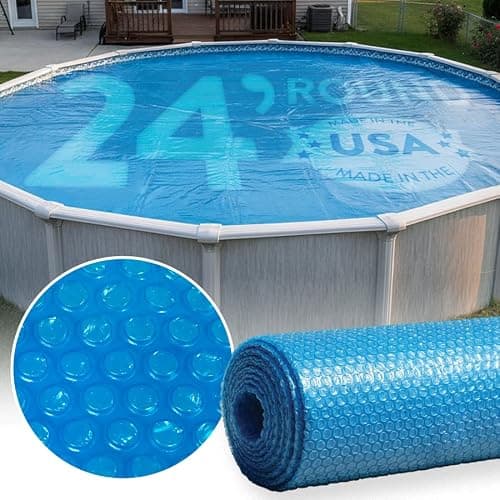 Bubble Solar Cover for Above-Ground Pools It cuts evaporation, and evaporation is simultaneously your water bill, your chemical bill and your heat loss. Nothing else on this site reduces three costs at once. | The single highest-return accessory hereSeveral seasons | 9.0out of 10 |
What does not go on it
Winter covers are heavy, solid and full of water. They are folded and stored, never reeled.
| # | Product | Best for | Score | Price |
|---|---|---|---|---|
| 1 | No image Winter Cover for Above-Ground Pools A structural product, not a summer one. Its job is carrying snow and blocking light for a whole winter, and a solar cover pressed into that role will be in shreds by February. | Five months of weather, not one nightSeveral seasons | 8.3out of 10 |
The short version
- The reel is not a water product, it is a compliance product. It exists to make the cover something you use nightly rather than occasionally.
- Size to the pool’s diameter, not the cover’s. The tube has to be longer than the cover is wide.
- Freestanding beats deck-mounted here. Most above-ground pools have nothing to mount to.
- Solar covers only. Never a winter cover. A wet solid cover weighs far more than any reel is built for.
Why the reel matters more than it should
A solar cover is the highest-return purchase on this site. It cuts evaporation, which is both the water bill and the heat loss, and our solar cover roundup and heating cost guide both make the case with numbers.
The catch is entirely behavioral. A 15- or 18-foot solar cover is an awkward, slippery, wet sheet that has to come off before swimming and go back on afterwards. Dragging it onto the grass gets grass on it, which then goes in the pool. Folding it wet is unpleasant. So on a warm evening with people about, it does not go back on — and a cover that is off is worth nothing.
The reel turns a two-person five-minute job into a one-person one-minute job. That is the entire product, and it is why the reel is worth buying at the same time as the cover rather than a season later.
Sizing, which people get wrong once
Reels are sold by the pool width they span, and the number to match is your pool’s diameter, not the cover’s cut size. A solar cover is usually trimmed slightly smaller than the pool so it floats inside the walls, so buying a reel to the cover’s dimensions leaves you short.
| Check | What to compare | Failure if you get it wrong |
|---|---|---|
| Tube span | Pool diameter, plus clearance | Cover overhangs the tube and rolls unevenly |
| Tube sections | Does it come apart? | A one-piece tube cannot be stored over winter |
| Base type | Freestanding vs deck-mounted | Deck brackets need a deck; most pools have none |
| Base footprint | Ground beside your pool | Needs level ground and clearance to roll back |
| Cover straps | Number and attachment | Too few and the cover pulls crooked every time |
| Material | Aluminum or resin | Both fine; steel fittings near a pool eventually rust |
The above-ground mounting problem
Most solar cover reels on the market are designed for inground pools with a concrete deck to bolt to. Above-ground pools generally have grass or pavers, and the top rail is structural — it carries the load of thousands of gallons and it is not a mounting point.
So the format that applies here is freestanding: a wheeled or footed frame that stands beside the pool and rolls back out of the way. Two practical requirements come with it. The ground needs to be level, for the same reason the pool itself does — our leveling guide covers why that matters more than people expect. And you need clearance on one side of the pool to park it.
The honest case for skipping it
Three situations where the reel is not the right purchase.
A small pool. On a 10- or 12-foot pool the cover is light enough for one person to lift off and drape over a rail in about thirty seconds. The reel solves a problem you do not have, and it takes up more space beside the pool than the cover does.
A pool with no level ground beside it. A freestanding reel on a slope rolls, tips or simply will not turn.
A pool that comes down each season. If you are packing the whole pool away — the situation our storing a pool guide covers — a reel is one more large item to find room for.
Everywhere else, on a 15-foot pool and up, it is the accessory that makes the highest-value purchase on the site actually work.
Looking after it
The reel lives outdoors in sun and chlorinated splash all season, which is the same environment that degrades the cover. Rinse the tube when you rinse the cover, keep the straps out of the water when the cover is off the reel, and check the fittings mid-season.
At closing, the cover comes off the reel entirely. Roll the solar cover for storage as our solar cover guide describes, break the tube down into its sections, and store both out of the sun — UV is what ends solar covers, and it is doing the same to a reel tube left out all winter.
The picks, in full
Scores are our own reading of published specifications. They are not test results — we have not tested these products and we do not claim to.
Pick #1 · Making sure the cover actually gets used
Solar Cover Reel for Above-Ground Pools
Various
A cover that takes two people and ten minutes to move gets left off. A reel makes it a one-person, one-minute job, which is the difference between owning a cover and using one.
Key specs
- Function
- Rolls the solar cover on and off
- Fit
- Must match pool diameter and wall type
- Mounting
- Freestanding or wall-mounted depending on model
How it scoresour reading of published specs, not a test result
- Retention
- 7.0
- Durability
- 7.5
- Handling
- 9.5
- Running cost
- 8.5
- Value
- 7.0
Overall 7.7 / 10
What works
- Turns cover use from a chore into a habit, which is where all the savings actually are
- Keeps the cover off the ground, which is what shortens its life
- One-person operation
What doesn't
- Frequently costs more than the cover it handles
- Takes up permanent space beside the pool
- Sizing must match the pool exactly, and returns are awkward
Skip it if: A small pool. Under about 12 feet the cover is light enough to handle by hand and the reel is a solution to a problem you do not have.
What it costs to run: Only justified on larger pools. The value is not the reel, it is the cover getting used every night instead of most nights — quantify it by how often you would actually bother otherwise.
Several seasons: Buy-once. Built and warranted to come back out of the box for a few years, if you store it properly.
Pick #2 · The single highest-return accessory here
Bubble Solar Cover for Above-Ground Pools
Various
It cuts evaporation, and evaporation is simultaneously your water bill, your chemical bill and your heat loss. Nothing else on this site reduces three costs at once.
#ad how this is funded · price as of October 8, 2026
Key specs
- Construction
- Bubble sheet, thickness published in mil
- Thickness
- Higher mil lasts longer — 12 mil and 16 mil are common
- Fit
- Cut to size; buy oversize and trim
- Orientation
- Bubbles face down, toward the water
How it scoresour reading of published specs, not a test result
- Retention
- 9.0
- Durability
- 7.0
- Handling
- 6.0
- Running cost
- 9.8
- Value
- 9.5
Overall 9.0 / 10
What works
- Reduces evaporation, which is the mechanism behind the water, chemical and heat savings all at once
- Cheap relative to everything it saves
- Can be cut to fit any pool shape, so sizing is forgiving
What doesn't
- Awkward to get on and off without a reel, and awkward is how covers end up unused
- Degrades in UV like every vinyl product
- Not a safety cover and will not support weight — this is important
Skip it if: Being a safety barrier. A solar cover looks solid and is not; a child or pet on it goes through and under.
What it costs to run: The one accessory with a clear payback. Every gallon that does not evaporate is a gallon you do not replace at the EPA WaterSense national average of $6.06 per 1,000 gallons, and it is chlorine you do not re-dose. If you buy one thing from this hub, buy this.
Several seasons: Buy-once. Built and warranted to come back out of the box for a few years, if you store it properly.
Specs from: EPA WaterSense — cost per 1,000 gallons
Pick #3 · Five months of weather, not one night
Winter Cover for Above-Ground Pools
Various
A structural product, not a summer one. Its job is carrying snow and blocking light for a whole winter, and a solar cover pressed into that role will be in shreds by February.
Key specs
- Construction
- Woven polyethylene, weight published in mil or scrim count
- Securing
- Cable and winch, or wraparound straps
- Overlap
- Needs genuine overlap past the wall — check the stated size against your pool
- Not the same as
- A solar cover or a safety cover
How it scoresour reading of published specs, not a test result
- Retention
- 8.5
- Durability
- 8.0
- Handling
- 6.5
- Running cost
- 9.0
- Value
- 8.5
Overall 8.3 / 10
What works
- Blocks light for the whole winter, which is what stops algae in a closed pool
- Cable-and-winch securing survives wind that lifts a strapped cover
- Buying the heavier scrim genuinely doubles the number of winters you get
What doesn't
- Needs a way to shed or pump off standing water, or the weight tears it
- Bulky to store in summer
- Not a safety cover — it will not support a person and must not be treated as if it will
Skip it if: A pool you take down each autumn. If the pool comes apart, the cover is money spent on nothing.
What it costs to run: This is insurance rather than a saving. A torn cover in January means an opening in April that costs a full shock treatment and a week of filtration to fix, which is more than the better cover cost.
Several seasons: Buy-once. Built and warranted to come back out of the box for a few years, if you store it properly.
Questions people actually ask
Do I need a solar cover reel?
What size solar cover reel do I need?
Can you put a winter cover on a solar cover reel?
Can you use a cover reel on an above-ground pool?
Sources
Read next
- Closing, covering and opening againWinterizing, covers and spring opening - the four weeks of the year that decide whether you own a pool next summer.
- The best solar covers, and why this is the one thing to buyBubble covers compared on thickness and sizing, plus the arithmetic that makes this the highest-return purchase in the hub.
- Solar cover or winter cover: they are not the same productWhat a solar cover does, what a winter cover does, why neither substitutes for the other, and which one to buy first.
- Adding weeks to the season, starting with the cheapest thing firstCover, placement and timing before hardware, plus the kilowatt arithmetic that shows what running an electric heater actually costs.
- A winter cover fails from water on top of it, not from coldWhy standing water is what destroys winter covers, the mid-winter checks that prevent it, and how to store one so it lasts.
- Taking the pool down without ruining itThe take-down sequence for a seasonal pool: draining responsibly, drying completely, folding warm, and storing where rodents are not.
- Heating a pool, priced properlyThe physics of heating a pool turned into dollars, why a cover changes the answer more than the heater does, and when heating is worth it.
- What it costs to fill a pool, and to keep it fullOne fill priced for four common pool volumes at the national average water rate, plus why every gallon you add has to be re-balanced.
- The pool thermometer, and the two expensive questions it answersFloating, digital and wireless pool thermometers compared, and why the closing decision alone justifies owning one.