Pool Equipment
Solar pool heating: collector area is the whole story
Three formats, three wildly different amounts of black surface facing the sun. And one compatibility note, published by the biggest maker in the category, that quietly rules its own panels out for most readers of this site.
Heads up: we earn a commission if you buy through the links on this page, at no extra cost to you. It never decides the ranking — here is how we pick and here is the full disclosure. Prices are checked automatically; last verified October 8, 2026.
Quick picks
Segmented before it is ranked — the right answer depends on which of these you actually are. Tap any row for the full write-up.
If your pump is not an Intex unit
A real collector panel, with roughly seven times the black surface of a single mat and a published sizing chart by pool diameter.
| # | Product | Best for | Score | Price |
|---|---|---|---|---|
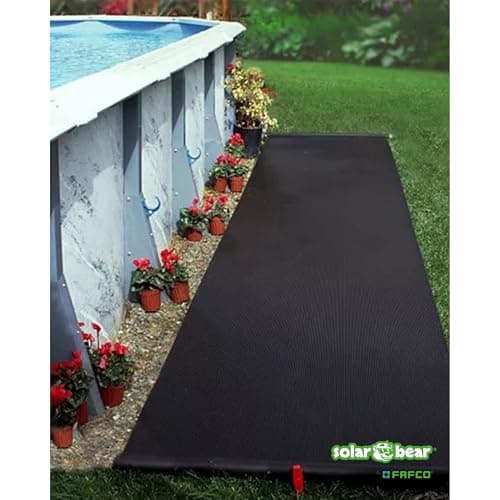
| 1 | FAFCO Original Solar Bear Solar Pool Heater, 4 ft x 20 ft A real collector panel from the company that has been making them longest. It publishes a square footage, a tilt angle and a bypass valve, and it tells you plainly that it will not work with an Intex filter. | The only format here that genuinely heatsSeveral seasons | 8.3out of 10 |
If your pump came in the pool box
Built around the flow rate a frame-pool filter actually produces, and sold in multiples because one mat is not much collector.
| # | Product | Best for | Score | Price |
|---|---|---|---|---|
| 1 | 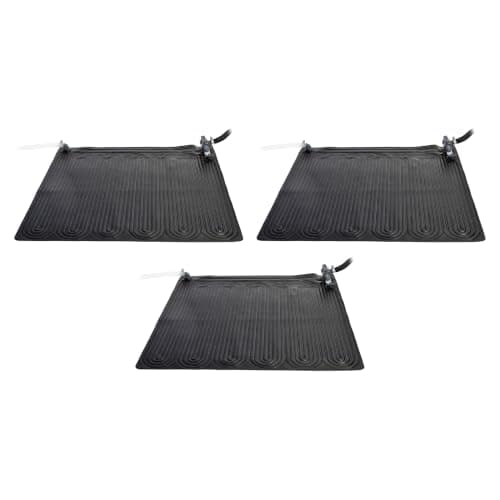 Intex 28685E Solar Mat Pool Water Heater, 3-Pack The answer for the pump most readers of this site actually own. One mat is a fraction of a panel's collector area, which is exactly why it is sold in multiples. | A frame pool whose pump rules the panels outSeveral seasons | 8.0out of 10 |
If you would rather not plumb anything
Floating discs that heat and cover at once. Nothing connects to the pump, and the maker is unusually honest about the limits.
| # | Product | Best for | Score | Price |
|---|---|---|---|---|
| 1 | 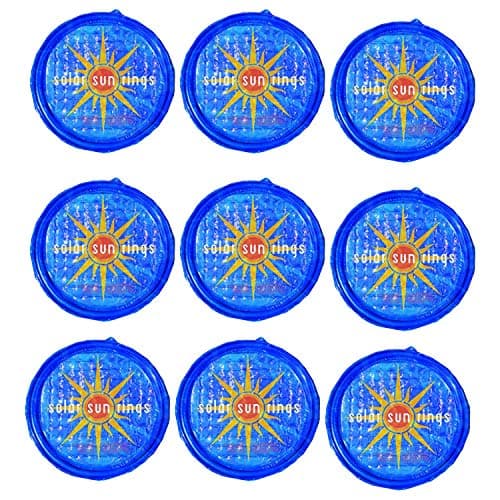 Solar Sun Rings 60-Inch Solar Pool Heater with Water Anchors Floating discs that heat and cover at the same time, from a maker that is unusually candid about what they will not do. Nothing connects to the pump, which is the whole appeal. | Heating without plumbing anythingSeveral seasons | 7.8out of 10 |
The short version
- Collector area decides everything. A full panel publishes 79.2 sq ft. One solar mat publishes 11. That ratio is the product difference.
- FAFCO publishes that its panels will not work with Intex filters. For a lot of readers here, that single line settles the format question.
- Every claim in this category is a manufacturer claim. No independent testing exists that we could find, so we quote who said what.
- Buy the cover first. On an uncovered pool, stopping losses beats adding heat, and it costs less.
The number that separates these products
Solar heating is one of the few pool categories where the physics is legible from the spec sheet. Black surface facing the sun, with pool water moving behind it, is the entire mechanism. So the question is not which brand is best — it is how much black surface you are buying.
| Format | Collector area | Temperature claim published | Connects to the pump? |
|---|---|---|---|
| Collector panel (FAFCO Solar Bear 4 x 20) | 79.2 sq ft | Up to 10 degrees F | Yes, 1-1/2 in hose |
| Solar mat (Intex 28685E) | 11 sq ft per mat | 5 to 9 degrees F | Yes, 1.25 in with 1.5 in adaptors |
| Floating rings (Solar Sun Rings 60 in) | Not published; about 19.6 sq ft computed from the published 5 ft diameter | 8 to 12 degrees F over time | No |
A single mat is roughly one seventh of a panel. That is not a knock on the mat — it is why Intex sells them in multiples, and why three of them is a more honest comparison than one. But it does mean a reader looking at a mat and a panel side by side is not looking at two versions of the same product.
The rings are a different thing again. A 5 ft disc is about 19.6 sq ft of surface, so the numbers look competitive — but a ring is heating the water it floats on directly rather than circulating water through a collector, and it is doing the job of a cover at the same time. The maker is explicit that they are not a heater replacement.
The compatibility line that decides most of this
This is the same theme as our hoses and fittings guide: above-ground pool equipment is split into a frame-pool world with its own hose sizes and flow rates, and a conventional-pool world that assumes a full-size pump. Solar is where that split is most expensive to get wrong, because the panel is the costliest item in this roundup.
Intex’s own mat publishes the other side of the same line: suitable for filter pumps up to 1/3 HP or under 2,000 gal/hr. Worth knowing before you order: other listings for the same part publish 1/2 hp and under 2,500 gal/hr. The sources disagree, and a reader with a 2,100 GPH pump sits precisely in the gap. Check your own pump’s published flow against our pump sizing guide before you commit.
What we will and will not claim
Every temperature figure on this page is a manufacturer or retailer claim, attributed to whoever made it. We found no independent testing of consumer pool solar collectors, and we are not going to invent any. What we can do is point out where the published numbers disagree with each other, because that is usually where the marketing is.
The clearest example is the rings. The manufacturer’s own page says to cover 50% to 70% of the pool and expect 8 to 12 degrees F over time. Retailer copy for the same product routinely says 70% to 80% coverage and 10 to 15 degrees. When the seller is more optimistic than the maker, the maker is the one to believe.
The same manufacturer also publishes its own limits, which is rare enough to be worth repeating: the rings are not a replacement for a heater, going above 90% coverage risks overheating the water or promoting algae, and they will not fully prevent heat loss on a cold night. That is a company arguing against its own upsell, and it is the most credible thing in this category.
Where the panel has to go
A 4 ft by 20 ft collector is a piece of yard infrastructure, not an accessory. FAFCO publishes that it performs best tilted 10 to 30 degrees to the south with unobstructed sunlight, which in practice means a shed roof, a fence run or a purpose-built frame.
Find twenty feet of unshaded south-facing run
Before anything else. A panel in afternoon shade is a panel that does not work, and no amount of plumbing fixes it.Check the panel is downstream of the filter
Solar goes after filtration so the collector is fed clean water. This is the standard order and it is what the supplied hose kit assumes.Fit the bypass where you can reach it
The built-in manual bypass is how you stop heating once the pool is warm enough. It is useless at the top of a roof you need a ladder for.Run it in the middle of the day
Published guidance is to operate between about 10 a.m. and 4 p.m. on sunny days, which is a timer job rather than a leave-it-on job.Drain it before the first freeze
Water left in a collector over winter does exactly what water left in a pump does. Our winterizing guide covers the same mechanism.
That fourth step is the one that changes the arithmetic quietly. Solar wants the pump running during peak sun, which may not be the schedule you chose for filtration — and on a frame pool the pump is often the largest line in the annual running cost. A solar collector is free to run; the pump hours it asks for are not.
How much collector your pool actually wants
The trade rule most often quoted is that a collector should be somewhere between half and all of the pool’s surface area. Nobody in this category publishes that as a specification, so treat it as orientation rather than a number — but it is the right way to think about what you are buying, and it makes the gap between the formats concrete.
Collector area against pool surface, for three common above-ground sizes
- A 15 ft round pool
- About 177 sq ft of water surface
- An 18 ft round pool
- About 254 sq ft
- A 24 ft round pool
- About 452 sq ft
- One FAFCO Solar Bear panel [Leslie's — FAFCO Solar Bear published specifications]
- 79.2 sq ft of collector, published
- One Intex 28685E solar mat [In The Swim — Intex 28685E published specifications]
- 11 sq ft of collector, published
Pool surface = pi x radius squared. One panel on an 18 ft round pool is 79.2 / 254, or about 31% of the surface.
One panel is about 45% of a 15 ft pool, 31% of an 18 ft, and 18% of a 24 ft
Run the same arithmetic for your own pool before you order anything. The diameter is on the box, the surface area is one multiplication, and the collector area is published for both products on this page. It is the only calculation in this category that is not somebody else’s marketing claim.
The running cost, against the alternatives
The phrase “free to run” is doing a lot of work on every solar product page, including this one, so it is worth setting against a real figure rather than leaving it as a feeling.
An electric or gas heater is the largest recurring line a pool can acquire, which is why our heating cost guide works it out rather than quoting a range. Solar adds no element and no compressor, so the marginal cost of the heat is genuinely zero. What it is not free of is pump hours: a collector only works while water is moving through it, and the published guidance is to run it through the middle of the day.
What the pump hours a collector asks for actually cost
- EIA US residential average rate [EIA Electric Power Monthly, Table 5.6.A]
- 18.34 cents per kWh (June 2026)
- A typical frame-pool pump
- Around 300 W
- Extra run time a collector wants
- Say 2 hours a day through a 120-day season
300 W x 2 h x 120 days / 1,000 = 72 kWh; 72 x $0.1834
About $13 a season in extra pump time
That is the honest frame for the whole category. Solar is not a cheap heater, it is a no-running-cost one with a hard ceiling on what it can deliver. If you need the pool at a set temperature on a given evening, nothing here does that at any price, and our heater roundup is the page you want instead.
How this compares to actually heating the pool
Nothing on this page is in the same category as a gas or electric heater, and it is worth being blunt about that. Our heater roundup and our heating cost arithmetic cover what it takes to hold a pool at a set temperature on demand. Solar does not do that at any price.
What solar does is shift the season. A pool that is comfortable from mid-June becomes a pool that is comfortable from late May, and stays usable a few weeks further into September. For a seasonal above-ground pool that is often the whole point, and our extend the season guide treats it as one measure among several rather than a product you buy in isolation.
Buy the cover first
This roundup exists because our solar heating guide argues that panels are the only one of the three that genuinely heats, and then had nothing to point at. But that same guide reaches a conclusion worth repeating here: on an uncovered pool, the loss side dominates, and a bubble cover is the cheapest intervention in the whole category.
If you do not already have one, start at our solar cover roundup and come back to this page afterwards. A collector added to an uncovered pool is heating water that evaporates overnight, which is the most expensive way to be slightly warmer. The payback math is worked through properly in our solar cover payback guide.
The honest recommendation
Check what your filter pump is before you look at anything else. If it is an Intex unit, the panels are out by the maker’s own instruction and the mats are what was designed for you — buy three rather than one, because 11 sq ft is not a heating system.
If you have a conventional pump and twenty feet of unshaded south-facing run, the panel is the only product here with enough collector to produce a difference you would describe as heating. And if neither of those is true, the rings are a legitimate answer that asks nothing of your plumbing — provided you take the maker at its word about what they will and will not do.
The picks, in full
Scores are our own reading of published specifications. They are not test results — we have not tested these products and we do not claim to.
Pick #1 · The only format here that genuinely heats
FAFCO Original Solar Bear Solar Pool Heater, 4 ft x 20 ft
FAFCO
A real collector panel from the company that has been making them longest. It publishes a square footage, a tilt angle and a bypass valve, and it tells you plainly that it will not work with an Intex filter.
#ad how this is funded · price as of October 8, 2026
Key specs
- Collector area
- 79.2 sq ft of parallel circular channels, published
- Material
- UV-stabilized polyolefin, published
- Temperature claim
- Increases water temperature by up to 10 degrees F, published
- Bypass
- Built-in manual bypass to switch the panel on and off, published
- Plumbing
- Supplied with 1-1/2 in hose; the barbs accept 1-1/2 in hose
- Pump compatibility
- Published as working with any pool pump — but explicitly NOT with Intex pool filters
- Orientation
- Published as most effective tilted 10 to 30 degrees to the south
- Sizing
- Published chart: one system for 12 to 24 ft round, two for 27 ft and up
- Warranty
- Three-year limited, published for the Solar Bear line
How it scoresour reading of published specs, not a test result
- Sizing fit
- 7.0
- Running cost
- 10.0
- Maintenance
- 8.5
- Build
- 8.5
- Value
- 7.5
Overall 8.3 / 10
What works
- 79.2 sq ft of collector, which is roughly seven times what a single solar mat offers
- Publishes an actual sizing chart by pool diameter rather than a vague suitability claim
- The manual bypass means you can switch it off when the pool is warm enough, which matters more than people expect
- Polyolefin collectors are the established technology here, and FAFCO publishes a warranty term against it
What doesn't
- Published as not compatible with Intex pool filters, which rules it out for a large share of frame-pool owners
- By far the most expensive option in this roundup, and it needs somewhere to sit in full sun
- The 10 degree claim is a manufacturer figure with no independent test behind it that we could find
- It is a 20 ft panel: it needs a fence run, a roof or a frame, not a corner of the deck
Skip it if: Pools running the pump that came in the box. If your filter is an Intex unit, the maker says this will not work with it, and that is the end of the conversation rather than something to try.
What it costs to run: Running cost is genuinely zero — there is no element and no compressor, only the pump you were already running. The whole cost is the purchase, which is why the payback question is about how many seasons you keep the pool rather than about the price per degree.
Several seasons: Buy-once. Built and warranted to come back out of the box for a few years, if you store it properly.
Specs from: PoolSupplies — FAFCO Solar Bear published claims, bypass, tilt and Intex incompatibility, Leslie's — FAFCO Solar Bear system, published material, temperature claim and warranty
Pick #2 · A frame pool whose pump rules the panels out
Intex 28685E Solar Mat Pool Water Heater, 3-Pack
Intex
The answer for the pump most readers of this site actually own. One mat is a fraction of a panel's collector area, which is exactly why it is sold in multiples.
#ad how this is funded · price as of October 8, 2026
Key specs
- Mat size
- 47.25 in x 47.25 in flat before fill, published
- Collector area
- 11 sq ft per mat, published
- Temperature claim
- 5 to 9 degrees F, published
- Pump compatibility
- Published as up to 1/3 HP or under 2,000 gal/hr
- Published elsewhere as
- Up to 1/2 hp or under 2,500 gal/hr — the sources disagree
- Plumbing
- 1.25 in attachment points; adaptors A and B for 1.5 in hose included
- Bypass
- Bypass valve included, published
- Pool size
- Rated for above-ground pools up to 8,000 gallons
How it scoresour reading of published specs, not a test result
- Sizing fit
- 9.0
- Running cost
- 10.0
- Maintenance
- 7.5
- Build
- 6.5
- Value
- 8.0
Overall 8.0 / 10
What works
- Designed around the flow rate of a frame-pool filter pump rather than a full-size pool pump
- Ships with both 1.25 in and 1.5 in connections, so it fits the hose sizes these pools actually use
- Modular — three mats is 33 sq ft, and you add them as the budget allows
- Flat and light enough to lie on a lawn or a shed roof without a mounting frame
What doesn't
- 11 sq ft per mat against 79.2 for a full panel, and collector area is what does the heating
- The published pump ceiling contradicts itself across sources: 1/3 HP and under 2,000 gal/hr on one, 1/2 hp and under 2,500 gal/hr on another
- Vinyl mats are a seasonal item rather than a decade-long purchase
- Every mat added is another pair of hose joints and another thing to drain in autumn
Skip it if: Heating a big pool quickly. Three mats on an 8,000 gallon pool is a nudge across a sunny week, not a heater you switch on the night before guests arrive.
What it costs to run: No running cost beyond the pump you already run. The real cost is head loss: every mat in the loop is more resistance for a small pump, which is the thing to watch rather than the electricity.
Several seasons: Buy-once. Built and warranted to come back out of the box for a few years, if you store it properly.
Specs from: In The Swim — Intex 28685E solar mat, published dimensions, pump limits and connections
Pick #3 · Heating without plumbing anything
Solar Sun Rings 60-Inch Solar Pool Heater with Water Anchors
Solar Sun Rings
Floating discs that heat and cover at the same time, from a maker that is unusually candid about what they will not do. Nothing connects to the pump, which is the whole appeal.
#ad how this is funded · price as of October 8, 2026
Key specs
- Diameter
- About 5 ft (60 in) per ring, published
- Heat claim
- Up to 21,000 BTU per ring per day under full sun, published
- Coverage guidance
- 50% to 70% of the pool surface ideal, published by the maker
- Temperature claim
- 8 to 12 degrees F over time against an uncovered pool, published by the maker
- Published elsewhere as
- 70% to 80% coverage and 10 to 15 degrees F — retailer copy claims more than the maker does
- Construction
- UV-resistant floating discs; two layers of vinyl, published
- Life
- Three to five years with proper care, published
- Plumbing
- None — nothing connects to the pump
How it scoresour reading of published specs, not a test result
- Sizing fit
- 8.0
- Running cost
- 10.0
- Maintenance
- 6.5
- Build
- 7.5
- Value
- 7.5
Overall 7.8 / 10
What works
- No plumbing at all, so pump compatibility stops being a question
- The maker publishes a coverage percentage, a BTU figure and a lifespan, which is more than most of this category does
- They cover the water as well as heating it, so the evaporation saving is real alongside the heat gain
- Water anchors on this version are the difference between rings that stay put and rings that pile up downwind
What doesn't
- The maker warns that over 90% coverage can overheat the water or promote algae, so more is not better
- Retailer copy routinely claims higher coverage and a bigger temperature gain than the manufacturer does
- They have to be taken out and stacked before anyone swims, every time
- Published as not a replacement for a heater in cold weather or on a shaded pool, by the maker itself
Skip it if: A pool that gets used spontaneously. Anything floating on the surface is something to clear first, and that friction is what decides whether these stay in use past July.
What it costs to run: Zero running cost and no pump involvement at all. The honest comparison is against a bubble solar cover, which does the same two jobs on the same pool for less money and more hassle to handle.
Several seasons: Buy-once. Built and warranted to come back out of the box for a few years, if you store it properly.
Specs from: Solar Sun Rings — manufacturer's published BTU, coverage, temperature gain and caveats
Questions people actually ask
Do solar pool heaters actually work on an above-ground pool?
Will a solar panel work with my Intex filter pump?
How much solar collector do I need for my pool?
Is a solar cover better than a solar heater?
Do solar pool heaters cost anything to run?
Sources
- PoolSupplies — FAFCO Solar Bear published claims, bypass, tilt and Intex incompatibility
- Leslie's — FAFCO Solar Bear system, published material, temperature claim and warranty
- In The Swim — Intex 28685E solar mat, published dimensions, pump limits and connections
- Solar Sun Rings — manufacturer's published BTU, coverage, temperature gain and caveats
- EIA Electric Power Monthly, Table 5.6.A
- ENERGY STAR — Pool Pumps
Read next
- Equipment, sized to your pool and costed by the wattPumps, filters, vacuums, heaters and ladders - matched to your gallons and priced by what they draw.
- Solar heating: three products, two of which mostly stop lossesSolar covers, rings and panels compared on what they actually do, what each costs to run, and the order to buy them in.
- Pool heaters, priced by the wattHeater running costs computed at national average rates, and why a cover has to come first for a heater to make any sense.
- Sizing a heater: one calculation, and a warning about the answerThe BTU sum that sizes a heater to your pool, why undersized units cost more overall, and why a cover changes the answer more than capacity does.
- The best solar covers, and why this is the one thing to buyBubble covers compared on thickness and sizing, plus the arithmetic that makes this the highest-return purchase in the hub.
- Adding weeks to the season, starting with the cheapest thing firstCover, placement and timing before hardware, plus the kilowatt arithmetic that shows what running an electric heater actually costs.
- Heating a pool, priced properlyThe physics of heating a pool turned into dollars, why a cover changes the answer more than the heater does, and when heating is worth it.
- The solar cover pays for itself, and it is not closeWhat a solar cover saves on water and on heat, why the payback is measured in weeks rather than seasons, and the behavior problem that decides it.
- Sizing a pump: the number on the box is not the number you useTurnover time computed from published system flow rates for common pool volumes, and why an oversized pump costs you money every day.