Pool Costs
What a cold plunge actually costs to run
The water is about six dollars a year. The ice has no published quantity and the chiller has no published wattage, so the number everyone wants does not exist - and the figures that do exist still decide which tub to buy.

Heads up: we earn a commission if you buy through the links on this page, at no extra cost to you. It never decides the ranking — here is how we pick and here is the full disclosure. Prices are checked automatically; last verified October 17, 2026.
The short version
- The water costs about $6 to $17 a year. Thirteen changes on the published four-week interval, at the EPA WaterSense national average.
- No chiller publishes an input wattage. Horsepower is a compressor rating, not a draw, so the electricity cost cannot be calculated from published figures.
- No tub maker publishes how much ice a session takes. We looked. Ice Barrel’s FAQ covers temperature, duration and water changes and is silent on ice.
- Gallons are the running cost. The 216-gallon tub costs a fifth of the 77-gallon one and needs nearly three times the cooling, every session, forever.
Here is the whole answer in one paragraph. A cold plunge tub’s water costs between about $6 and $17 a year, which is nothing. The cooling is the real cost and it cannot be priced from what manufacturers publish - no chiller in this category publishes an input wattage and no tub maker publishes an ice quantity. What published figures can settle is the decision that matters more: which tub to buy, because a tub’s capacity is its running cost and the cheapest tubs hold the most water.
This site exists partly because the above-ground pool category will not publish the cost of owning a pool for a year. The cold plunge category is worse. It publishes less than the pool industry does, and it sells harder.
What can be priced: the water
Ice Barrel publishes a water change interval, which is more than most of the category does: “We recommend changing the water every four weeks or as preferred.” Its Amazon listings repeat it. Four weeks is thirteen changes a year.
A year of water, by tub size
- Change interval [Ice Barrel FAQ]
- Every four weeks, published by Ice Barrel
- Changes per year
- 52 / 4 = 13
- Water rate [EPA WaterSense — how the calculator works]
- $6.06 per 1,000 gallons
published gallons x 13 changes / 1,000 x $6.06 = water cost per year
$6.07 at 77 gal, $8.67 at 110 gal, $17.02 at 216 gal
| Tub | Published gallons | Gallons per year | Water per year |
|---|---|---|---|
| Ice Barrel 300 | 77 | 1,001 | $6.07 |
| AS ColdPlunge bundle tub | 100 | 1,300 | $7.88 |
| Bubplay | 105 | 1,365 | $8.27 |
| Ice Pod Pro | 110 | 1,430 | $8.67 |
| VEVOR | 216 | 2,808 | $17.02 |
What can be priced: the time, not the money
Chillers publish cooling rates, and a rate plus a volume gives you a duration. Two units publish both halves:
Hours to pull a tub from 60 degreesF to 45 degreesF
- 1/3 HP unit
- 2 degreesF per hour, rated for up to 79 gallons, published
- 1 HP unit
- About 6 degreesF per hour on 132 gallons, published
- Temperature drop
- 60 degreesF to 45 degreesF = 15 degreesF
temperature drop / published cooling rate = hours
About 7.5 hours on the 1/3 HP unit, about 2.5 hours on the 1 HP unit
What cannot be priced, and why
Two gaps, both of them the same shape as gaps we have documented elsewhere on this site.
Chiller electricity. Every unit publishes horsepower. Horsepower on a refrigeration compressor describes the compressor, not the wall draw, and converting one to the other requires an efficiency figure that nobody publishes. One unit publishes a 10,000 BTU cooling capacity, which is a cooling output rather than an electrical input. Without watts there is no kWh, and without kWh the EIA residential rate - 18.31 cents per kWh for July 2026, the most recent figure in EIA Table 5.6.A as of this writing - has nothing to multiply.
This is exactly the gap we hit on pool heat pumps, where none of the three units published a COP, and on hot tub covers, where no maker publishes an R-value. Where the figure does not exist we say so rather than estimate it.
Ice quantity. No maker publishes how much ice a session needs or how long it lasts. Ice Barrel’s FAQ publishes a target temperature of “below 60 degreesF”, a session guide of “3-5 minutes” and the four-week change interval, and says nothing about ice at all. Its marketing goes the other way entirely, selling the barrel on there being “no need to spend money on ice” - a comparative claim with no quantity behind it.
Why the cheap tub is the expensive one
This is the one piece of arithmetic in the category that changes a purchase, so it is worth doing slowly.
A 216-gallon inflatable costs roughly a fifth of a 77-gallon insulated barrel. It also holds 2.8 times the water. Since cooling cost - whether paid in ice or in kWh - scales with the volume being cooled, the cheap tub has a cooling bill nearly three times larger for the same plunge, every single session, for as long as you own it.
And it closes the cheap exit. The 1/3 HP chiller publishes a rating of “up to 79 gallons”. A 216-gallon tub is 2.7 times that rating, so there is no affordable chiller that publishes a figure covering it. The big inflatable is an ice tub for life.
Cost per plunge in year one, purchase included
- Daily use
- 365 plunges in the first year
- Cheapest tub here
- $54.33 at the price shown on this page
- Small insulated barrel
- $1,149.99 at the price shown on this page
- Water
- $8.27 and $6.07 respectively, from the table above
(purchase + year of water) / 365 = cost per plunge, year one, before ice or electricity
About $0.17 a plunge against about $3.17 a plunge
The seasonal free ride nobody sells
In January, in much of the country, cold tap water comes out near enough to the published target of below 60 degreesF that you may need little ice or none. In July it comes out warm and the whole gap has to be paid for.
That is the inverse of every other water product in this backyard. A pool is cheapest to enjoy in July. An inflatable hot tub is most expensive in January, because the gap between 102 degreesF and the air is at its widest. A cold plunge is cheapest exactly when the hot tub is dearest.
If you are going to try this at all, trying it now costs the least it ever will - which is a genuine reason to buy in the cold months rather than a marketing one.
The honest bottom line
Budget about $10 a year for water and forget it
Thirteen changes on the published four-week interval is a rounding error on a utility bill, whichever tub you buy.Buy the smallest tub you fit in
Capacity is the running cost. Check the published maximum user height, then take the smallest tub that clears it.If you want a chiller, buy the tub to suit the chiller
The affordable units publish a 79-gallon rating. Choose a tub inside it, or accept that you are on ice permanently.Do not believe any monthly electricity figure, including a flattering one
No chiller in this category publishes an input wattage. If a seller quotes you a monthly cost, ask which nameplate figure it came from.
The tub choice itself is in our cold plunge tub roundup, and if what you actually want is warm water in cold weather, the comparison is in cold plunge against hot tub.
What to buy
Scores are our own reading of published specifications. They are not test results — we have not tested these products and we do not claim to.
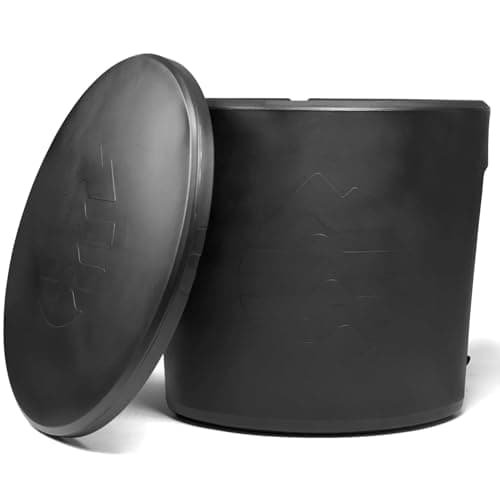
The least water to cool, which is the whole point of a barrel
Ice Barrel 300 Insulated Cold Plunge Tub
Ice Barrel
Seventy-seven gallons, rigid recycled LLDPE, polyurethane foam insulation through the barrel and the lid, and 3/4 in NPT chiller ports. The small capacity is the feature: it is the only tub here that sits inside the published rating of an affordable chiller.
#ad how this is funded · price as of October 17, 2026
Key specs
- Water capacity
- "Holds 292 liters (77 gallons)", published by Ice Barrel
- Dimensions
- W 35.5 in x H 30.5 in, published
- Weight
- "61 lbs. when empty (700 lbs. when full)", published
- Material
- Recycled LLDPE, "Made in the USA from recycled materials", published
- Insulation
- "Thick polyurethane foam insulation throughout the barrel and lid"; no thickness published for the 300
- Chiller ports
- "Chiller ports are 3/4in NPT with 14 TPI", published; bulkheads, seals and a pre-filter included
- Fits users up to
- "comfortably fits most body sizes up to 6'", published
How it scoresour reading of published specs, not a test result
- Capacity
- 5.5
- Insulation
- 9.0
- Chiller fit
- 9.5
- Build
- 9.0
- Value
- 5.5
Overall 7.7 / 10
What works
- 77 published gallons is inside the 79-gallon rating of the cheap 1/3 HP chiller — the only tub here that is
- Insulated barrel and lid, so a chilled tub holds temperature between sessions instead of being re-cooled
- Rigid construction with no fabric, no seams and nothing to puncture
- Publishes its empty and full weights, which tells you where it can stand
What doesn't
- You sit upright with knees bent; the published fit is up to 6 ft and no taller
- The warranty page contradicts itself — it offers a "limited lifetime warranty" and then states "The limited lifetime warranty is limited to 3 years"
- Ice Barrel publishes that the LLDPE "will fade over time if left in direct sunlight", and fading is not warranted
- No insulation thickness or R-value published for the 300, so "thick" is the whole claim
Skip it if: Lying down, and anyone over 6 ft. The maker's own published fit is up to 6 ft; above that the barrel format stops working and the long inflatable ovals are the honest answer.
What it costs to run: At the published four-week change interval, 77 gallons is about 1,001 gallons a year — roughly $6 of water at the EPA WaterSense average of $6.06 per 1,000 gallons. Every ice session also cools 64 percent less water than the 216-gallon inflatable, which is where the real running-cost difference sits.
Several seasons: Buy-once. Built and warranted to come back out of the box for a few years, if you store it properly.
Specs from: Ice Barrel 300 — published capacity, dimensions, weights, material, insulation and chiller port spec, Ice Barrel warranty page — "limited lifetime warranty" and "limited to 3 years", plus the sunlight fading exclusion
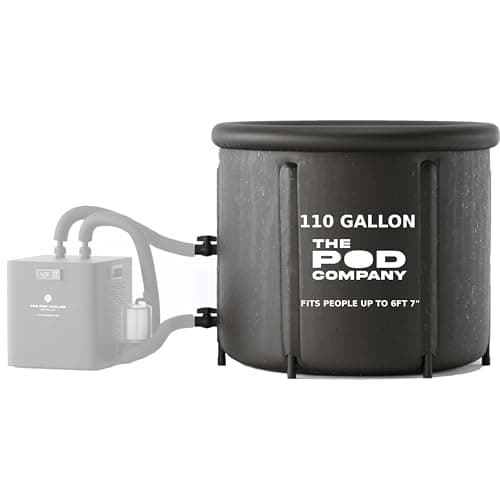
The best-specified cheap tub, and the one that can take a chiller later
The Pod Company Ice Pod Pro, 110 gal
The Pod Company
A hundred and ten published gallons with double-layer insulation, a reinforced thermal lid, a UV-resistant nylon shell and chiller compatibility stated on the listing. If you are starting with ice and might add a chiller, this is the tub that does not have to be replaced to do it.
#ad how this is funded · price as of October 17, 2026
Key specs
- Water capacity
- 110 gallons (420 L), published
- Fits users up to
- 6 ft 7 in, published
- Insulation
- "Double-layer insulation and a reinforced thermal lid", published
- Shell
- UV-resistant nylon with a leak-proof PVC liner, published
- Chiller
- Published as compatible with The Pod Company's own water chiller
- Drain
- Dual drain hoses, published
- Session guidance
- Maker's own: "Use daily or post-workout for 2-10 minutes"
How it scoresour reading of published specs, not a test result
- Capacity
- 7.5
- Insulation
- 7.0
- Chiller fit
- 7.5
- Build
- 6.5
- Value
- 9.0
Overall 7.5 / 10
What works
- Publishes both a gallon figure and a liter figure, and they agree (110 gal / 420 L)
- Chiller compatibility is stated, so the ice-to-chiller upgrade does not mean a second tub
- UV resistance is named for the shell fabric, which is what fails first on a tub left outside
- Insulated lid included, which is the single thing that decides how long a filled tub stays cold
What doesn't
- No insulation thickness or R-value published, so "double-layer" cannot be compared to anything
- 110 gallons is more water to chill than the 79-gallon rating of the common 1/3 HP chiller
- Inflatable construction, so it is a puncture risk in a way a rigid barrel is not
- Published session guidance of 2-10 minutes is broad enough to be no guidance at all
Skip it if: Being matched to a budget chiller. At 110 published gallons it sits above the 79-gallon rating the cheap 1/3 HP units publish, so a chiller that fits it is a bigger purchase than the tub.
What it costs to run: Four weeks between water changes is the published interval across this category, so 110 gallons is about 1,430 gallons a year. At the EPA WaterSense national average of $6.06 per 1,000 gallons that is about $8.70 of water a year — the water is never the expensive part.
One honest season: The cheapest setup that genuinely works for a season of real swimming. Nothing spare, nothing missing.
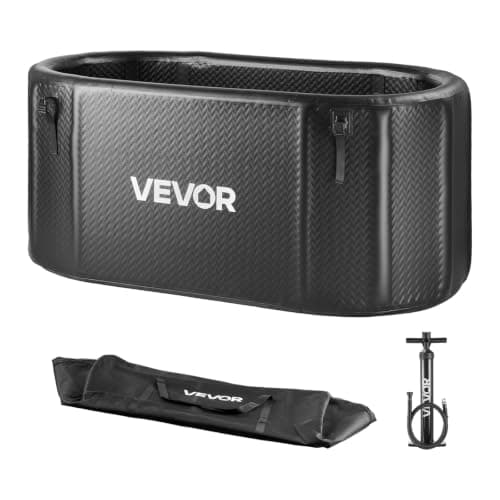
Lying down rather than sitting up — and the trap that comes with it
VEVOR Cold Plunge Tub, 216 gal
VEVOR
The most tub for the money and the most water to cool: 216 published gallons in a 59 x 31.5 x 29.9 in oval with 3.1 in drop-stitch walls and G1/2 in chiller ports. It is nearly three times the water of an Ice Barrel 300 and well past the published rating of every affordable chiller.
#ad how this is funded · price as of October 17, 2026
Key specs
- Water capacity
- 216 gallons, published
- Dimensions
- 59.1 in x 31.5 in x 29.9 in, published
- Fits users up to
- 6 ft 9 in, published
- Wall construction
- 3.1 in thick drop-stitch fabric, published
- Temperature range
- Published as resisting deformation from -4 degreesF to 140 degreesF
- Chiller ports
- Standard G1/2 in with adapters, published
- Empty weight
- 29.8 lb, published; dual-action pump, carry bag and repair kit included
How it scoresour reading of published specs, not a test result
- Capacity
- 9.5
- Insulation
- 4.5
- Chiller fit
- 5.0
- Build
- 7.0
- Value
- 7.0
Overall 6.9 / 10
What works
- Drop-stitch walls at a published 3.1 in are a real structural spec, not an adjective
- Publishes a temperature range for the material, which nothing else in this category does
- Standard G1/2 in ports rather than a proprietary fitting, so chiller choice stays open
- Full-length oval, so tall users lie down instead of folding into a barrel
What doesn't
- 216 gallons is 2.7x the 79-gallon published rating of the common 1/3 HP chiller — the cheap chiller cannot hold this
- Ice cost scales directly with gallons, so the cheapest big tub is the dearest to run on ice
- No insulation specification published at all, only the wall thickness
- Stock on this listing has been thin
Skip it if: Being chilled affordably. This is the clearest example of the trap on this page: the tub is cheap, the water in it is not, and no chiller under four hundred dollars publishes a rating that covers it.
What it costs to run: On the published four-week change interval, 216 gallons is about 2,808 gallons a year, or roughly $17 of water at the EPA WaterSense average of $6.06 per 1,000 gallons. The ice is the number that matters: every session cools nearly three times the water of a 77-gallon barrel.
One honest season: The cheapest setup that genuinely works for a season of real swimming. Nothing spare, nothing missing.
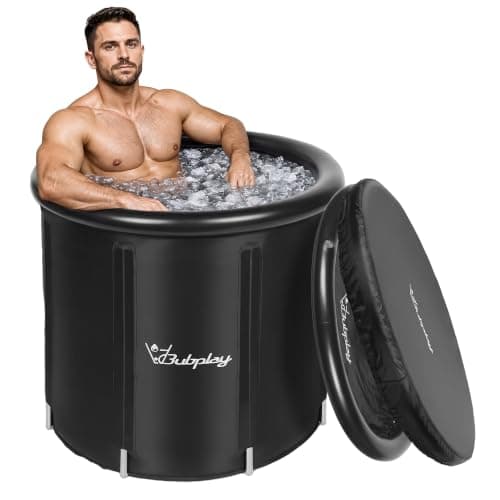
Finding out whether you will actually do this
Bubplay Ice Bath Cold Plunge Tub, 105 gal
Bubplay
A hundred and five published gallons, a fitted insulated cover and eight stainless support rods for about the price of a pool cover clip set. Buy it to discover whether cold water is a habit or a January idea, and expect to replace it if it becomes a habit.
Key specs
- Water capacity
- 105 gallons, published
- Fits users up to
- 6 ft 7 in, published
- Outer fabric
- 210D, published
- Cover
- Included, published as a 6-layer insulated construction
- Structure
- Inflatable top ring plus 8 stainless steel support rods, published
- Drain
- Bottom drain valve with hose included, published
- Freezing weather
- Maker's own guidance: "use indoors when temperatures drop below freezing"
How it scoresour reading of published specs, not a test result
- Capacity
- 7.0
- Insulation
- 5.5
- Chiller fit
- 2.0
- Build
- 5.0
- Value
- 9.0
Overall 6.3 / 10
What works
- Publishes a gallon figure, a height fit and a fabric denier, which is more than the price suggests
- Cover is in the box, and the cover is what keeps the cold in between sessions
- Support rods mean it stands up on its own rather than relying on water pressure
- Folds flat, so an abandoned experiment does not become a yard ornament
What doesn't
- No chiller ports, so this is an ice-only tub unless you drop a submersible pump in it
- The maker itself tells you to move it indoors below freezing, which is most of the plunge season in a cold climate
- 210D fabric is luggage-grade, not the drop-stitch construction the dearer inflatables use
- 105 gallons is a lot of water to cool with bagged ice
Skip it if: Living outdoors through a northern winter. The published guidance is explicit about moving it inside below freezing, which makes it a garage tub rather than a backyard one.
What it costs to run: Running cost here is ice, and ice scales with gallons. At 105 published gallons this needs about a third more ice per session than the 77-gallon Ice Barrel 300 and about half what the 216-gallon inflatable needs — the arithmetic is on our cold plunge running-cost guide.
One honest season: The cheapest setup that genuinely works for a season of real swimming. Nothing spare, nothing missing.
The cheapest way to stop buying ice — if your tub is small enough
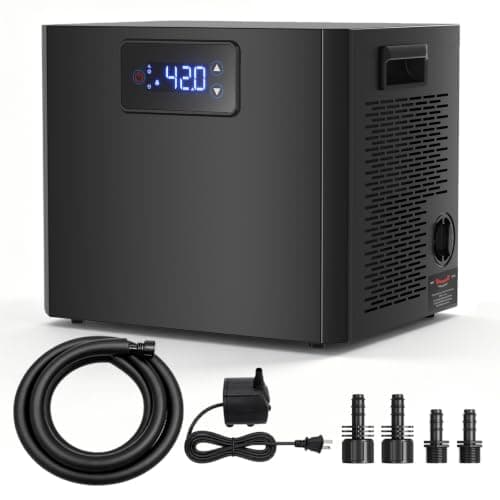
FADHOLE 1/3 HP Cold Plunge Chiller
FADHOLE
A 1/3 HP chiller that publishes the two numbers that decide everything: rated "for up to 79 gallons (300L)" and cooling at 2 degreesF per hour. Read those together and most cheap tubs on this page are too big for it, which is the single most useful fact in this category.
Key specs
- Rated capacity
- "Designed for up to 79 gallons (300L)", published
- Cooling rate
- "Cooling 2 degreesF/H", published
- Minimum temperature
- Cools water down to 42 degreesF, published
- Ports
- Connects to tubs with 1/2 in inlet/outlet ports; insulated hoses and fittings included, published
- Filter
- Washable fine-mesh metal filter rather than a disposable cartridge, published
- Supply
- 115 V; unit weight 36 lb, published
- Input power
- Not published — HP is a compressor rating, not a power draw, so running cost cannot be calculated from it
How it scoresour reading of published specs, not a test result
- Capacity
- 4.0
- Insulation
- 6.5
- Chiller fit
- 8.0
- Build
- 6.5
- Value
- 8.0
Overall 6.7 / 10
What works
- Publishes a rated gallon figure, which is the one spec that tells you whether it suits your tub
- Publishes a cooling rate, so time-to-temperature is simple division rather than guesswork
- Reusable metal filter instead of a consumable cartridge removes a recurring cost
- Includes a submersible pump, so it works with a plain bathtub as well as a ported plunge tub
What doesn't
- 79 published gallons rules out the 105, 110 and 216-gallon tubs on this page
- 2 degreesF per hour means a 15-degree pull takes most of a working day
- Input wattage is not published, so the electricity cost of running it cannot be computed from published figures
- One-year warranty on a sealed refrigeration system
Skip it if: Big tubs. The published rating is 79 gallons and it should be read as a limit, not a suggestion — pairing it with a 216-gallon inflatable is asking it to do 2.7x its stated job.
What it costs to run: The honest statement is that this cannot be costed from what the maker publishes. No chiller in this category publishes an input wattage, and horsepower is a compressor rating rather than a draw — so the kWh figure that would let you price a season does not exist. Our running-cost guide shows what can be computed instead.
Several seasons: Buy-once. Built and warranted to come back out of the box for a few years, if you store it properly.
A matched chiller and tub in one box, with the mismatch built in
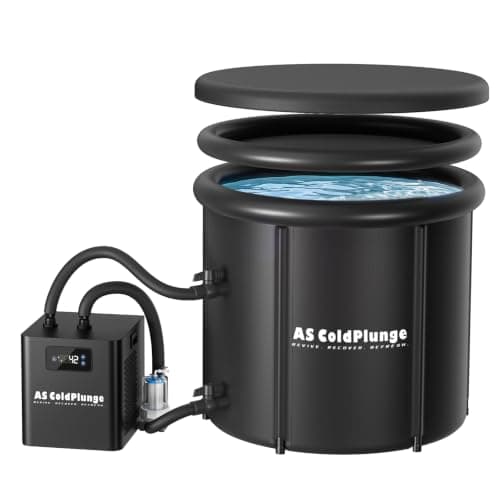
AS ColdPlunge 1/3 HP Chiller and 100 gal Tub Bundle
AS ColdPlunge
A 1/3 HP chiller sold with a 100-gallon insulated tub, which is a convenient bundle and a published sizing problem: the same class of chiller publishes a 79-gallon rating elsewhere. It is the cheapest ice-free route, and the tub is 21 gallons past where that class of unit is usually rated.
#ad how this is funded · price as of October 17, 2026
Key specs
- Tub capacity
- 100 gallons, published
- Tub insulation
- "Reinforced PVC and 10 mm EPE insulation", published
- Chiller
- 1/3 HP, cools to 42 degreesF, LED touchscreen thermostat, published
- Filtration
- External circulation pump with a 20-micron replaceable filter, published
- Included
- Insulated hoses, quick-connect fittings, sealing tape and a submersible pump for bathtub use, published
- Warranty
- 1 year, published
- Rated capacity of the chiller
- Not published for this bundle — the comparable 1/3 HP unit publishes 79 gallons
How it scoresour reading of published specs, not a test result
- Capacity
- 7.0
- Insulation
- 7.5
- Chiller fit
- 6.5
- Build
- 6.5
- Value
- 8.5
Overall 7.2 / 10
What works
- Publishes an actual insulation figure for the tub: 10 mm EPE
- Publishes a filter rating of 20 microns, which nothing else here does
- One purchase, matched fittings, no port-size research needed
- Cheapest ice-free setup on this page by a wide margin
What doesn't
- The chiller's rated gallon capacity is not published for the bundle, which is the figure that decides whether it can hold the tub
- 100 gallons against the 79-gallon rating published for the equivalent standalone unit
- 20-micron filter is a replaceable cartridge, so it is a recurring cost the metal-filter unit does not have
- Chiller and tub are published as shipping separately and may arrive on different days
Skip it if: Telling you whether it is correctly sized. The bundle publishes the tub's gallons and the chiller's horsepower but not the chiller's rated gallons, which is the one number that would settle it.
What it costs to run: Same gap as every chiller here: no input wattage is published, so a season cannot be priced from the maker's figures. What can be priced is the water — 100 gallons on the published four-week interval is about 1,300 gallons a year, roughly $8 at the EPA WaterSense average of $6.06 per 1,000 gallons.
Several seasons: Buy-once. Built and warranted to come back out of the box for a few years, if you store it properly.
Questions people actually ask
How much does it cost to run a cold plunge tub?
Is ice or a chiller cheaper for a cold plunge?
How long does a chiller take to cool a cold plunge?
Does a cold plunge cost more than a hot tub to run?
What is the cheapest way to cold plunge?
Sources
- Ice Barrel FAQ - published four-week water change interval, target temperature and session duration
- Ice Barrel 300 - published 77-gallon capacity and insulation description
- FADHOLE 1/3 HP chiller - published 79-gallon rating, 2 degreesF per hour cooling rate and 42 degreesF minimum
- AS ColdPlunge chiller and tub bundle - published 100-gallon tub, 10 mm EPE insulation and 20-micron filter
- EPA WaterSense — how the calculator works
- EIA Electric Power Monthly, Table 5.6.A
Read next
- What a pool actually costs, with the arithmetic shownPurchase, electricity, chemicals, water and replacement parts - added up, sourced, and shown as arithmetic you can redo.
- The best cold plunge tubs, judged by how much water you have to coolCold plunge tubs ranked on published capacity, insulation and chiller fit - because gallons, not sticker price, decide what a plunge habit costs.
- Cold plunge against inflatable hot tub: which backyard tub to buy this winterThe two backyard tubs that make sense in winter, compared on what each publishes about energy, water changes, sanitizer and who can actually use it.
- Inflatable hot tub running cost: the bill is a winter billThe electricity arithmetic for an inflatable hot tub held at temperature through winter, built from published heater wattage and current published rates.
- Cost per swim, and why it is the only number that settles the argumentThe running cost divided by realistic use, worked out for three pool sizes, and why the denominator matters more than the numerator.
- What it costs to fill a pool, and to keep it fullOne fill priced for four common pool volumes at the national average water rate, plus why every gallon you add has to be re-balanced.
- Seven ways to cut a pool's running cost, ranked by what they actually saveEvery saving measure priced with the same arithmetic and ranked, so you spend effort where the money actually is.
- An inflatable hot tub in winter: never let it freeze, cover everything elseWhat changes when an inflatable hot tub runs through the cold months - the loss-side purchases that pay for themselves, and the freeze failure that ends the tub.