Above-Ground Pools
A dog in the pool is a liner problem before it is anything else
Every soft-side pool on this site is a single layer of vinyl holding several thousand gallons. Dogs have claws. That is the entire brief.
Heads up: we earn a commission if you buy through the links on this page, at no extra cost to you. It never decides the ranking — here is how we pick and here is the full disclosure. Prices are checked automatically; last verified October 8, 2026.
Quick picks
Segmented before it is ranked — the right answer depends on which of these you actually are. Tap any row for the full write-up.
If the dog is going in the main pool
Hard-sided, steel-frame construction with the thickest liner in the class. Nothing inflatable, and nothing with a single-layer wall.
| # | Product | Best for | Score | Price |
|---|---|---|---|---|
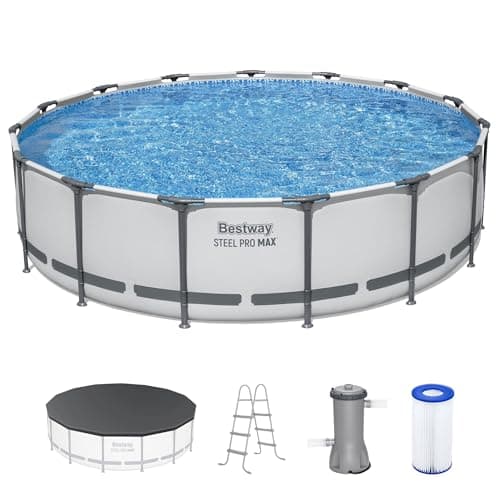
| 1 | Bestway Steel Pro MAX Pool Set, 15ft x 42in Fewer gallons and a shallower wall than the Intex flagship, which makes it easier to level, cheaper to fill and cheaper to keep clean. For most first-pool families this is the right size, not the compromise size. | The honest middle of the marketSeveral seasons | 8.2out of 10 | |
| 2 | 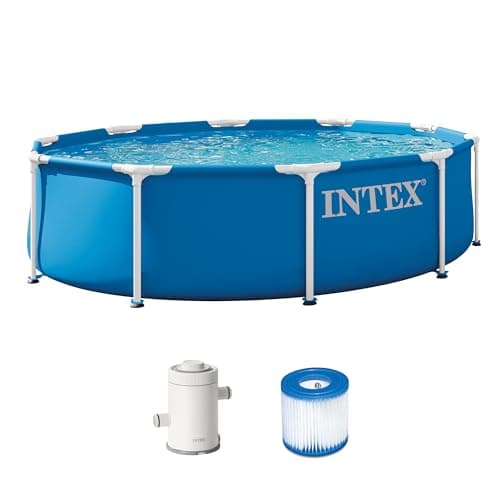 Intex Metal Frame Pool, 10ft x 30in Below this size you are buying a paddling pool with a pump attached. At 10 feet you still get a real frame and real filtration, in a footprint that fits almost any yard. | The smallest pool worth filteringOne honest season | 7.8out of 10 |
The better answer for most households
A separate, small, hard-plastic dog pool. It costs a fraction of a liner replacement and keeps hair out of your filtration entirely.
| # | Product | Best for | Score | Price |
|---|---|---|---|---|
| 1 | 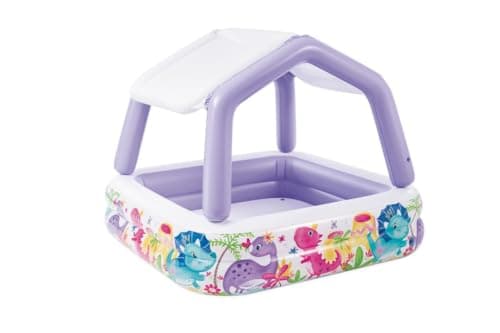 Intex Sun Shade Inflatable Kiddie Pool A small inflatable pool with an integrated canopy. For toddlers the shade matters more than the water does, and most kiddie pools do not have any. | Under-fives, with shade built inA few weekends | 7.6out of 10 |
Buy this whichever route you take
A liner patch kit that cures underwater turns a claw puncture into a fifteen-minute job instead of a new liner.
| # | Product | Best for | Score | Price |
|---|---|---|---|---|
| 1 | No image Vinyl Liner Patch Kit Vinyl patches and an adhesive rated to cure underwater. The difference between a fifteen-minute job and a new liner, which is the largest single bill in above-ground pool ownership. | A pinhole leak without draining the poolSeveral seasons | 8.8out of 10 |
The short version
- Claws and vinyl are the whole problem. Not the water, not the dog — the wall of the pool.
- Inflatable is out. A soft-side pool has a single chamber and a dog has sixteen to twenty claws.
- Hair is a filtration cost, not a chemistry one. It ends up in the cartridge, and cartridges are a consumable.
- A separate dog pool is usually the right answer, and it is cheaper than one liner replacement.
The construction question, first
Our pool types guide divides this category three ways, and the division maps almost exactly onto how each type handles a dog.
| Type | Wall | With a dog |
|---|---|---|
| Soft-side inflatable | Single vinyl chamber, inflated ring on top | No. One puncture in the ring and the pool is finished |
| Metal frame, vinyl liner | Vinyl wall supported by an external frame | Workable on the thicker three-ply liners; the floor is the risk |
| Steel wall, thick liner | Rigid steel with a heavier liner inside | The best of the three — the wall is not the liner |
| Hard-plastic dog pool | Molded plastic, no liner at all | Nothing to puncture. This is what the category exists for |
The distinction that matters is whether the wall and the liner are the same thing. On a soft-side pool they are, and a claw through it is a structural failure. On a steel-wall pool the liner is a lining inside a rigid wall, so a puncture is a leak rather than a collapse — and a patchable one, which is why our liner guide is worth reading before rather than after.
Getting out, which is the safety issue
A dog in a 42-inch above-ground pool cannot get out the way it got in. Ladders are designed for human feet, and a dog that panics will claw at the nearest surface until it finds purchase — which is the liner.
So the requirements are an exit the dog can use unaided and, more importantly, the same rule that applies to children: the dog does not go in unsupervised, and the ladder comes out when nobody is there. Our dogs in the pool guide covers introducing a dog to water safely, and it is the page to read before this one if the dog has not swum before.
What a dog does to the water
Less than people expect chemically, and more than people expect mechanically.
Bather load. A dog contributes organic load like any swimmer — more per visit than a child, because of coat and dander. That is chlorine demand, and it is the mechanism our swimmer load guide describes. Test after, not before.
Hair. This is the real cost. Hair goes to the skimmer basket and then to the cartridge, and a loaded cartridge is a pool that stops turning over properly. On a dog household, budget for more frequent cartridge changes than the eight or nine a season our cartridge roundup works out, and rinse the basket after every swim rather than weekly.
Nothing about the chemistry changes. The CDC’s ranges are the same ranges. There is no special dog chemistry, and products sold on that basis are solving a problem that does not exist.
If the dog is going in the main pool anyway
Four things, in order of how much they help.
Keep the claws short. The single highest-value intervention, and it is free.
Have the patch kit before you need it. A vinyl kit that cures underwater means a pinhole is a fifteen-minute job rather than a drained pool.
Rinse the dog first. Loose coat, dirt and whatever is on the paws all go in otherwise, and all of it becomes chlorine demand and cartridge loading.
Skim after every session. Floating hair is easy; sunk hair is a vacuum job.
What we are scoring
We have not tested these and do not claim to. The scores reflect published construction — wall type, liner ply, frame and rated capacity — read against claws specifically, which is not a use case any manufacturer designs for. Our methodology page explains how our scoring works.
The picks, in full
Scores are our own reading of published specifications. They are not test results — we have not tested these products and we do not claim to.
Pick #1 · The honest middle of the market
Bestway Steel Pro MAX Pool Set, 15ft x 42in
Bestway
Fewer gallons and a shallower wall than the Intex flagship, which makes it easier to level, cheaper to fill and cheaper to keep clean. For most first-pool families this is the right size, not the compromise size.
#ad how this is funded · price as of October 8, 2026
Key specs
- Water capacity
- 3,955 gallons (90% full)
- Pump supplied
- 1,000 gal filter pump, Type III cartridge
- Liner
- Tritech 3-layer
- Included
- Ladder and cover
- Wall height
- 42 inches
- Pump wattage
- Not published by Bestway (US listing)
How it scoresour reading of published specs, not a test result
- Build
- 7.5
- Setup
- 8.0
- Upkeep
- 8.0
- Running cost
- 7.5
- Value
- 8.8
Overall 8.2 / 10
What works
- 3,955 gallons is roughly 43% less water than the 18ft Intex — that is 43% less chemical spend, every season, forever
- 42-inch wall is far more forgiving of a yard that is nearly-but-not-quite level
- Ladder and cover included
- Cartridge filtration means no sand to buy or change
What doesn't
- Cartridges are a recurring consumable, and in a busy pool you will rinse one weekly
- 42 inches is shallow for adults who want to actually swim rather than sit
- Wattage is not published, so the running-cost math needs the label on the box
Skip it if: Adults who want to swim lengths. At 42 inches you are sitting in it, not swimming in it.
What it costs to run: The gallons are the story. Chemical dosing scales with volume, so 3,955 gallons costs meaningfully less to sanitize all season than 6,981 does. Filling it once at the EPA WaterSense national average of $6.06 per 1,000 gallons is about $24 of water; the same fill on the 18ft Intex is about $42.
Several seasons: Buy-once. Built and warranted to come back out of the box for a few years, if you store it properly.
Specs from: Bestway USA — Steel Pro MAX 15' x 42' pool set, EPA WaterSense — how the calculator works ($6.06 per 1,000 gallons)
Pick #2 · The smallest pool worth filtering
Intex Metal Frame Pool, 10ft x 30in
Intex
Below this size you are buying a paddling pool with a pump attached. At 10 feet you still get a real frame and real filtration, in a footprint that fits almost any yard.
#ad how this is funded · price as of October 8, 2026
Key specs
- Nominal size
- 10ft diameter x 30in wall
- Water capacity
- Not published on the current Intex spec page
- Frame
- Powder-coated steel
- Pump supplied
- Varies by SKU — check the box, not the listing photo
- Pump wattage
- Not published by Intex
How it scoresour reading of published specs, not a test result
- Build
- 6.5
- Setup
- 9.0
- Upkeep
- 9.0
- Running cost
- 9.5
- Value
- 8.0
Overall 7.8 / 10
What works
- Fits a genuinely small yard with walking space left over
- Small enough to drain, dry and store indoors in one afternoon at season's end
- Lowest chemical bill of anything with a real frame
What doesn't
- Intex does not publish a capacity figure for every variant of this size, which makes dosing guesswork until you measure it yourself
- Some SKUs ship without a pump and the listings do not always make that obvious
- Two adults is a crowd
Skip it if: Anything involving more than about three people at once, or an adult who wants to lie on a lounger in it.
What it costs to run: Cheapest thing here to own. If your SKU does not state gallons, measure it: a round pool is roughly diameter squared x average depth x 5.9 gallons, so a 10ft pool filled to 24 inches is about 1,180 gallons. Do that once and every chemical dose for the rest of the pool's life is correct.
One honest season: The cheapest setup that genuinely works for a season of real swimming. Nothing spare, nothing missing.
Specs from: Intex — above-ground pools
Pick #3 · Under-fives, with shade built in
Intex Sun Shade Inflatable Kiddie Pool
Intex
A small inflatable pool with an integrated canopy. For toddlers the shade matters more than the water does, and most kiddie pools do not have any.
#ad how this is funded · price as of October 8, 2026
Key specs
- Type
- Inflatable kiddie pool with canopy
- Capacity
- Published per SKU by Intex
- Filtration
- None — drain and refill
- Age guidance
- Check the SKU; these are toddler-rated products
How it scoresour reading of published specs, not a test result
- Build
- 5.0
- Setup
- 9.8
- Upkeep
- 8.0
- Running cost
- 8.0
- Value
- 8.0
Overall 7.6 / 10
What works
- Built-in shade is genuinely the right feature for the age group this is for
- No filtration means no chemistry to learn — you empty it and refill it
- Small enough to tip out and dry every evening, which is the correct way to run one
What doesn't
- No filtration means the water is only clean because you keep replacing it
- Canopies are the first thing to tear
- Refilling every day or two is a real water cost people do not budget for
Skip it if: Anything beyond toddlers. There is no filtration, so this is a bath you empty, not a pool you maintain.
What it costs to run: The cost here is water, not electricity. Emptying and refilling 60 gallons every other day for a 90-day summer is roughly 2,700 gallons, or about $16 at the EPA WaterSense average of $6.06 per 1,000 gallons — more than most people assume for something this small.
A few weekends: Fine for a heatwave and a toddler. Treat it as consumable, not as a pool — it will not survive a winter in the yard.
Specs from: EPA WaterSense — cost per 1,000 gallons
Pick #4 · A pinhole leak without draining the pool
Vinyl Liner Patch Kit
Various
Vinyl patches and an adhesive rated to cure underwater. The difference between a fifteen-minute job and a new liner, which is the largest single bill in above-ground pool ownership.
Key specs
- Application
- Wet or dry — the adhesive cures under water
- Adhesive
- Commonly 4 oz of vinyl cement per kit
- Patches
- Pre-cut vinyl; some kits include 20 or more
- Also fits
- Inflatable pools, floats, loungers, covers
- Format
- Glue-down, or peel-and-stick on some kits
- Shelf life
- The adhesive, not the patches, is what expires
How it scoresour reading of published specs, not a test result
- Sizing fit
- 9.0
- Running cost
- 10.0
- Maintenance
- 9.0
- Build
- 7.5
- Value
- 9.5
Overall 8.8 / 10
What works
- No draining, which on a 3,955-gallon pool is both the water bill and the whole weekend
- One kit covers the liner, the floats and the solar cover
- Round the patch corners and it holds for seasons, not weeks
- Cheap enough that having one before you need one is the obvious move
What doesn't
- Only fixes punctures and pinholes — a split seam or a tear at a fitting is a liner job
- Underwater application is fiddly and you get one attempt per patch
- The adhesive goes off in the tube, so a kit bought three seasons ago may be dead
- Peel-and-stick patches are easier and do not last as long as glued ones
Skip it if: Structural damage. If the liner has failed at a seam or pulled out of its track, patching it is deferring the replacement rather than avoiding it.
What it costs to run: Set against a liner replacement, which our liner replacement cost guide prices as the single largest bill an above-ground pool produces. A kit is a rounding error against that.
Several seasons: Buy-once. Built and warranted to come back out of the box for a few years, if you store it properly.
Specs from: Vinyl liner patch kits — current Amazon category listing
Questions people actually ask
Can dogs swim in an above-ground pool?
Will a dog ruin a pool liner?
Does dog hair damage a pool filter?
Do I need different chemicals if my dog swims in the pool?
Sources
Read next
- Above-ground pools for ordinary backyardsSoft-side, metal-frame and steel-wall pools compared by what they cost across a whole season, not at the till.
- The types of backyard pool, and who each is forInflatable, metal frame, permanent steel wall and inground - what separates them and which one you are actually shopping for.
- The best above-ground pools for an ordinary backyardFrame pools ranked on published specs and season running cost, from a 1,700-gallon first pool to a 7,000-gallon family one.
- The dog can swim. Here is what it costs the water.What a swimming dog does to chlorine demand, filter loading and the liner, and the routine that keeps it manageable.
- Pool floats and ramps for dogsClaw-resistant decks, ramps for getting out, and the safety question that matters more than any product here.
- Liner replacement: the big occasional cost, and how to avoid itOverlap, beaded and unibead are not interchangeable - plus the three habits that decide whether you ever need a replacement.
- The liner is the most expensive thing you can wreck in an afternoonBeaded, overlap and unibead liners explained, what gauge in mil buys, and the patch kit that turns a leak into a fifteen-minute job.
- Bather load: the variable that explains your worst weeksWhy gallons per swimmer is the number that matters, what a busy afternoon costs you in chlorine, and the routine that absorbs it.
- Filter cartridges: the consumable that decides whether your water is clearGetting the right cartridge for your pump, how many a season takes, and why buying singly is where this line gets expensive.