Above-Ground Pools
Pool shape is a yard decision, not a taste decision
A round pool gives you the most water per square foot of ground and the cheapest replacement parts. Every other shape is a trade you should make deliberately.
Heads up: we earn a commission if you buy through the links on this page, at no extra cost to you. It never decides the ranking — here is how we pick and here is the full disclosure. Prices are checked automatically; last verified October 8, 2026.
The short version
- A circle is the most efficient shape there is. It gives more water per square foot of yard than any rectangle that fits in the same space.
- But a rectangle fits a rectangular yard. Most gardens are rectangular, and a round pool wastes the corners.
- Round is where the cheap parts are. Liners, covers and ladders for round pools are common and interchangeable; for other shapes they frequently are not.
- Oval frames are the hardest to level, because the straight sections carry load differently from the curved ends.
The geometry, briefly, because it decides the rest
Take a square patch of garden fifteen feet on a side. A round pool that fits inside it is fifteen feet across and covers about 177 square feet. A square pool filling the same patch covers 225. So a rectangle does hold more water in the same footprint — the circle wastes the corners.
What flips the answer is that gardens are not squares with nothing else in them. The usable patch is bounded by a fence on one side, a path on another, a tree root somewhere. Once you subtract the three feet of walking space manufacturers assume on every side, the largest circle that fits a real garden is very often larger than the largest rectangle you can also get around.
Water per square foot of ground you have to give up
- 15ft round pool, water area
- 176.7 sq ft
- Ground needed with 3ft access all round
- 21 × 21 = 441 sq ft
176.7 ÷ 441 = 0.40
A round pool turns about 40% of the ground it occupies into water
| Shape | Best at | Costs you |
|---|---|---|
| Round | Water per square foot, cheap parts, easiest to level | Wasted corners in a rectangular garden |
| Oval | Fitting a long narrow garden; a swimming lane | Hardest to level; parts are shape-specific |
| Rectangular | Matching a rectangular yard or patio | Mostly small soft-side models in this class |
| Square / soft-side | Toddler pools and tight patios | Little depth; not really a swimming pool |
Round: the default, and usually the right one
Almost everything in the frame-pool market is round, and that is not an accident. The shape distributes hoop stress evenly around the wall, which is why a round pool can be a light bolted frame rather than a braced structure. It also means it is the shape the aftermarket serves: liners, solar covers, winter covers and ladders for round pools are stocked in standard diameters, and prices reflect that.
That parts point matters more than it sounds. A replacement liner is the one genuinely expensive item you may buy in the life of a pool, and it is far easier to buy for a round pool than for anything else — our liner replacement guide covers why the types are not interchangeable, and shape adds another layer of that.
Oval: for the yard that is long and narrow
An oval exists to solve one problem, which is a garden with length and no width. It gives you a straight section to move along, which is closer to swimming than circling, and it slots down the side of a house where a round pool of the same volume never would.
Two honest warnings. First, the leveling tolerance is tighter and less forgiving, because the straight sections need external bracing and the load is not evenly distributed the way it is around a circle. Get the pad right or do not buy the shape — our leveling guide applies doubly here. Second, covers and liners are sized to the specific oval, so check availability before you commit rather than after.
Rectangular: mostly a soft-side proposition here
In the above-ground category rectangular usually means a multi-ring inflatable rather than a framed pool — something like the family swim centers, which have a rectangular footprint, no filtration supplied on most SKUs, and a plug drain. They are genuinely useful for a patio, a toddler and an afternoon, and they are not a pool in the sense the rest of this hub means.
If you want a framed rectangular pool of any real depth, you are usually into the permanent, installed end of the market, which is where our above-ground versus inground comparison becomes the more useful page.
The shape questions that actually decide it
Where is the flattest rectangle in your garden, and what shape is it? Measure before shopping. A long thin flat strip points at an oval; a square-ish flat patch points at a round pool.
Can you get all the way around it? Three feet on every side, including the side against the fence. If a shape only fits by pushing one wall against a boundary, you cannot maintain that side and you cannot see it.
Are replacement covers and liners available in that size today? Check before ordering.
What is under it? Shape changes nothing about the requirement for a ground cloth and a genuinely level pad. Our surface guide covers the load each size applies per square foot, which is the number any deck or patio has to carry.
If the shape decision has landed on oval, our oval pool roundup covers the sets themselves — and the accessory problem that catches people in year two, when the winter cover turns out to be harder to find than the pool was.
What to buy
Scores are our own reading of published specifications. They are not test results — we have not tested these products and we do not claim to.
Small yards and first-time owners
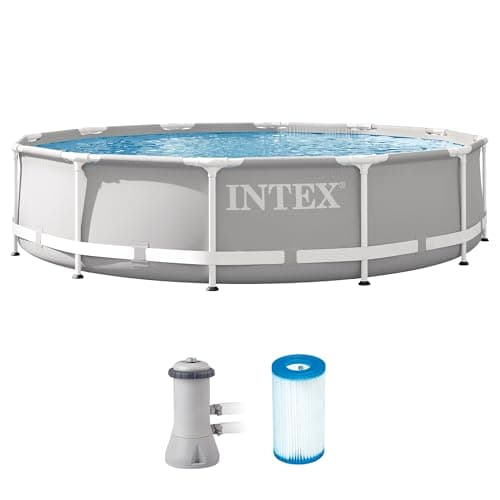
Intex Prism Frame Pool Set, 12ft x 30in
Intex
The size most people should buy first and the one most people talk themselves out of. 1,718 gallons is cheap to fill, cheap to treat, and forgiving of every mistake you are about to make.
Key specs
- Water capacity
- 1,718 gallons
- Pump supplied
- Krystal Clear C530 — 530 GPH pump / 475 GPH system
- Frame
- Powder-coated metal, tool-free Easy Lock
- Liner
- 3-ply, puncture resistant
- Manufacturer setup claim
- Ready in 30 minutes
- Pump wattage
- Not published by Intex
How it scoresour reading of published specs, not a test result
- Build
- 7.0
- Setup
- 9.0
- Upkeep
- 9.0
- Running cost
- 9.0
- Value
- 9.0
Overall 8.6 / 10
What works
- A 12-foot circle fits in a yard where a 15 or 18 will not, once you allow three feet of walking space
- 1,718 gallons turns over in about 3.6 hours on the supplied 475 GPH system flow — so a short daily run genuinely filters it
- Cheapest of the frame pools to make a mistake in: a bad chemical week costs a few dollars, not a few tens
- Tool-free assembly is real, not marketing — this is a genuinely one-afternoon job
What doesn't
- 30-inch wall means shallow water and it warms and cools fast
- Small enough that three adults fill it
- The C530 is sized for exactly this pool and nothing bigger, so it does not carry over if you upgrade
Skip it if: Anyone planning to swim rather than sit. This is a cooling-off and playing pool and it is very good at that.
What it costs to run: The cheapest frame pool here to run, and the gap is not small. At the EPA WaterSense average of $6.06 per 1,000 gallons a fill is about $10. Its turnover math — 1,718 gallons at 475 GPH system flow — means roughly 3.6 hours per full turnover, so a 7-8 hour daily run is two full turnovers rather than a partial one.
One honest season: The cheapest setup that genuinely works for a season of real swimming. Nothing spare, nothing missing.
Specs from: Intex — Prism Frame 12' x 30' pool set, Intex — Krystal Clear cartridge filter pumps
The honest middle of the market
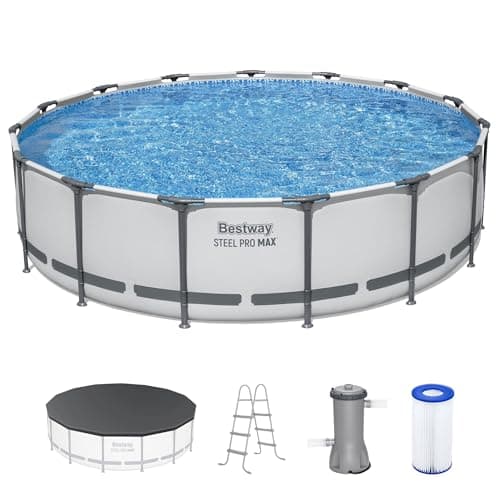
Bestway Steel Pro MAX Pool Set, 15ft x 42in
Bestway
Fewer gallons and a shallower wall than the Intex flagship, which makes it easier to level, cheaper to fill and cheaper to keep clean. For most first-pool families this is the right size, not the compromise size.
#ad how this is funded · price as of October 8, 2026
Key specs
- Water capacity
- 3,955 gallons (90% full)
- Pump supplied
- 1,000 gal filter pump, Type III cartridge
- Liner
- Tritech 3-layer
- Included
- Ladder and cover
- Wall height
- 42 inches
- Pump wattage
- Not published by Bestway (US listing)
How it scoresour reading of published specs, not a test result
- Build
- 7.5
- Setup
- 8.0
- Upkeep
- 8.0
- Running cost
- 7.5
- Value
- 8.8
Overall 8.2 / 10
What works
- 3,955 gallons is roughly 43% less water than the 18ft Intex — that is 43% less chemical spend, every season, forever
- 42-inch wall is far more forgiving of a yard that is nearly-but-not-quite level
- Ladder and cover included
- Cartridge filtration means no sand to buy or change
What doesn't
- Cartridges are a recurring consumable, and in a busy pool you will rinse one weekly
- 42 inches is shallow for adults who want to actually swim rather than sit
- Wattage is not published, so the running-cost math needs the label on the box
Skip it if: Adults who want to swim lengths. At 42 inches you are sitting in it, not swimming in it.
What it costs to run: The gallons are the story. Chemical dosing scales with volume, so 3,955 gallons costs meaningfully less to sanitize all season than 6,981 does. Filling it once at the EPA WaterSense national average of $6.06 per 1,000 gallons is about $24 of water; the same fill on the 18ft Intex is about $42.
Several seasons: Buy-once. Built and warranted to come back out of the box for a few years, if you store it properly.
Specs from: Bestway USA — Steel Pro MAX 15' x 42' pool set, EPA WaterSense — how the calculator works ($6.06 per 1,000 gallons)
A rectangular footprint on a small patch of grass
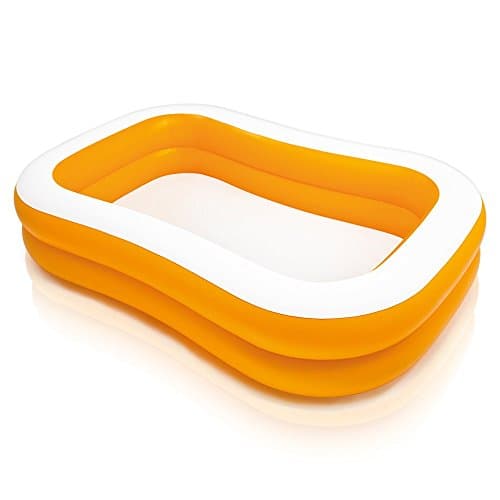
Intex Swim Center Family Inflatable Pool
Intex
A three-ring inflatable rectangle. It fits where a circle does not, it costs very little, and it is unapologetically a one-or-two-summer product.
#ad how this is funded · price as of October 8, 2026
Key specs
- Type
- Multi-ring inflatable, rectangular
- Capacity
- Published per SKU by Intex
- Filtration
- None supplied
- Drain
- Plug drain fitted on most SKUs
How it scoresour reading of published specs, not a test result
- Build
- 4.5
- Setup
- 9.5
- Upkeep
- 7.0
- Running cost
- 7.5
- Value
- 7.5
Overall 7.0 / 10
What works
- Rectangular shape uses a narrow yard far more efficiently than a circle
- Very cheap, and honest about what it is
- Light enough that one adult can empty and move it
What doesn't
- No filter, so the water needs changing rather than treating
- Multiple inflation chambers means multiple things that can fail
- Sidewalls are low enough that kids climb over rather than through
Skip it if: Being kept for more than a few weeks at a time. Without filtration, standing water goes off quickly in heat.
What it costs to run: Same shape of cost as the kiddie pool: water rather than power. If you find yourself refilling it more than twice a week, a small frame pool with a cartridge pump is cheaper by August.
A few weekends: Fine for a heatwave and a toddler. Treat it as consumable, not as a pool — it will not survive a winter in the yard.
Protecting the liner from below
Pool Ground Cloth / Under-Pool Pad
Various
Most liner punctures come from underneath, from a stone or a root you did not see. A ground cloth is the cheapest way to avoid the most expensive repair in above-ground pool ownership.
Key specs
- Function
- Barrier between ground and liner
- Sizing
- Should extend past the pool footprint
- Included with
- Some kits — check before buying separately
How it scoresour reading of published specs, not a test result
- Retention
- 8.0
- Durability
- 7.5
- Handling
- 8.5
- Running cost
- 10.0
- Value
- 9.0
Overall 8.5 / 10
What works
- Prevents the failure mode that ends pools: a puncture in the floor you cannot reach to patch
- Also slows grass and weeds growing up under the pool
- Included free in better kits, so check before you buy one
What doesn't
- Not a substitute for actually clearing stones and roots first
- Thin ones tear during installation before the pool is even up
- Traps moisture, which kills the grass underneath regardless
Skip it if: Fixing uneven ground. It protects against punctures; it does nothing about level, and level is the bigger problem.
What it costs to run: Compare its cost to a liner replacement, which is the single largest unplanned expense in above-ground pool ownership. It is not a close call.
Several seasons: Buy-once. Built and warranted to come back out of the box for a few years, if you store it properly.
Questions people actually ask
Is a round or oval above-ground pool better?
Do rectangular above-ground pools exist?
Which pool shape is easiest to maintain?
Does pool shape affect how level the ground has to be?
Sources
Read next
- Above-ground pools for ordinary backyardsSoft-side, metal-frame and steel-wall pools compared by what they cost across a whole season, not at the till.
- What size pool your backyard can actually takeThe three-foot rule, the level-ground tolerance, and a table matching yard size to pool size with the running cost attached.
- Pools for a small yardRound versus rectangular in a narrow yard, the smallest sizes worth filtering, and why smaller is cheaper twice over.
- The types of backyard pool, and who each is forInflatable, metal frame, permanent steel wall and inground - what separates them and which one you are actually shopping for.
- Leveling the ground, and the weight that makes it matterThe tolerance manufacturers publish, the weight of water that enforces it, and the method for getting a circle genuinely flat with hand tools.
- Liner replacement: the big occasional cost, and how to avoid itOverlap, beaded and unibead are not interchangeable - plus the three habits that decide whether you ever need a replacement.
- The best winter covers for an above-ground poolScrim weight, cable-and-winch versus straps, and the overlap you need - the three specs that decide whether a cover survives a winter.
- Rectangular pools, and the hoop strength they give upRectangular frame pools compared on published gallons, wall height and included filtration, with the extra leveling and support the shape genuinely requires.