Pool Equipment
Solar heating: three products, two of which mostly stop losses
A solar cover is not really a heater. It is a lid, and on an uncovered pool a lid is worth more than most heaters - which is why it is always the first purchase.
Heads up: we earn a commission if you buy through the links on this page, at no extra cost to you. It never decides the ranking — here is how we pick and here is the full disclosure. Prices are checked automatically; last verified October 8, 2026.
The short version
- A solar cover is a loss-prevention device that also lets sunlight through. Most of its value is the first half.
- Solar rings are a partial cover, and they deliver in proportion to how much of the surface they actually cover.
- Solar panels genuinely add heat, but they need surface area, plumbing and pump flow through them.
- The order is not negotiable: cover first, then a reel so it gets used, then consider anything else.
Why the loss side dominates
An above-ground pool is a shallow, uninsulated body of water with a very large surface area relative to its volume, sitting outdoors. It gains heat from the sun all day and loses it to the air all night, and the largest single loss mechanism is evaporation — turning water into vapor takes energy, and that energy comes out of the pool.
Which means the highest-leverage intervention is not adding heat, it is stopping the loss. A pool that keeps overnight what the sun gave it for free during the day does not need much help. Our heating cost guide works the same point from the money side.
| Product | Prevents loss? | Adds heat? | Needs |
|---|---|---|---|
| Bubble solar cover | Yes, substantially | Some — transmits sunlight | Cutting to size; a reel |
| Solar rings or discs | Partly, by coverage | Some | Nothing; they just float |
| Liquid solar cover | Marginally | No | Repeat dosing |
| Solar panels or mats | No | Yes, genuinely | Roof or ground area, plumbing, pump flow |
| Electric heater | No | Yes, on demand | Often a dedicated circuit |
The bubble cover, which is the recommendation
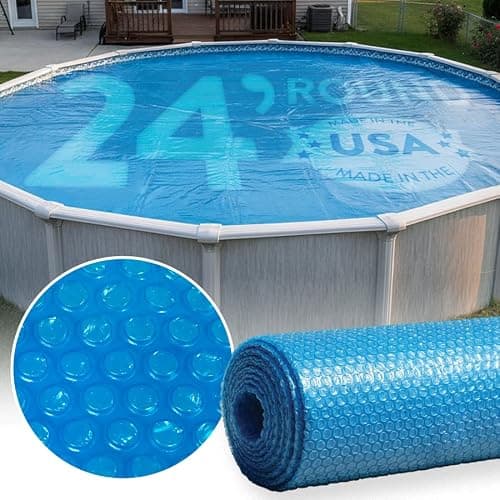
It floats directly on the surface, so it physically stops evaporation while it is on, and the bubble structure lets sunlight through to the water beneath. It is inexpensive, it needs no plumbing, and it is the single highest-return item across this entire site.
Three requirements decide whether yours works. Bubbles face down, toward the water — the most common installation mistake, and it costs you most of the benefit. Buy oversize and trim, because these are sold to be cut to size and a gap around the edge is a gap in the lid. And thickness is about durability, not heating: higher mil lasts longer, with 12 and 16 mil the common options. Our solar cover roundup covers the choice.
Solar rings and discs
Individual floating discs are the answer to the handling problem: they lift off one at a time rather than as a single wet sheet, they store easily, and there is no reel to buy.
The trade is coverage. A cover is a continuous lid; rings leave gaps between and around them, and evaporation continues from every square foot they do not cover. So the benefit is proportional and always less than a fitted cover — on a small round pool where a cover fits neatly, the cover wins clearly. Rings make more sense on awkward shapes, or where the honest alternative is no cover at all because the fitted one is too much hassle.
Liquid solar covers
These form a very thin layer on the surface intended to slow evaporation. They are dosed repeatedly rather than bought once, they are disrupted by wind and swimming, and the effect is modest compared with a physical barrier.
They are worth knowing about for a pool where a physical cover genuinely cannot be used — an unusual shape, or a situation where the cover cannot be stored. As a substitute for a cover on an ordinary round above-ground pool, they are not the better buy.
Solar panels: the one that actually heats
Panels or mats are the only solar product here that adds meaningful energy. Pool water is pumped through black collectors in the sun, warms, and returns. On the right installation they work well and their running cost is close to nothing beyond the pump you were already running.
The requirements are the reason they are less common on above-ground pools. They need genuine collector area in full sun. They need plumbing into the return line. And they need flow — which means the pump runs longer, and it must have enough head to push through the panels. Sizing a small cartridge pump into a panel array is not a given, and our pump sizing guide explains why system flow rate, not headline flow, is the figure that matters.
They are also a daytime-only heat source, which pairs naturally with a cover: panels add during the day, the cover keeps it overnight. Without the cover a great deal of what the panels gained is gone by morning.
The order to buy in
First, the cover and a reel. Cheapest, highest return, and it makes everything after it cheaper to run by reducing the loss the rest have to fight.
Second, the free adjustments. Uncover in the morning so the pool gets the full day of sun, cover before the evening drop rather than at bedtime, run the pump during daylight, and use any existing fence or hedge as a windbreak because wind accelerates evaporation. All covered in our season extension guide.
Third, and only then, added heat. Panels if you have the area, sun and flow; an electric heater if you do not, with a clear understanding of the running cost — a 3 kW unit run 8 hours a day for a month is about $132 at the national average rate. Our heater sizing guide does the arithmetic and the heater roundup covers what to look for.
What we will not publish
A degrees-gained figure for any of these. Solar performance depends on your latitude, your shading, your pool’s surface area, air temperature, humidity and wind, and any single national number would be invented. What we can say with confidence is the ranking: prevent loss before adding heat, because on an uncovered pool the loss term is the larger one.
What to buy
Scores are our own reading of published specifications. They are not test results — we have not tested these products and we do not claim to.
The single highest-return accessory here
Bubble Solar Cover for Above-Ground Pools
Various
It cuts evaporation, and evaporation is simultaneously your water bill, your chemical bill and your heat loss. Nothing else on this site reduces three costs at once.
#ad how this is funded · price as of October 8, 2026
Key specs
- Construction
- Bubble sheet, thickness published in mil
- Thickness
- Higher mil lasts longer — 12 mil and 16 mil are common
- Fit
- Cut to size; buy oversize and trim
- Orientation
- Bubbles face down, toward the water
How it scoresour reading of published specs, not a test result
- Retention
- 9.0
- Durability
- 7.0
- Handling
- 6.0
- Running cost
- 9.8
- Value
- 9.5
Overall 9.0 / 10
What works
- Reduces evaporation, which is the mechanism behind the water, chemical and heat savings all at once
- Cheap relative to everything it saves
- Can be cut to fit any pool shape, so sizing is forgiving
What doesn't
- Awkward to get on and off without a reel, and awkward is how covers end up unused
- Degrades in UV like every vinyl product
- Not a safety cover and will not support weight — this is important
Skip it if: Being a safety barrier. A solar cover looks solid and is not; a child or pet on it goes through and under.
What it costs to run: The one accessory with a clear payback. Every gallon that does not evaporate is a gallon you do not replace at the EPA WaterSense national average of $6.06 per 1,000 gallons, and it is chlorine you do not re-dose. If you buy one thing from this hub, buy this.
Several seasons: Buy-once. Built and warranted to come back out of the box for a few years, if you store it properly.
Specs from: EPA WaterSense — cost per 1,000 gallons
Making sure the cover actually gets used
Solar Cover Reel for Above-Ground Pools
Various
A cover that takes two people and ten minutes to move gets left off. A reel makes it a one-person, one-minute job, which is the difference between owning a cover and using one.
Key specs
- Function
- Rolls the solar cover on and off
- Fit
- Must match pool diameter and wall type
- Mounting
- Freestanding or wall-mounted depending on model
How it scoresour reading of published specs, not a test result
- Retention
- 7.0
- Durability
- 7.5
- Handling
- 9.5
- Running cost
- 8.5
- Value
- 7.0
Overall 7.7 / 10
What works
- Turns cover use from a chore into a habit, which is where all the savings actually are
- Keeps the cover off the ground, which is what shortens its life
- One-person operation
What doesn't
- Frequently costs more than the cover it handles
- Takes up permanent space beside the pool
- Sizing must match the pool exactly, and returns are awkward
Skip it if: A small pool. Under about 12 feet the cover is light enough to handle by hand and the reel is a solution to a problem you do not have.
What it costs to run: Only justified on larger pools. The value is not the reel, it is the cover getting used every night instead of most nights — quantify it by how often you would actually bother otherwise.
Several seasons: Buy-once. Built and warranted to come back out of the box for a few years, if you store it properly.
Extending the season, at a price
Electric Above-Ground Pool Heater
Various
It works, and it will be the largest line on your pool electricity bill by a distance. Buy it knowing the running cost, not the purchase price.
Key specs
- Power draw
- Published in kW — this is the number that matters, not the price
- Circuit requirement
- Frequently needs a dedicated circuit — check before buying
- Rated pool size
- Published per model
How it scoresour reading of published specs, not a test result
- Sizing fit
- 7.0
- Running cost
- 2.5
- Maintenance
- 7.0
- Build
- 7.0
- Value
- 5.0
Overall 6.0 / 10
What works
- Genuinely extends a swim season by weeks at each end
- Electric units are simpler to install than gas and need no fuel supply
- Manufacturers do publish kW draw, unlike pump makers
What doesn't
- The running cost dwarfs every other item on this site
- Often needs electrical work, which is a cost nobody quotes you up front
- Almost pointless without a solar cover to hold the heat you paid for
Skip it if: An uncovered pool. Heating water and then letting it evaporate overnight is the most expensive thing you can do with a pool.
What it costs to run: Do this arithmetic first. A 3 kW heater running 6 hours a day for 30 days is 540 kWh; at the EIA's June 2026 US residential average of 18.34 cents per kWh that is about $99 for one month. Compare that to the cost of a solar cover, which is a one-time purchase, before you decide.
More than you need yet: Real capability a first-pool family cannot use yet. Buy cheaper and put the difference toward chemicals and a cover.
Specs from: EIA Electric Power Monthly, Table 5.6.A
Cutting the electricity bill without cutting filtration
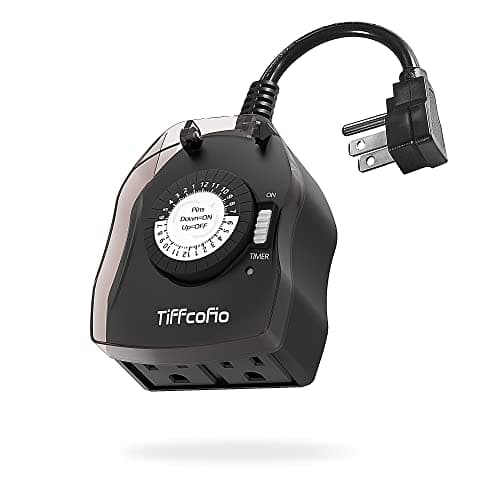
Outdoor Pool Pump Timer
Various
A weatherproof outdoor timer is the highest-return equipment purchase on this site. Most people run the pump too long because remembering to switch it off is a chore.
#ad how this is funded · price as of October 8, 2026
Key specs
- Type
- Outdoor-rated mechanical or digital timer
- Required rating
- Must be rated for the pump's amperage and for outdoor use
- Must not defeat
- The pump's GFCI protection
How it scoresour reading of published specs, not a test result
- Sizing fit
- 8.5
- Running cost
- 9.8
- Maintenance
- 9.0
- Build
- 7.5
- Value
- 9.5
Overall 9.0 / 10
What works
- Turns your filtration from a guess into a schedule
- Pays for itself within a single season on most pools
- Lets you shift running hours to off-peak if your utility has time-of-use rates
What doesn't
- Must be genuinely outdoor-rated and correctly amperage-matched, which cheap indoor timers are not
- Never bypass or defeat the pump's GFCI to fit one
- Mechanical timers drift and need resetting after a power cut
Skip it if: Fixing an undersized pump. Running the wrong pump on a schedule just makes the schedule longer.
What it costs to run: The arithmetic that justifies it: at the EIA's June 2026 US residential average of 18.34 cents per kWh, trimming a 400 W pump from 12 hours to 8 hours a day across a 120-day season saves 192 kWh, or about $35. That is more than the timer costs.
Several seasons: Buy-once. Built and warranted to come back out of the box for a few years, if you store it properly.
Specs from: EIA Electric Power Monthly, Table 5.6.A
Questions people actually ask
Does a solar cover actually heat a pool?
Are solar rings as good as a solar cover?
Do solar panels work on an above-ground pool?
Which way up does a solar cover go?
Sources
Read next
- Equipment, sized to your pool and costed by the wattPumps, filters, vacuums, heaters and ladders - matched to your gallons and priced by what they draw.
- Pool heaters, priced by the wattHeater running costs computed at national average rates, and why a cover has to come first for a heater to make any sense.
- Sizing a heater: one calculation, and a warning about the answerThe BTU sum that sizes a heater to your pool, why undersized units cost more overall, and why a cover changes the answer more than capacity does.
- The best solar covers, and why this is the one thing to buyBubble covers compared on thickness and sizing, plus the arithmetic that makes this the highest-return purchase in the hub.
- Adding weeks to the season, starting with the cheapest thing firstCover, placement and timing before hardware, plus the kilowatt arithmetic that shows what running an electric heater actually costs.
- Heating a pool, priced properlyThe physics of heating a pool turned into dollars, why a cover changes the answer more than the heater does, and when heating is worth it.
- Seven ways to cut a pool's running cost, ranked by what they actually saveEvery saving measure priced with the same arithmetic and ranked, so you spend effort where the money actually is.
- Solar pool heating: collector area is the whole storySolar panels, mats and rings compared on published collector area, pump compatibility and what each maker will actually claim in writing.