Pool Equipment
Electric or gas, and the third answer that usually wins
Both are real products that work. On a seasonal above-ground pool, both are also usually beaten by something that costs nothing to run.
Heads up: we earn a commission if you buy through the links on this page, at no extra cost to you. It never decides the ranking — here is how we pick and here is the full disclosure. Prices are checked automatically; last verified October 8, 2026.
The short version
- Gas heats in hours; electric heats in days. That is the real difference and everything else follows from it.
- Both are installation jobs, not purchases. Gas needs a gas connection and a flue; electric needs a dedicated circuit.
- An uncovered heated pool is a hole you pour money into — evaporation takes most of it back overnight.
- Cover first, heater second, and often cover only. That is the honest order for a seasonal above-ground pool.
What each one actually is
Gas. A burner and a copper heat exchanger. The common above-ground unit is around 150,000 BTU per hour with a polymer header, copper fin tube, electronic ignition and a digital control panel. It is rated by altitude band, and standard models are not compliant where Low NOx emissions rules apply — which is a real constraint in parts of the country and one to check before ordering rather than after.
Electric. Either resistance heating or a heat pump. Resistance is simple and expensive to run. A heat pump moves heat from the air rather than making it, which is far more efficient and comes with the catch that it works less well exactly when you need it most — cold nights and early spring.
| Gas | Electric | |
|---|---|---|
| Time to heat | Hours | Days |
| Works in cold air | Yes | Heat pumps lose output as air cools |
| Installation | Gas line and flue clearance | Dedicated GFCI-protected circuit |
| Fuel cost | Gas, consumed while running | Electricity, consumed while running |
| Suits | Occasional, on-demand heating | Holding a temperature over weeks |
| Regulatory catch | Low NOx rules in some areas | Electrical service capacity |
The pattern is that gas suits the person who wants the pool warm this weekend, and electric suits the person who wants it warm for a month. Our heater roundup covers the units and our heater sizing guide does the BTU arithmetic for your own gallons.
The number that reframes the whole question
Heat leaves an uncovered pool primarily through evaporation, and evaporation runs all night. A heater on an uncovered pool is replacing, every day, most of what it added the day before.
Our solar cover payback guide works out that an 18-foot pool evaporates on the order of 4,750 gallons across a season at a quarter-inch a day — and every one of those gallons left as vapor, taking heat with it. Putting a cover on is not a supplement to a heater. It is the precondition for one being worth running.
Why the cover comes first
- Cover cost
- A small one-off, no running cost
- Heater cost
- Unit, installation, then fuel every hour it runs
- US residential average electricity [EIA]
- 18.34 ¢/kWh
- Reference point [ENERGY STAR]
- ENERGY STAR puts a certified above-ground pump saving at ~$20/yr
Cover: one purchase, zero per hour Heater: one purchase + installation + fuel × every hour × every season
The cover is the only heating intervention with no marginal cost
The third answer
For most seasonal above-ground pools, the sequence that gives the best result per dollar is:
One, a solar cover. Free to run, works every night, and it is what makes May and September usable. Our season extension guide covers the mechanism.
Two, a thermometer. So you know whether any of this is working, rather than assuming. Two dollars against a heater’s installation quote — the argument our thermometer roundup makes.
Three, solar heating panels, if the cover is not enough and there is roof or ground space in sun. No fuel, no gas line, no dedicated circuit. Our solar heating guide is honest about the conditions it needs.
Four, a heater — and by then you will know exactly how many degrees you are short, which is the only way to size one properly anyway.
If you are buying one
Check the altitude band and the emissions rules for gas. Check your electrical service capacity and the heat pump’s rated output at the air temperature you actually care about for electric — the headline output is usually quoted at a warm ambient. And in both cases size from your own gallons with our sizing guide rather than from the pool diameter on the box.
What to buy
Scores are our own reading of published specifications. They are not test results — we have not tested these products and we do not claim to.
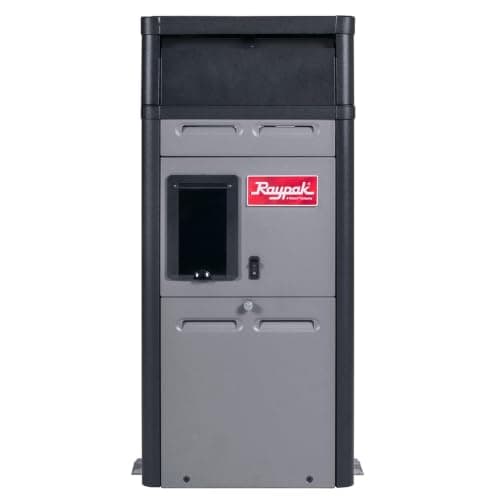
Heating fast, when the season is the point
Gas Pool Heater (Above-Ground)
Raypak
A 150,000 BTU gas heater raises a pool in hours rather than days. It is also the largest running cost available to an above-ground pool by a wide margin, and that trade is the whole decision.
Key specs
- Output
- 150,000 BTU/hr on the common above-ground model
- Fuel
- Natural gas or propane — separate part numbers
- Heat exchanger
- Copper fin tube with a polymer header
- Control
- Digital panel, electronic ignition, flame supervision
- Elevation
- Rated by altitude band — 0-1,999 ft or 0-4,999 ft
- Emissions
- Standard models are not Low NOx compliant
How it scoresour reading of published specs, not a test result
- Sizing fit
- 6.0
- Running cost
- 2.0
- Maintenance
- 6.5
- Build
- 8.5
- Value
- 4.5
Overall 6.0 / 10
What works
- Heats on demand rather than gradually, so a cold snap does not cost you the weekend
- Independent of sun and air temperature, unlike a solar cover or a heat pump
- Digital control with flame supervision on current models, not a pilot light
- Makes a genuine difference at the shoulders of the season, in May and September
What doesn't
- Fuel is the dominant cost and it is consumed every hour the heater runs
- Installation is a gas connection and a flue clearance, which is a trade job, not a delivery
- Low NOx regulations exclude the standard models in some states and districts
- Sized for a pool far larger than most above-ground pools actually are
Skip it if: Being economical. Nothing about a gas heater is cheap to run, and on a seasonal pool a solar cover does most of the same job for nothing.
What it costs to run: Heat output is the easy part; the cost is the fuel. Work the arithmetic from your own gallons and your own gas rate before buying — and put a solar cover on first, because an uncovered pool loses overnight most of what the heater put in.
More than you need yet: Real capability a first-pool family cannot use yet. Buy cheaper and put the difference toward chemicals and a cover.
Specs from: Raypak 156A 150K BTU above-ground pool heater — Amazon listing, Raypak — above-ground pool and spa heaters
Extending the season, at a price
Electric Above-Ground Pool Heater
Various
It works, and it will be the largest line on your pool electricity bill by a distance. Buy it knowing the running cost, not the purchase price.
Key specs
- Power draw
- Published in kW — this is the number that matters, not the price
- Circuit requirement
- Frequently needs a dedicated circuit — check before buying
- Rated pool size
- Published per model
How it scoresour reading of published specs, not a test result
- Sizing fit
- 7.0
- Running cost
- 2.5
- Maintenance
- 7.0
- Build
- 7.0
- Value
- 5.0
Overall 6.0 / 10
What works
- Genuinely extends a swim season by weeks at each end
- Electric units are simpler to install than gas and need no fuel supply
- Manufacturers do publish kW draw, unlike pump makers
What doesn't
- The running cost dwarfs every other item on this site
- Often needs electrical work, which is a cost nobody quotes you up front
- Almost pointless without a solar cover to hold the heat you paid for
Skip it if: An uncovered pool. Heating water and then letting it evaporate overnight is the most expensive thing you can do with a pool.
What it costs to run: Do this arithmetic first. A 3 kW heater running 6 hours a day for 30 days is 540 kWh; at the EIA's June 2026 US residential average of 18.34 cents per kWh that is about $99 for one month. Compare that to the cost of a solar cover, which is a one-time purchase, before you decide.
More than you need yet: Real capability a first-pool family cannot use yet. Buy cheaper and put the difference toward chemicals and a cover.
Specs from: EIA Electric Power Monthly, Table 5.6.A
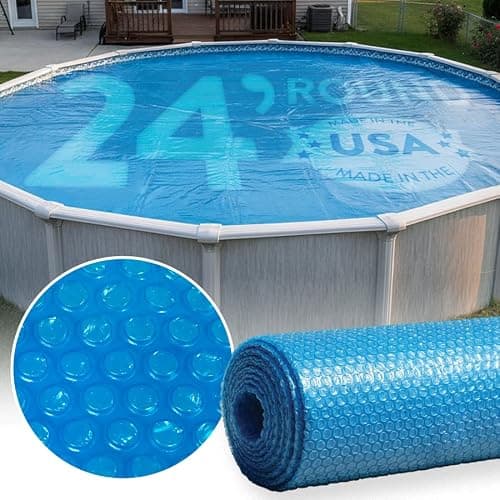
The single highest-return accessory here
Bubble Solar Cover for Above-Ground Pools
Various
It cuts evaporation, and evaporation is simultaneously your water bill, your chemical bill and your heat loss. Nothing else on this site reduces three costs at once.
#ad how this is funded · price as of October 8, 2026
Key specs
- Construction
- Bubble sheet, thickness published in mil
- Thickness
- Higher mil lasts longer — 12 mil and 16 mil are common
- Fit
- Cut to size; buy oversize and trim
- Orientation
- Bubbles face down, toward the water
How it scoresour reading of published specs, not a test result
- Retention
- 9.0
- Durability
- 7.0
- Handling
- 6.0
- Running cost
- 9.8
- Value
- 9.5
Overall 9.0 / 10
What works
- Reduces evaporation, which is the mechanism behind the water, chemical and heat savings all at once
- Cheap relative to everything it saves
- Can be cut to fit any pool shape, so sizing is forgiving
What doesn't
- Awkward to get on and off without a reel, and awkward is how covers end up unused
- Degrades in UV like every vinyl product
- Not a safety cover and will not support weight — this is important
Skip it if: Being a safety barrier. A solar cover looks solid and is not; a child or pet on it goes through and under.
What it costs to run: The one accessory with a clear payback. Every gallon that does not evaporate is a gallon you do not replace at the EPA WaterSense national average of $6.06 per 1,000 gallons, and it is chlorine you do not re-dose. If you buy one thing from this hub, buy this.
Several seasons: Buy-once. Built and warranted to come back out of the box for a few years, if you store it properly.
Specs from: EPA WaterSense — cost per 1,000 gallons
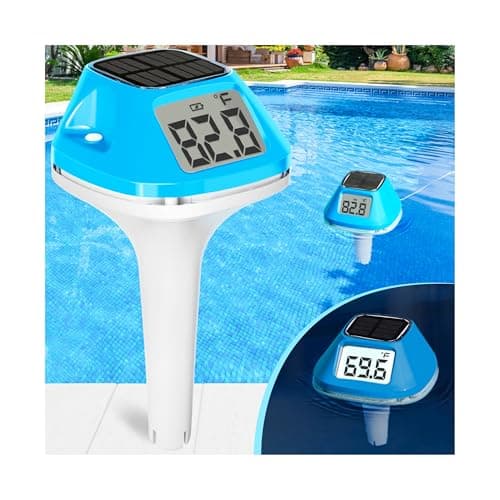
Knowing when to close, and when to stop heating
Floating Pool Thermometer
Various
The cheapest instrument on this site and the one that answers two expensive questions: is it warm enough to swim, and is it cold enough to close.
#ad how this is funded · price as of October 8, 2026
Key specs
- Types
- Floating analog, digital solar, or wireless with an indoor display
- Typical digital range
- About 15.8°F to 176°F on current models
- Typical stated accuracy
- About ±1.8°F on current digital models
- Water resistance
- IPX8 on current digital models
- Materials
- UV-stabilized and chlorine-resistant on better models
How it scoresour reading of published specs, not a test result
- Accuracy
- 7.5
- Ease
- 9.0
- Coverage
- 5.0
- Cost per use
- 9.8
- Value
- 9.2
Overall 8.4 / 10
What works
- Turns the closing decision from a guess into a reading, which is the most expensive judgment call of the pool year
- Tells you whether a solar cover is actually doing anything, rather than assuming
- Digital models are readable from the deck; analog ones need fishing out
- Cheap enough that having one is never the wrong call
What doesn't
- Analog floats get lost, get chewed, and end up under the ladder
- Solar and wireless models add batteries or a panel to a thing that could have had neither
- Tethering it is essential and almost nobody does it
- Accuracy claims are rarely independently verified — treat ±2°F as the working assumption
Skip it if: Telling you anything about water chemistry. It measures one thing, and every other decision needs a test kit.
What it costs to run: A few dollars, once. It pays for itself the first time it stops you closing a pool that was still warm, which is the mistake that produces a green opening in April.
Several seasons: Buy-once. Built and warranted to come back out of the box for a few years, if you store it properly.
Specs from: Digital floating pool thermometer — current Amazon listing and published specifications
Questions people actually ask
Is a gas or electric pool heater better?
How fast does a gas pool heater heat a pool?
Do I need a heater for an above-ground pool?
Can I install a pool heater myself?
Sources
Read next
- Equipment, sized to your pool and costed by the wattPumps, filters, vacuums, heaters and ladders - matched to your gallons and priced by what they draw.
- Pool heaters, priced by the wattHeater running costs computed at national average rates, and why a cover has to come first for a heater to make any sense.
- Sizing a heater: one calculation, and a warning about the answerThe BTU sum that sizes a heater to your pool, why undersized units cost more overall, and why a cover changes the answer more than capacity does.
- Solar heating: three products, two of which mostly stop lossesSolar covers, rings and panels compared on what they actually do, what each costs to run, and the order to buy them in.
- The electrical side, which is the one part of a pool you should not improviseGFCI protection, extension cords, timers and heater circuits - what is a homeowner job around a pool and what is not.
- Heating a pool, priced properlyThe physics of heating a pool turned into dollars, why a cover changes the answer more than the heater does, and when heating is worth it.
- The solar cover pays for itself, and it is not closeWhat a solar cover saves on water and on heat, why the payback is measured in weeks rather than seasons, and the behavior problem that decides it.
- Adding weeks to the season, starting with the cheapest thing firstCover, placement and timing before hardware, plus the kilowatt arithmetic that shows what running an electric heater actually costs.
- The pool thermometer, and the two expensive questions it answersFloating, digital and wireless pool thermometers compared, and why the closing decision alone justifies owning one.