Pool Care & Chemistry
The three balancing chemicals, and which one your reading actually calls for
Two of these raise things and one lowers them, and they overlap in ways the labels do not explain. Getting the order right is worth more than getting the brand right.
Heads up: we earn a commission if you buy through the links on this page, at no extra cost to you. It never decides the ranking — here is how we pick and here is the full disclosure. Prices are checked automatically; last verified October 8, 2026.
The short version
- Alkalinity first, then pH, every time. The PHTA is explicit that total alkalinity should be corrected before adjusting pH or sanitizer.
- Sodium bicarbonate raises alkalinity with minimal pH movement. That selectivity is exactly why it is the first bottle to buy.
- Soda ash raises pH and takes alkalinity up with it. Useful, and not what you want if alkalinity is already fine.
- Dry acid lowers both together, which is why lowering alkalinity alone needs acid plus aeration rather than a bottle.
Three bottles, and exactly what each one moves
| Product | Moves | Published dosing |
|---|---|---|
| Alkalinity increaser (sodium bicarbonate) | Alkalinity up, pH barely | ≈1.5 lb per 10,000 gal raises TA ≈10 ppm |
| pH increaser (sodium carbonate / soda ash) | pH up, alkalinity up somewhat | Per label — it is the less selective of the two |
| pH decreaser (sodium bisulfate / dry acid) | pH down and alkalinity down together | ≈2.1 lb of 94% per 10,000 gal drops TA ≈10 ppm |
Read that table twice, because it contains the whole strategy. Only one product moves one number selectively: sodium bicarbonate raises alkalinity while leaving pH close to where it was. Everything else moves both, which is why people who reach for the wrong bottle end up chasing their own corrections around all season.
The order of operations, and why it is not negotiable
Total alkalinity is the water’s buffering capacity — its resistance to pH change. If it is low, pH will not stay where you put it no matter how much pH increaser you add, because there is nothing holding it. So you fix the buffer first and the pH second, and the PHTA states this directly: total alkalinity should be corrected before adjusting pH or sanitizer levels.
Our pH and alkalinity guide is the full walkthrough of that sequence. What this page adds is which bottle each step needs.
| What the test says | Reach for | Then |
|---|---|---|
| Alkalinity low, pH low | Alkalinity increaser | Re-test after a turnover — pH often follows on its own |
| Alkalinity fine, pH low | pH increaser | Small doses; it takes alkalinity up too |
| Alkalinity fine, pH high | pH decreaser, sparingly | It will pull alkalinity down as well |
| Alkalinity high, pH high | pH decreaser, then aerate | Repeat cycles — see the high alkalinity guide |
| Alkalinity high, pH already low | Nothing — aerate only | Adding acid here makes the water aggressive |
Why trichlor pools drift one particular way
If you dose with three-inch trichlor tablets — the default in this category — the tablets are acidic, and they push pH down steadily across a season. That is not a fault, it is the chemistry, and it explains why most above-ground pools spend the summer needing pH raised rather than lowered.
It also explains the published ideal. The ANSI standard’s ideal total alkalinity band is 100 to 120 ppm where trichlor or dichlor is in use, precisely because more buffer is wanted against a sanitizer that drags pH downward, against 80 to 100 ppm where the sanitizer pushes pH up. So a reading of 120 on a tablet-dosed pool is where you want to be, not a problem to fix.
Practically: most seasonal pools need one container of alkalinity increaser and one of pH increaser per season, and a container of dry acid that lasts several. Our chemical cost guide puts that in the season budget.
Adding them without creating a second problem
Dissolve dry acid first. Granules broadcast across a vinyl liner bleach and weaken it. Dissolve in a bucket of pool water and pour the solution slowly around the pool with the pump running.
Add everything with the pump running. Chemicals that settle on the liner instead of distributing are how bleached patches happen, and a reading taken before a full turnover is measuring the dose rather than the pool.
Small doses, then re-test. Overcorrection is far harder to reverse than undercorrection, and on the volumes here — 1,485 to 6,981 gallons — the difference between a right dose and a wrong one is a matter of ounces.
Expect to re-balance after rain and top-ups. Both dilute everything at once, and rain pushes pH and alkalinity down together. Our after heavy rain guide is the recovery order.
The picks, in full
Scores are our own reading of published specifications. They are not test results — we have not tested these products and we do not claim to.
Pick #1 · Fixing the number beginners skip
Alkalinity Increaser (sodium bicarbonate)
Various
The most under-bought chemical in the category. If your pH will not stay put, this is almost always the actual fix, and it is chemically just baking soda.
Key specs
- Active
- Sodium bicarbonate
- Raises
- Total alkalinity, with minimal pH movement
- Common target range
- 80-120 ppm (industry convention, not a CDC figure)
How it scoresour reading of published specs, not a test result
- Effectiveness
- 9.0
- Ease
- 8.0
- Water impact
- 9.0
- Cost per season
- 9.8
- Value
- 9.5
Overall 9.0 / 10
What works
- Raises alkalinity with only a small effect on pH, which is exactly what you want
- Extremely cheap — it is sodium bicarbonate
- Fixing alkalinity first stops the endless pH chase that eats a first season
What doesn't
- Works slowly and needs circulation, so it is not a same-afternoon fix
- Easy to overshoot, and bringing alkalinity back down is more work than raising it
- The 80-120 ppm target is an industry convention rather than a published federal standard, so treat it as guidance
Skip it if: Emergencies. Nothing about alkalinity is urgent; it is the thing you fix first and then stop thinking about.
What it costs to run: Pennies per dose, and it is the cheapest lever on your whole chemical bill: stable alkalinity means stable pH, and stable pH means the chlorine you already bought actually works.
One honest season: The cheapest setup that genuinely works for a season of real swimming. Nothing spare, nothing missing.
Pick #2 · Bringing pH back up after a season of trichlor
pH Increaser (sodium carbonate)
Various
One of two bottles every pool owner ends up with. Trichlor tablets push pH down all season, and this is what pushes it back.
Key specs
- Active
- Sodium carbonate (soda ash)
- Raises
- pH, and total alkalinity somewhat
- CDC pH target
- 7.0-7.8
How it scoresour reading of published specs, not a test result
- Effectiveness
- 8.5
- Ease
- 8.5
- Water impact
- 8.0
- Cost per season
- 9.5
- Value
- 8.8
Overall 8.5 / 10
What works
- Cheap, stable and does exactly one thing
- Also nudges total alkalinity up, which is often what actually needed fixing
- A single container lasts most seasonal pools a full year
What doesn't
- Overdosing clouds the water for a day or two
- Raises alkalinity as well as pH, which is not always what you want
- Needs to be added with the pump running or it settles
Skip it if: Raising alkalinity on its own without moving pH. Use sodium bicarbonate for that.
What it costs to run: A few dollars a season. The expensive mistake is not this bottle, it is failing to fix alkalinity first and then using this one repeatedly all summer.
One honest season: The cheapest setup that genuinely works for a season of real swimming. Nothing spare, nothing missing.
Specs from: CDC — recommended pH range for pools
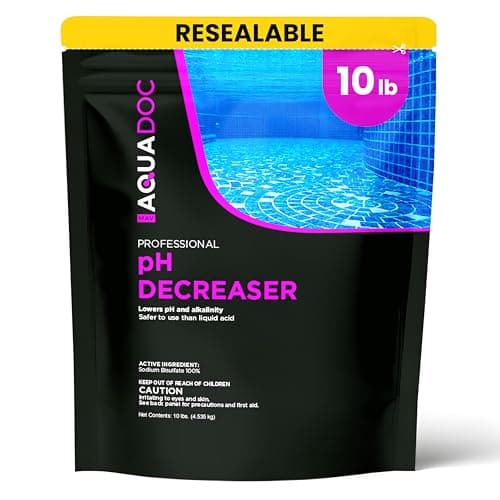
Pick #3 · Bringing high alkalinity and pH back down
pH Decreaser (sodium bisulfate)
Various
Dry acid, sold as pH minus or pH down. It is the only practical way to lower total alkalinity in a home pool, and it lowers pH on the way past whether you wanted that or not.
#ad how this is funded · price as of October 8, 2026
Key specs
- Active
- Sodium bisulfate (dry acid)
- Lowers
- Total alkalinity and pH together
- Published dosing
- ≈2.1 lb of 94% per 10,000 gal drops TA ≈10 ppm (PHTA)
- Form
- Granular — dissolve in a bucket of pool water first
- Adds
- Sulfate, which accumulates in water you keep
How it scoresour reading of published specs, not a test result
- Effectiveness
- 9.0
- Ease
- 6.5
- Water impact
- 6.5
- Cost per season
- 9.0
- Value
- 8.5
Overall 8.0 / 10
What works
- The only realistic way to bring total alkalinity down; nothing else in the aisle does it
- Granular rather than liquid, so no fumes and far easier to store than muriatic acid
- Published dosing means the amount is arithmetic rather than guesswork
- A single small container covers several corrections on a pool this size
What doesn't
- Lowers pH as well as alkalinity, so it usually needs a second step to bring pH back
- Adds sulfate to the water every time it is used
- Must be dissolved first — dropping granules straight in risks bleaching a vinyl liner
- Easy to overshoot; the correction is far harder to reverse than to make
Skip it if: Lowering alkalinity without touching pH. Nothing does that in one step — it takes acid followed by aeration.
What it costs to run: Cheap per correction and rarely needed on a seasonal pool, because the water is replaced each year. Its real cost is the afternoon of acid-then-aerate cycles, not the container.
One honest season: The cheapest setup that genuinely works for a season of real swimming. Nothing spare, nothing missing.
Specs from: PHTA — Total Alkalinity in Pool and Spa Water (fact sheet), CDC — recommended pH range for pools
Pick #4 · The default first test kit
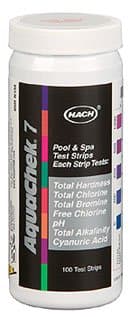
AquaChek Silver 7-Way Test Strips (100 count)
AquaChek
Seven readings in fifteen seconds, including the two that beginners never measure and then fight all summer: total alkalinity and cyanuric acid.
#ad how this is funded · price as of October 8, 2026
Key specs
- Tests
- Free chlorine, total chlorine, bromine, pH, total alkalinity, total hardness, cyanuric acid
- Free chlorine range
- 0-20 ppm
- pH range
- 6.2-8.4
- Total alkalinity range
- 0-240 ppm
- Cyanuric acid range
- 0-300 ppm
- Read time
- 15 seconds
- Count
- 100 strips
How it scoresour reading of published specs, not a test result
- Accuracy
- 7.0
- Ease
- 9.5
- Coverage
- 9.5
- Cost per use
- 9.0
- Value
- 9.2
Overall 8.9 / 10
What works
- Covers cyanuric acid, which most cheap strips omit and which is the reason chlorine stops working in a stabilized pool
- pH range spans 6.2-8.4, comfortably bracketing the CDC's recommended 7.0-7.8
- 15 seconds and a color chart printed on the bottle — no separate booklet to lose
- 100 strips is a full season of twice-weekly testing with room to spare
What doesn't
- Strips are a comparison against a printed color chart, so they are directional rather than precise
- Reading them in bright sun is harder than it should be
- The bottle must be kept sealed and dry or the strips degrade quietly
Skip it if: Fine adjustment. If you are chasing a stubborn problem and need a number rather than a color band, a liquid reagent kit is the tool.
What it costs to run: 100 strips at twice-weekly testing covers roughly two seasons for one pool. The real saving is upstream: knowing your alkalinity stops you buying pH adjuster you did not need.
One honest season: The cheapest setup that genuinely works for a season of real swimming. Nothing spare, nothing missing.
Specs from: CDC — home pool and hot tub water treatment and testing
Pick #5 · When you need a number, not a color band
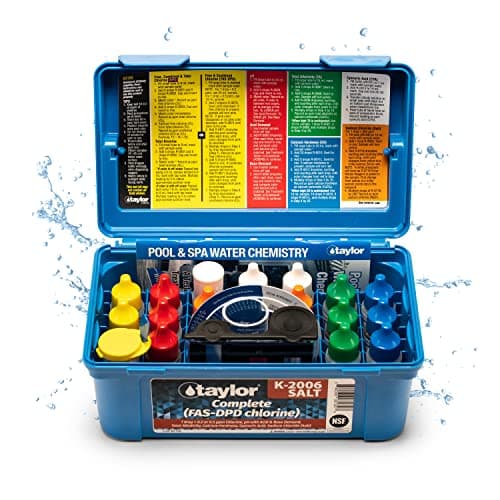
Taylor K-2006 Complete Test Kit (FAS-DPD)
Taylor Technologies
The reference kit. It uses a drop-count titration for free chlorine, which gives you an actual figure rather than a shade of pink. Overkill for a 1,500-gallon pool and indispensable when something has gone properly wrong.
#ad how this is funded · price as of October 8, 2026
Key specs
- Method
- FAS-DPD drop-count titration
- Measures
- Free and combined chlorine, pH, alkalinity, calcium hardness, cyanuric acid
- Resolution
- Reads to 0.2 ppm free chlorine with the standard 10 mL sample
- Format
- Reagent bottles and graduated comparators
How it scoresour reading of published specs, not a test result
- Accuracy
- 9.8
- Ease
- 5.5
- Coverage
- 9.5
- Cost per use
- 7.0
- Value
- 8.0
Overall 8.3 / 10
What works
- Distinguishes free from combined chlorine, which is the single most useful thing a test can tell you when water smells of chlorine
- Gives a numeric result you can act on precisely rather than a color to interpret
- Reagents are individually replaceable, so the kit is a multi-season purchase
What doesn't
- Considerably more expensive than strips and more of a ritual to use
- Reagents have a shelf life and do expire
- Genuinely more kit than a small seasonal pool needs
Skip it if: Casual weekly checks. If it is a five-minute job you will skip it, and a test you skip is worse than a rough one you actually do.
What it costs to run: The reagents are the running cost, not the kit. For most seasonal above-ground owners this is a second purchase made in year two after a bad algae summer, not a first one.
Several seasons: Buy-once. Built and warranted to come back out of the box for a few years, if you store it properly.
Specs from: Taylor Technologies
Questions people actually ask
What raises pool alkalinity without raising pH?
What is the difference between pH increaser and alkalinity increaser?
Can I lower pH without lowering alkalinity?
What should pool alkalinity be if I use chlorine tablets?
Sources
Read next
- Pool care, from someone who assumes you have never done thisThe weekly routine, the four numbers that matter, and the fix for the week the water turns.
- pH and alkalinity, and why yours will not stay putWhy pH drifts, what total alkalinity actually does, and the order of operations that turns a season of chasing into one adjustment.
- High alkalinity, cloudy water, and the pH you cannot hold downWhy high total alkalinity clouds water and drives pH up, the published dosing to bring it down, and the cyanuric acid correction that shows whether yours is genuinely high.
- Pool test kits, and when you need a number rather than a colorReagent kits and digital testers compared against strips, with the specific situations where each one earns its place.
- Calcium hardness: the reading a vinyl pool can mostly ignoreWhy the fourth reading matters less on a vinyl above-ground pool, the two cases where it genuinely does, and how to test it.
- The morning after a storm, in the right orderWhy rain wrecks pool chemistry three ways at once, and the recovery sequence that gets the water back in a day rather than a week.
- What a season of pool chemicals actually adds up toSeason chemical quantities computed from published dosing for four pool volumes, plus the shopping list that is genuinely necessary.