Pool Care & Chemistry
Smart pool monitors: the device is the cheap part
Buy the WaterGuru float-ring bundle if you want wet-chemistry readings and will pay for cassettes, the AIPER if you want no consumables at all, and the iopool if you have a hot tub as well. The sticker price is the smaller half of what any of these costs over three years.
Heads up: we earn a commission if you buy through the links on this page, at no extra cost to you. It never decides the ranking — here is how we pick and here is the full disclosure. Prices are checked automatically; last verified October 11, 2026.
Quick picks
Segmented before it is ranked — the right answer depends on which of these you actually are. Tap any row for the full write-up.
If you want wet-chemistry readings in an above-ground pool
Cassette-based, so the measurement principle matches a reagent kit. Bought in the float-ring configuration, because the bare unit needs a skimmer most above-ground pools do not have.
| # | Product | Best for | Score | Price |
|---|---|---|---|---|
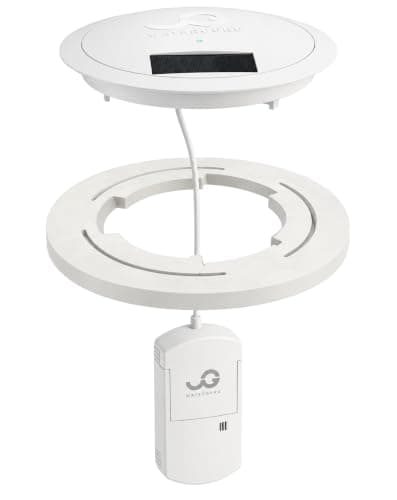
| 1 | WaterGuru Sense 3 Smart Monitor Bundle with Float Ring The cassette-based monitor, bought in the one configuration that suits this site's readers. WaterGuru publishes an 8 to 9 inch round skimmer requirement; the float ring is how an above-ground pool gets around it. | An above-ground pool, because the bare unit does not fit the skimmerSeveral seasons | 7.1out of 10 |
If you want nothing to replace every month
Sensor-based with no published consumable. Floats rather than mounting, so the skimmer question disappears entirely.
| # | Product | Best for | Score | Price |
|---|---|---|---|---|
| 1 | 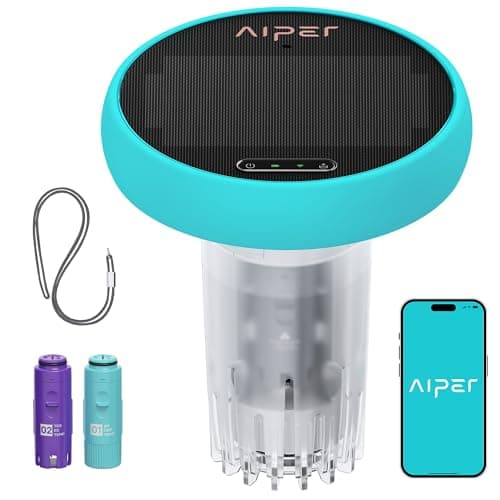 AIPER HydroSync Smart Pool Monitor, 5-in-1 The sensor-based option, so there is nothing to replace every month. That is the whole argument for it, and the trade is that electrode sensors read free chlorine less directly than a wet-chemistry cassette does. | No consumables, if you accept sensor readingsSeveral seasons | 7.9out of 10 |
If you have a pool and a hot tub
Published for both, with a whole-sensor swap every two years instead of monthly cassettes. Bluetooth rather than WiFi, which is the catch.
| # | Product | Best for | Score | Price |
|---|---|---|---|---|
| 1 | 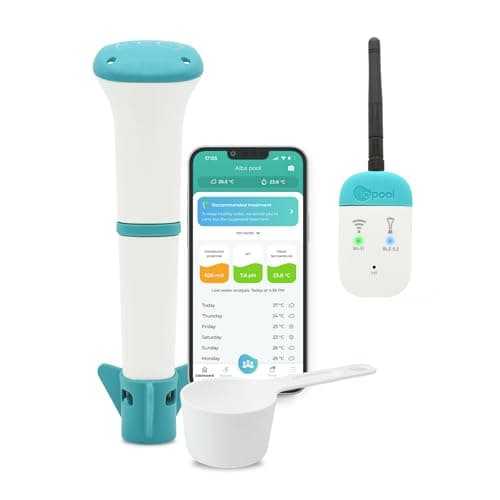 iopool EcO Smart Water Monitor Published for pools and spas, with a whole-sensor replacement every two years instead of monthly cassettes. It talks Bluetooth, not WiFi, which is the detail that decides whether it works for you. | A pool and a hot tub from one deviceSeveral seasons | 7.5out of 10 |
The short version
- Consumables are the real price. Cassettes are published at about $20 each with a one-to-two month life — call it $40 to $100 a season on top of the device.
- WaterGuru publishes an 8 to 9 inch skimmer requirement. Most above-ground skimmers are smaller, which is why the float-ring bundle is the pick.
- The iopool is Bluetooth, not WiFi. Remote access needs a gateway or a spare phone parked by the pool.
- None of them replaces a test kit. A monitor spots drift; a drop count gives you a number you can dose from.
What a monitor is actually for
Our weekly routine is built around testing twice a week, and it works. What it cannot do is notice the Tuesday afternoon your chlorine fell off a cliff because a dozen people got in, or the four days after a storm when stabilizer was diluted and nobody checked.
That is the gap a continuous monitor fills: it watches between your tests. It is genuinely useful and it is sold as something it is not, which is a replacement for testing. Our testing mistakes page covers why readings disagree, and a monitor adds a fourth reading rather than settling the argument.
The spec that rules one of these out
It is worth noticing what that tells you about the category generally. These devices are designed around an inground pool with a full-size skimmer and a pump running most of the day. Everything on this site is the other thing, so the fit question comes before the feature list.
Consumables, which is where the money is
Every listing in this category leads with the purchase price. None of them leads with what it costs to keep running, and the three devices here have three completely different answers.
| Monitor | Consumable | Published life | Published cost | Three-year picture |
|---|---|---|---|---|
| WaterGuru Sense | Test cassette + C batteries | 1 month (5-test) or 2 months (2-test); batteries ~6 months | About $20 per cassette; 3-pack $60 | Device plus roughly $120-300 of cassettes |
| AIPER HydroSync | None published | Sensor life not published | n/a | Unknown - cannot be costed |
| iopool EcO | The whole sensor | Replaced every 2 years, per the maker | $109 preferential replacement, per the maker | Device plus about $109 |
The cassette arithmetic is the reason this page exists. At roughly $20 a cassette, with the five-test version lasting about a month and the two-test version about two months, a five-month northern season is somewhere between two and five cassettes. That is $40 to $100 a year, every year, on a device that already cost several hundred.
It is not a criticism of the product — wet chemistry needs reagents, and that is precisely why its readings are closer to a reagent test than a sensor's are. It is a criticism of how it is sold, because none of that appears next to the price.
How each one talks to you
| Monitor | Mounting | Connectivity | Needs the pump running? | Spa rated? |
|---|---|---|---|---|
| WaterGuru Sense | Skimmer, 8-9 in - or the float ring | WiFi 2.4 GHz only, WPA/WPA2 | Yes - tests on detected flow | Published on the later model |
| AIPER HydroSync | Floats | App; band not published | No | Published for pools, hot tubs and spas on the Pure variant |
| iopool EcO | Floats | Bluetooth LE; gateway needed for remote | No | Yes, published |
Two practical notes. The WaterGuru publishes its WiFi requirement as an actual signal figure — RSSI -75 or better at the skimmer, -65 preferred — which is both unusually honest and a warning: the far corner of a yard is where home WiFi is weakest, and 2.4 GHz only means a modern mesh network set to steer devices to 5 GHz needs configuring around it.
The iopool's Bluetooth is the quieter catch. The maker publishes that remote access needs an official gateway or an old smartphone acting as a bridge. If your plan was to check the pool from work, that is an extra purchase or an extra device left outdoors.
What none of them does
Dose the pool. Every device here reads and reports; none adds chemical. People search for connected chlorine dispensers expecting one box that measures and doses, and in the consumer above-ground market that product barely exists — the closest things are salt chlorine generators, which our salt system roundup covers, and plumbed tablet feeders, covered in our chlorine feeder roundup. A monitor plus a feeder is two products, not one.
They also do not change what the target numbers are. The CDC's published free chlorine range of 1-4 ppm and pH range of 7.2 to 7.8 apply exactly as before, and our when can you swim page covers why the label answer is a reading rather than a clock. A monitor makes that reading continuous. It does not make it different.
Who should skip all three
Anyone whose pool is closed for half the year and lightly used for the other half. A seasonal 15-foot pool tested twice a week by a person who already owns a drop kit does not have a monitoring problem, and several hundred dollars plus cassettes buys a very large quantity of reagent.
The case strengthens sharply with bather load, with a pool that is used daily, and with anyone managing a pool they are not standing next to. If you are at the other end — still deciding between strips and a kit — our strips versus kits comparison is the page to read first, and it costs a fraction of anything here.
The picks, in full
Scores are our own reading of published specifications. They are not test results — we have not tested these products and we do not claim to.
Pick #1 · An above-ground pool, because the bare unit does not fit the skimmer
WaterGuru Sense 3 Smart Monitor Bundle with Float Ring
WaterGuru
The cassette-based monitor, bought in the one configuration that suits this site's readers. WaterGuru publishes an 8 to 9 inch round skimmer requirement; the float ring is how an above-ground pool gets around it.
Key specs
- Fits
- Published for an 8 to 9 in round operational skimmer; this bundle adds the float ring instead
- Measures
- Free chlorine and pH via replaceable cassette, plus water temperature and pump flow
- Cassette life
- Published as one month for the 5-test cassette, two months for the 2-test
- Cassette cost
- About $20 each; a 3-pack published at $60
- Power
- Four C-cell alkaline batteries on the published spec sheet
- Connectivity
- 802.11 b/g/n 2.4 GHz only; WPA/WPA2, published. WEP and 802.1X not supported
- Signal
- Published as RSSI -75 or better at the skimmer, -65 preferred
- App
- Published as requiring iOS 12 or later, or Android 9 or later
How it scoresour reading of published specs, not a test result
- Accuracy
- 8.5
- Ease
- 7.0
- Coverage
- 8.0
- Cost per use
- 5.0
- Value
- 6.5
Overall 7.1 / 10
What works
- Wet-chemistry cassettes rather than electrodes, which is the same measurement principle as a reagent test kit
- The float-ring bundle is the maker's own answer to pools without a full-size skimmer
- Reads pump flow as well as chemistry, so it notices a pump that has stopped
- Publishes its WiFi signal requirement as an actual RSSI figure, which almost no consumer device does
What doesn't
- The cassettes are a real recurring cost — at a published $20 each and a one-to-two month life, a season is roughly another $100 to $120
- Only tests when it detects flow, so it is blind whenever the pump is off
- 2.4 GHz only, and a skimmer at the far end of a yard is exactly where home WiFi is weakest
- The published skimmer requirement rules out the bare unit on most above-ground pools, so the cheaper listing is the wrong one to buy here
Skip it if: Being cheap to own. The purchase price is the smaller half of the three-year cost; the cassettes are the larger half, and nothing about that is visible on the listing.
What it costs to run: Price the cassettes, not the device. At the published $60 per 3-pack and a one-to-two month life, a 5-month season is two to five cassettes, so roughly $40 to $100 a year on top of the unit — before batteries.
Several seasons: Buy-once. Built and warranted to come back out of the box for a few years, if you store it properly.
Specs from: LanOC — WaterGuru SENSE published specifications (skimmer size, batteries, WiFi and RSSI requirements), PCWorld — WaterGuru Sense S2 review, published cassette life, cassette pricing and what each cassette measures
Pick #2 · No consumables, if you accept sensor readings
AIPER HydroSync Smart Pool Monitor, 5-in-1
AIPER
The sensor-based option, so there is nothing to replace every month. That is the whole argument for it, and the trade is that electrode sensors read free chlorine less directly than a wet-chemistry cassette does.
Key specs
- Measures
- Published as 5-in-1 digital testing
- Consumables
- None published — sensor-based rather than cassette-based
- Form
- Floating monitor; no skimmer mounting requirement published
- Testing
- Published as automatic water testing
- App
- Smartphone app; connectivity band not published on the listing
- Sensor life
- Not published
- Subscription
- None published
How it scoresour reading of published specs, not a test result
- Accuracy
- 6.5
- Ease
- 9.0
- Coverage
- 7.5
- Cost per use
- 8.5
- Value
- 8.0
Overall 7.9 / 10
What works
- No cassettes, so the running cost is the thing it does not have
- Floats rather than mounting in a skimmer, which removes the fit problem that rules the WaterGuru out of most above-ground pools
- Cheapest of the three continuous monitors here
- Sold in several colorways at one price, which is a small thing but means stock is rarely a problem
What doesn't
- No sensor life published, so the real replacement interval — and therefore the real cost — is unknown
- Electrode-style sensors are historically less direct on free chlorine than reagent chemistry
- The listing publishes "5-in-1" without consistently naming all five parameters
- A floating device in an above-ground pool is a thing children will pick up
Skip it if: Replacing a drop test when something is wrong. A continuous monitor is for noticing drift; our test kit roundup covers the kit you reach for when you need a defensible number.
What it costs to run: The honest unknown here is sensor life. With no published replacement interval you cannot build a three-year cost, which is the comparison the cassette-based option loses on and this one cannot be scored on at all.
Several seasons: Buy-once. Built and warranted to come back out of the box for a few years, if you store it properly.
Pick #3 · A pool and a hot tub from one device
iopool EcO Smart Water Monitor
iopool
Published for pools and spas, with a whole-sensor replacement every two years instead of monthly cassettes. It talks Bluetooth, not WiFi, which is the detail that decides whether it works for you.
#ad how this is funded · price as of October 11, 2026
Key specs
- Measures
- Published by the maker as disinfection capacity rather than free chlorine, plus pH and temperature
- Connectivity
- Bluetooth Low Energy; the maker publishes that remote access needs a gateway or a spare phone as a bridge
- Replacement
- Maker publishes the sensor is replaced every 2 years, at a stated $109 preferential price
- Warranty
- 2 years, published by the maker
- Works with
- Published as chlorine, bromine and active oxygen; a salt-compatible version exists
- Spa use
- Published as available for pool and spa
- Subscription
- None, published
How it scoresour reading of published specs, not a test result
- Accuracy
- 7.0
- Ease
- 6.5
- Coverage
- 8.5
- Cost per use
- 8.0
- Value
- 7.5
Overall 7.5 / 10
What works
- Published for spa as well as pool, so one device covers a backyard that has both
- A two-year sensor swap is a far smaller running cost than monthly cassettes
- No subscription, published
- Floating, so no skimmer size requirement at all
What doesn't
- Bluetooth only — without the gateway or a permanently parked spare phone, you have to walk to the pool to read it
- It reports disinfection capacity rather than free chlorine, which is a different number from the one on every label and in CDC guidance
- The whole sensor is the consumable, so the cost arrives as one lump every two years
- Most of the published comparison detail comes from the maker's own page, which is not a neutral source
Skip it if: Matching the number on your chemical label. If you dose from free chlorine in ppm, a device reporting a different metric adds a translation step rather than removing one.
What it costs to run: Two-year arithmetic is the fair comparison and the maker publishes it: a $109 sensor replacement every two years against roughly $20 a cassette every one to two months on the cassette-based alternative.
Several seasons: Buy-once. Built and warranted to come back out of the box for a few years, if you store it properly.
Specs from: iopool — the maker's own EcO vs WaterGuru comparison (sensor replacement, connectivity, spa compatibility)
Pick #4 · When you need a number, not a color band
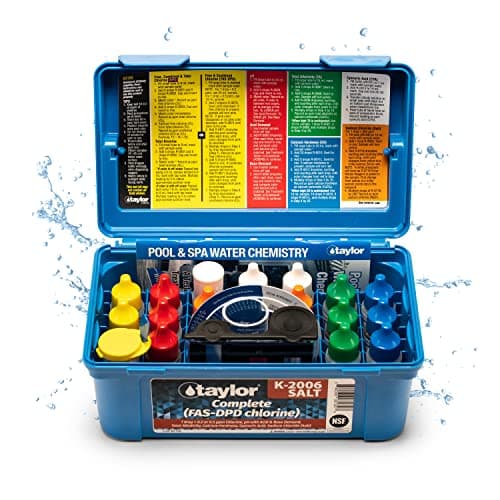
Taylor K-2006 Complete Test Kit (FAS-DPD)
Taylor Technologies
The reference kit. It uses a drop-count titration for free chlorine, which gives you an actual figure rather than a shade of pink. Overkill for a 1,500-gallon pool and indispensable when something has gone properly wrong.
Key specs
- Method
- FAS-DPD drop-count titration
- Measures
- Free and combined chlorine, pH, alkalinity, calcium hardness, cyanuric acid
- Resolution
- Reads to 0.2 ppm free chlorine with the standard 10 mL sample
- Format
- Reagent bottles and graduated comparators
How it scoresour reading of published specs, not a test result
- Accuracy
- 9.8
- Ease
- 5.5
- Coverage
- 9.5
- Cost per use
- 7.0
- Value
- 8.0
Overall 8.3 / 10
What works
- Distinguishes free from combined chlorine, which is the single most useful thing a test can tell you when water smells of chlorine
- Gives a numeric result you can act on precisely rather than a color to interpret
- Reagents are individually replaceable, so the kit is a multi-season purchase
What doesn't
- Considerably more expensive than strips and more of a ritual to use
- Reagents have a shelf life and do expire
- Genuinely more kit than a small seasonal pool needs
Skip it if: Casual weekly checks. If it is a five-minute job you will skip it, and a test you skip is worse than a rough one you actually do.
What it costs to run: The reagents are the running cost, not the kit. For most seasonal above-ground owners this is a second purchase made in year two after a bad algae summer, not a first one.
Several seasons: Buy-once. Built and warranted to come back out of the box for a few years, if you store it properly.
Specs from: Taylor Technologies
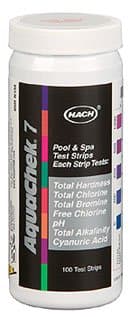
Pick #5 · The default first test kit
AquaChek Silver 7-Way Test Strips (100 count)
AquaChek
Seven readings in fifteen seconds, including the two that beginners never measure and then fight all summer: total alkalinity and cyanuric acid.
#ad how this is funded · price as of October 11, 2026
Key specs
- Tests
- Free chlorine, total chlorine, bromine, pH, total alkalinity, total hardness, cyanuric acid
- Free chlorine range
- 0-20 ppm
- pH range
- 6.2-8.4
- Total alkalinity range
- 0-240 ppm
- Cyanuric acid range
- 0-300 ppm
- Read time
- 15 seconds
- Count
- 100 strips
How it scoresour reading of published specs, not a test result
- Accuracy
- 7.0
- Ease
- 9.5
- Coverage
- 9.5
- Cost per use
- 9.0
- Value
- 9.2
Overall 8.9 / 10
What works
- Covers cyanuric acid, which most cheap strips omit and which is the reason chlorine stops working in a stabilized pool
- pH range spans 6.2-8.4, comfortably bracketing the CDC's recommended 7.0-7.8
- 15 seconds and a color chart printed on the bottle — no separate booklet to lose
- 100 strips is a full season of twice-weekly testing with room to spare
What doesn't
- Strips are a comparison against a printed color chart, so they are directional rather than precise
- Reading them in bright sun is harder than it should be
- The bottle must be kept sealed and dry or the strips degrade quietly
Skip it if: Fine adjustment. If you are chasing a stubborn problem and need a number rather than a color band, a liquid reagent kit is the tool.
What it costs to run: 100 strips at twice-weekly testing covers roughly two seasons for one pool. The real saving is upstream: knowing your alkalinity stops you buying pH adjuster you did not need.
One honest season: The cheapest setup that genuinely works for a season of real swimming. Nothing spare, nothing missing.
Specs from: CDC — home pool and hot tub water treatment and testing
Questions people actually ask
Are smart pool monitors worth it?
Do pool monitors need a subscription?
Will a WaterGuru fit an above-ground pool skimmer?
How accurate are smart pool monitors?
Does a monitor work when the pump is off?
Sources
- LanOC — WaterGuru SENSE published specifications (8-9 in skimmer requirement, C-cell batteries, 2.4 GHz WiFi and RSSI)
- PCWorld — WaterGuru Sense S2 review, published cassette life and cassette pricing
- iopool — the maker's own EcO vs WaterGuru comparison (two-year sensor replacement, Bluetooth, spa compatibility)
- CDC — home pool and hot tub water treatment and testing
Read next
- Pool care, from someone who assumes you have never done thisThe weekly routine, the four numbers that matter, and the fix for the week the water turns.
- Pool test kits, and when you need a number rather than a colorReagent kits and digital testers compared against strips, with the specific situations where each one earns its place.
- The best pool test stripsTest strips compared on parameter coverage - specifically whether they read cyanuric acid, which most cheap strips omit.
- Strips, drops or digital: how precise does the answer need to be?Test strips, FAS-DPD drop kits and digital testers compared on what each actually measures, the resolution you get, and which readings a strip cannot really give you.
- Your test result is only as good as how you took itThe six common testing errors that produce misleading readings, and how to take a sample that means something.
- Automating a small pool: one thing is obvious, the rest is notWhich pool automation genuinely pays on a seasonal above-ground pool, ranked, and which items are solving inground problems.
- The weekly pool routine, and how little time it really takesThe daily, weekly and monthly jobs written as a schedule, with the kit each one needs and roughly how long it takes.
- The feeder turns a guess into a dialOff-line automatic chlorine feeders compared with floating dispensers on control, capacity and installation, and whether they suit a seasonal pool.
- How long before you can swim? The label gives a number, not a timePublished re-entry rules for each pool chemical, read off EPA labels - and why the real answer is a chlorine reading rather than a number of hours.