Above-Ground Pools
12 feet or 15 feet: the step that doubles the water
Three feet of diameter sounds like a small upgrade. It is more than twice the water, a deeper wall, a bigger circle of level ground and a proportionally bigger bill all season.
Heads up: we earn a commission if you buy through the links on this page, at no extra cost to you. It never decides the ranking — here is how we pick and here is the full disclosure. Prices are checked automatically; last verified October 8, 2026.
Quick picks
Segmented before it is ranked — the right answer depends on which of these you actually are. Tap any row for the full write-up.
If the yard is the constraint
1,718 gallons, a 30-inch wall and a 14-foot working circle. The size that fits where a 15-footer will not.
| # | Product | Best for | Score | Price |
|---|---|---|---|---|
| 1 | 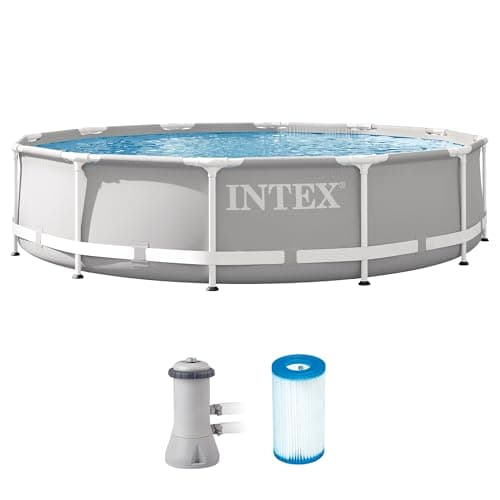 Intex Prism Frame Pool Set, 12ft x 30in The size most people should buy first and the one most people talk themselves out of. 1,718 gallons is cheap to fill, cheap to treat, and forgiving of every mistake you are about to make. | Small yards and first-time ownersOne honest season | 8.6out of 10 |
If you want to actually cool off in it
3,955 gallons at 90% fill on a 42-inch wall, with a ladder and cover in the box. More than twice the water of the 12.
| # | Product | Best for | Score | Price |
|---|---|---|---|---|
| 1 | 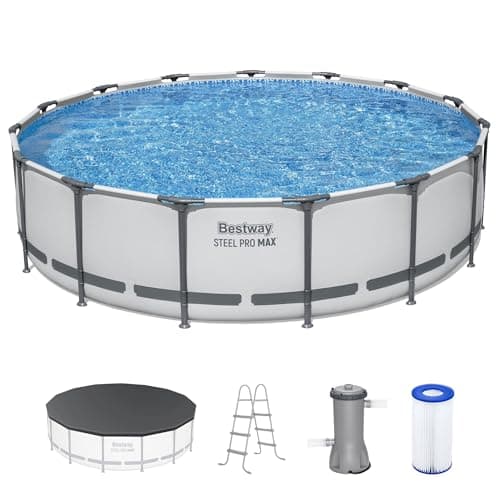 Bestway Steel Pro MAX Pool Set, 15ft x 42in Fewer gallons and a shallower wall than the Intex flagship, which makes it easier to level, cheaper to fill and cheaper to keep clean. For most first-pool families this is the right size, not the compromise size. | The honest middle of the marketSeveral seasons | 8.2out of 10 |
The short version
- It is not a 25% upgrade, it is more than double. 1,718 gallons against 3,955 on the pools compared here.
- The wall usually grows too. Twelve-foot pools are commonly 30 inches; fifteen-foot pools are commonly 42.
- Add a foot of working room all round. Installation guides put a 12 ft pool in a 14 ft circle and a 15 ft pool in a 17 ft one.
- Every running cost scales with the water, not with the diameter.
Why three feet is not a small step
Pool volume scales with the square of the radius, so diameter is a misleading way to think about size. Add the fact that the bigger class usually comes with a deeper wall, and the jump is larger again.
| 12 ft (Prism Frame) | 15 ft (Steel Pro MAX) | |
|---|---|---|
| Published capacity | 1,718 gal | 3,955 gal at 90% fill |
| Wall height | 30 in | 42 in |
| Pump supplied | 530 GPH cartridge | 1,000 gal filter pump |
| In the box | Pool, pump | Pool, pump, ladder, cover |
| Cleared circle needed | About 14 ft | About 17 ft |
That is 2.3 times the water. Every dose of chemistry, every hour of pump run time and every gallon of fill scales with that number rather than with the three feet you added. Our cost of going bigger guide is built entirely around this effect.
What the extra water costs to put in
- 12 ft capacity, published
- 1,718 gal
- 15 ft capacity, published at 90%
- 3,955 gal
- EPA WaterSense average water cost
- $6.06 per 1,000 gal
1,718 × $6.06/1,000 = about $10 | 3,955 × $6.06/1,000 = about $24
About $14 more to fill — and then 2.3x the chemistry all season
The ground question
Installation guidance is to clear and level a circle about a foot larger than the pool all round, so a 12 ft pool wants roughly a 14 ft circle and a 15 ft pool roughly 17 ft. On top of that, manufacturers ask for clearance from anything a child can climb — Intex publishes five to six feet.
Leveling a 17-foot circle is materially more work than a 14-foot one, and the penalty for getting it wrong is larger because there is more water pushing on the low side. Our leveling guide covers the method and why manufacturers refuse to publish a tolerance.
What the extra depth buys
The honest answer is: the difference between standing in water and cooling off in it. A 30-inch wall holds roughly 23 inches of water; a 42-inch wall holds around three feet. For adults that is the difference between a paddling pool and a pool.
It also changes safety. Deeper water is more dangerous for small children, and the deeper class is where a ladder becomes essential rather than optional — covered in our ladder roundup.
Who should buy which
Twelve feet if the yard is tight, if the users are young children, or if you want the cheapest genuinely filtered pool to run. Our small yards guide covers the constraint properly.
Fifteen feet if adults will use it, if more than two people will be in it at once, or if you want a pool that still feels worth filling in year three. Our bather load guide explains why the number of people matters as much as the number of feet.
Do not split the difference on ground prep. Whichever you choose, the circle has to be level and cleared a foot wider than the pool. That work does not scale down just because the pool did.
Filtration at each size
Turnover is the number that decides whether the supplied pump is adequate, and at both of these sizes it usually is. What changes is how long the pump has to run.
Hours per turnover at each size
- 12 ft volume, published
- 1,718 gal
- 12 ft pump, system flow
- 475 gph
- 15 ft volume, published at 90%
- 3,955 gal
- 15 ft pump, published rating
- 1,000 gal filter pump
1,718 ÷ 475 = 3.6 h | 3,955 ÷ 1,000 = about 4 h
Both clear a turnover in about four hours
What else scales with the water
Chemicals. Every dose is per gallon, so 2.3 times the water is 2.3 times the chlorine, the shock and the balancing products across a season. Our chemical cost guide works a season out properly.
Heat. A bigger pool warms more slowly and loses heat over a larger surface. At 15 feet a cover stops being a nice idea, which our solar cover guide quantifies.
Winter. A larger pool is a larger thing to drain, dry, fold and store, or a larger cover to buy and pump out. Neither is hard; both are bigger.
The sizes in between
Fourteen-foot pools exist and are frequently the sensible answer for a yard that cannot take fifteen. So do 13 and 16 foot models from some brands. The arithmetic on this page applies to any pair: square the radius, compare the volumes, and remember the wall height usually changes at the same time.
If you are deciding across a wider range, our sizing guide starts from the yard rather than the catalog, which is the right order.
The ground work, which is where the real difference lands
Leveling a 14-foot circle and leveling a 17-foot circle are not the same afternoon. The area grows with the square of the radius just as the volume does, so the bigger pool is roughly 45% more ground to clear, level and check.
Method matters more than effort. Bestway’s instruction is that the ground must be dug out where necessary and that sand should not be used to create a level base, because sand compacts unevenly under load and the pool settles into the dip. Intex asks for absolutely flat and level ground and offers the water test: fill to an inch and see whether it runs to one side.
The penalty for getting it wrong also scales. An out-of-level 15-foot pool puts far more water weight on the low side than a 12-foot one does, and that is the failure mode behind most collapsed frame pools. Our leveling guide covers the method and why no manufacturer will publish a tolerance.
If you cannot decide
Buy the larger one if the ground and the budget both allow it, because the constraint people regret is space in the water rather than space in the yard. Two adults and a child in a 12-foot pool is a full pool.
Buy the smaller one if leveling a 17-foot circle is genuinely difficult on your ground, if the pool has to come down each autumn and be stored, or if the people using it are young enough that 30 inches is the right depth anyway. A 12-foot pool that is level, filtered and covered beats a 15-foot pool sitting an inch out of true.
And if the yard could take either, our sizing guide starts from the space rather than the catalog, which is the order that produces fewer regrets.
What to buy
Scores are our own reading of published specifications. They are not test results — we have not tested these products and we do not claim to.
Small yards and first-time owners
Intex Prism Frame Pool Set, 12ft x 30in
Intex
The size most people should buy first and the one most people talk themselves out of. 1,718 gallons is cheap to fill, cheap to treat, and forgiving of every mistake you are about to make.
Key specs
- Water capacity
- 1,718 gallons
- Pump supplied
- Krystal Clear C530 — 530 GPH pump / 475 GPH system
- Frame
- Powder-coated metal, tool-free Easy Lock
- Liner
- 3-ply, puncture resistant
- Manufacturer setup claim
- Ready in 30 minutes
- Pump wattage
- Not published by Intex
How it scoresour reading of published specs, not a test result
- Build
- 7.0
- Setup
- 9.0
- Upkeep
- 9.0
- Running cost
- 9.0
- Value
- 9.0
Overall 8.6 / 10
What works
- A 12-foot circle fits in a yard where a 15 or 18 will not, once you allow three feet of walking space
- 1,718 gallons turns over in about 3.6 hours on the supplied 475 GPH system flow — so a short daily run genuinely filters it
- Cheapest of the frame pools to make a mistake in: a bad chemical week costs a few dollars, not a few tens
- Tool-free assembly is real, not marketing — this is a genuinely one-afternoon job
What doesn't
- 30-inch wall means shallow water and it warms and cools fast
- Small enough that three adults fill it
- The C530 is sized for exactly this pool and nothing bigger, so it does not carry over if you upgrade
Skip it if: Anyone planning to swim rather than sit. This is a cooling-off and playing pool and it is very good at that.
What it costs to run: The cheapest frame pool here to run, and the gap is not small. At the EPA WaterSense average of $6.06 per 1,000 gallons a fill is about $10. Its turnover math — 1,718 gallons at 475 GPH system flow — means roughly 3.6 hours per full turnover, so a 7-8 hour daily run is two full turnovers rather than a partial one.
One honest season: The cheapest setup that genuinely works for a season of real swimming. Nothing spare, nothing missing.
Specs from: Intex — Prism Frame 12' x 30' pool set, Intex — Krystal Clear cartridge filter pumps
The honest middle of the market
Bestway Steel Pro MAX Pool Set, 15ft x 42in
Bestway
Fewer gallons and a shallower wall than the Intex flagship, which makes it easier to level, cheaper to fill and cheaper to keep clean. For most first-pool families this is the right size, not the compromise size.
#ad how this is funded · price as of October 8, 2026
Key specs
- Water capacity
- 3,955 gallons (90% full)
- Pump supplied
- 1,000 gal filter pump, Type III cartridge
- Liner
- Tritech 3-layer
- Included
- Ladder and cover
- Wall height
- 42 inches
- Pump wattage
- Not published by Bestway (US listing)
How it scoresour reading of published specs, not a test result
- Build
- 7.5
- Setup
- 8.0
- Upkeep
- 8.0
- Running cost
- 7.5
- Value
- 8.8
Overall 8.2 / 10
What works
- 3,955 gallons is roughly 43% less water than the 18ft Intex — that is 43% less chemical spend, every season, forever
- 42-inch wall is far more forgiving of a yard that is nearly-but-not-quite level
- Ladder and cover included
- Cartridge filtration means no sand to buy or change
What doesn't
- Cartridges are a recurring consumable, and in a busy pool you will rinse one weekly
- 42 inches is shallow for adults who want to actually swim rather than sit
- Wattage is not published, so the running-cost math needs the label on the box
Skip it if: Adults who want to swim lengths. At 42 inches you are sitting in it, not swimming in it.
What it costs to run: The gallons are the story. Chemical dosing scales with volume, so 3,955 gallons costs meaningfully less to sanitize all season than 6,981 does. Filling it once at the EPA WaterSense national average of $6.06 per 1,000 gallons is about $24 of water; the same fill on the 18ft Intex is about $42.
Several seasons: Buy-once. Built and warranted to come back out of the box for a few years, if you store it properly.
Specs from: Bestway USA — Steel Pro MAX 15' x 42' pool set, EPA WaterSense — how the calculator works ($6.06 per 1,000 gallons)
Questions people actually ask
How much bigger is a 15 ft pool than a 12 ft?
How much space do I need for a 15 ft pool?
Does a bigger pool cost much more to run?
Is a 12 ft pool big enough for adults?
Sources
Read next
- Above-ground pools for ordinary backyardsSoft-side, metal-frame and steel-wall pools compared by what they cost across a whole season, not at the till.
- The best 12-foot pools, and why 12 feet is the sensible sizeFrame and inflatable 12-foot pools side by side, with the fill cost and season chlorine bill computed from published gallons.
- The 15-foot class, and the three things that stop being optionalThe 14 and 15-foot pools compared, and what doubling the water from a 12-footer actually commits you to.
- What size pool your backyard can actually takeThe three-foot rule, the level-ground tolerance, and a table matching yard size to pool size with the running cost attached.
- One size up is not a premium, it is a subscriptionThe recurring multiplier attached to each size step, priced out - and the two cases where paying it is clearly right.
- Pools for a small yardRound versus rectangular in a narrow yard, the smallest sizes worth filtering, and why smaller is cheaper twice over.
- Leveling the ground, and the weight that makes it matterThe tolerance manufacturers publish, the weight of water that enforces it, and the method for getting a circle genuinely flat with hand tools.