Seasonal Care
Storing pool chemicals over winter: separate the oxidizers, bin the liquids
Keep tablets and dry shock in a dry, cool, locked place well away from anything acidic. Throw out liquid chlorine now, because it will be weak by spring whatever you do. The container the chemicals came in is almost never the problem; what you store next to them is.
Heads up: we earn a commission if you buy through the links on this page, at no extra cost to you. It never decides the ranking — here is how we pick and here is the full disclosure. Prices are checked automatically; last verified October 11, 2026.
The short version
- Oxidizers and acid never share a space. Not a shelf, not a cabinet. This is the one rule that is about safety rather than waste.
- Liquid chlorine does not keep. Use it or lose it; it will be weak by April regardless of where you put it.
- Anything water-based freezes. Reagents, most liquid algaecides and clarifiers come indoors.
- Dry, cool, ventilated, locked. In that order. Sealed and airtight is not the same as dry, and it is worse for oxidizers.
The job nobody plans for
Our equipment storage page covers where the pump and filter spend the winter, which is the part of closing people remember. What is usually still sitting on the lawn at the end of the day is the chemicals — a part bucket of tablets, most of a closing kit, a jug of something, and a tub of test strips.
Those get put wherever there is room, which is how a bag of shock ends up on a shelf above a bottle of muriatic acid. This page is about not doing that, and about which of them is worth keeping at all.
The separation rule
The second half of the rule catches more people: different chlorine products should also be kept apart from each other. Cal-hypo, dichlor and trichlor are different chemistries, and the labels prohibit mixing them — including contaminating one scoop with residue from another. Our pool shock roundup covers how differently those three behave in water, and they behave differently in a container too.
Practically, that means keeping products in their original containers with their original lids, never decanting into anything unlabeled, and not reusing a scoop between products.
What keeps and what does not
| Product | Keeps over winter? | Where | Why |
|---|---|---|---|
| Chlorine tablets (trichlor) | Yes, well | Cool, dry, ventilated, locked, outdoors | Stable sealed; degrades with humidity |
| Dry shock (cal-hypo or dichlor) | Yes | Same, separated from tablets and acid | Stable dry; an oxidizer, so no heat sources nearby |
| Liquid chlorine | No | Use it before closing | Degrades steadily in storage; weak by spring |
| Muriatic acid | Yes, but isolated | Separate cabinet, never near chlorine | Stable, but the fumes corrode everything near it |
| Dry acid (sodium bisulfate) | Yes | Dry, away from oxidizers | Stable dry; far less hazardous to store than liquid acid |
| Alkalinity and pH increaser | Yes | Dry | Basic salts; only humidity hurts them |
| Stabilizer (cyanuric acid) | Yes | Dry | Very stable; caking is the only issue |
| Liquid algaecide and clarifier | Check the label | Indoors if it must not freeze | Water-based; freezing can separate the formulation |
| Test strips and reagents | Indoors only | A kitchen drawer | Humidity and heat ruin them, and they read wrong rather than failing |
The liquid chlorine row is the one worth acting on today rather than in April. It is the cheapest chlorine per unit while it is fresh and the most worthless after a winter, so the right move is to use it in the pool before you close rather than carrying it over.
The test strip row is the one that costs people a season of confusion. A tub of strips that spent six months in a damp shed does not stop working — it reads inaccurately, you dose from a wrong number, and you spend April wondering why the water will not come right. Our testing mistakes page is largely about this.
Dry, cool and ventilated — which is not the same as sealed
The instinct with chemicals is to seal everything into an airtight box. For oxidizers that is the wrong instinct, and it is worth understanding why.
| Condition | Protects against | Common mistake |
|---|---|---|
| Dry | Humidity degrading tablets and caking powders | A shed floor, which wicks damp |
| Cool | Heat accelerating decomposition | An attic or a sunlit plastic box |
| Ventilated | Gas building up if a container leaks | A sealed airtight bin, which is worse |
| Locked | Children and pets | An open shelf in an unlocked shed |
A lockable outdoor cabinet with shelves gets three of those four without thinking about it, and the fourth — ventilation — is the one to check before you buy, because very few listings in this category publish anything about it. Both cabinets on this page are resin outdoor units with shelves; neither publishes a ventilation detail, which we would rather state than skip over.
Where it should not go
Three places, all of them common.
An attached garage with a furnace or water heater. Oxidizers support combustion, and a pilot light is an ignition source in the same room. This is the highest-stakes version of the mistake.
On a concrete floor. Concrete wicks moisture upward continuously, and a cardboard shock container on a slab is a damp shock container by December. Everything goes on a shelf, which is why both cabinets here are specified with them.
Next to anything metal you care about. Chlorine fumes corrode, and they do not need a spill to do it — a sealed-but-not-airtight tablet bucket in a small shed will take the edge off tools and hardware over a winter. That is a real argument for a dedicated cabinet rather than a corner of the existing one, and our equipment storage page is the reason it matters: the pump and the filter are coming in at the same time of year.
What this is worth
Modest in money and meaningful in hassle. A part bucket of tablets is often the single most valuable thing left over at closing, and keeping it dry is the difference between starting April with chlorine and starting April with a shopping trip — our opening shopping list is shorter if October went well.
The real return is the one that does not show up as a saving: not having chlorine gas in a shed, and not having a child find a bucket of shock. Everything else on this page is housekeeping. That part is not.
What to buy
Scores are our own reading of published specifications. They are not test results — we have not tested these products and we do not claim to.
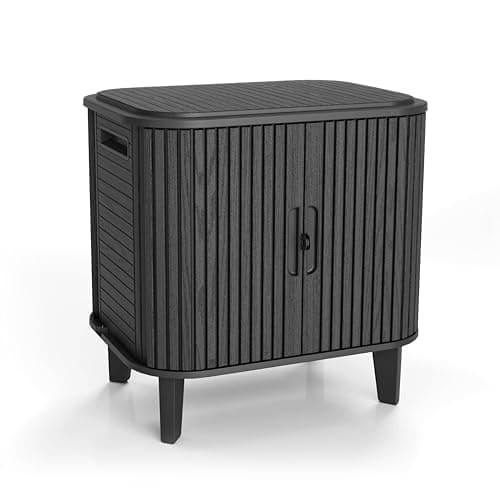
A seasonal above-ground pool's actual chemical volume
Keter Velo 30 Gallon Outdoor Storage Cabinet
Keter
Thirty gallons, which is the right size for what a seasonal above-ground pool actually has left in October — a part bucket of tablets, a bag of shock and a few bottles.
#ad how this is funded · price as of October 11, 2026
Key specs
- Capacity
- 30 gallons, published
- Material
- Resin, published
- Location
- Outdoor storage cabinet, published
- Lockable
- Check the listing variant — Keter's lockable provision varies by model
- Ventilation
- Not published
How it scoresour reading of published specs, not a test result
- Retention
- 7.5
- Durability
- 7.5
- Handling
- 8.5
- Running cost
- 10.0
- Value
- 8.5
Overall 8.2 / 10
What works
- Sized for a seasonal pool rather than a maintenance contractor, so you are not buying nine cubic feet of air
- Keter resin products are the ones already in this site's storage roundup, so the build is a known quantity
- Small enough to tuck beside a shed rather than needing its own footprint
- Cheapest cabinet here by a wide margin
What doesn't
- Lockability varies by Keter model and is not consistently published on every listing — check before ordering if that is why you are buying
- No ventilation detail published
- Thirty gallons fills faster than you expect once a closing kit is in it
- Resin in full sun has a finite life, like every cabinet on this page
Skip it if: Big volumes or liquid chemicals in a freezing climate. This is a dry-goods cabinet for a small pool; the liquids still come indoors.
What it costs to run: The sensible default on cost. Our deck box roundup covers the same brand for float storage, and buying one cabinet for chemicals and one box for floats is cheaper than one cabinet big enough for both.
Several seasons: Buy-once. Built and warranted to come back out of the box for a few years, if you store it properly.
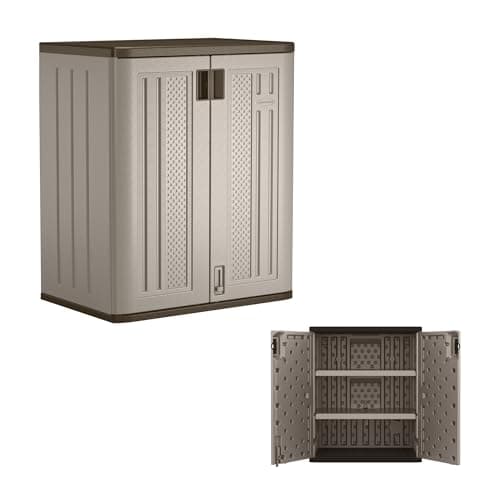
Chemicals that must be locked and must not be in the house
Suncast 9 Cu Ft Lockable Base Storage Cabinet
Suncast
Nine cubic feet, lockable, two shelves, and outdoors. Pool chemicals should not overwinter in a heated house or next to anything that can oxidize, and a lockable outdoor cabinet is the honest answer.
#ad how this is funded · price as of October 11, 2026
Key specs
- Capacity
- 9 cu ft, published
- Shelves
- 2, published
- Lockable
- Yes, published — padlock not usually included
- Material
- Resin, published
- Location
- Outdoor-rated, published
- Ventilation
- Not published — check before storing oxidizers
How it scoresour reading of published specs, not a test result
- Retention
- 8.0
- Durability
- 7.5
- Handling
- 8.0
- Running cost
- 10.0
- Value
- 7.0
Overall 8.0 / 10
What works
- Lockable, which is the first requirement for storing pool oxidizers where children or pets go
- Outdoors, so a chlorine smell and a damp garage never become the same problem
- Two shelves let incompatible chemicals be physically separated rather than stacked
- Resin does not rust, which matters because the thing corroding chemical containers is usually the shelf they sit on
What doesn't
- No ventilation detail published, and a sealed cabinet full of chlorine products is its own hazard
- Resin cabinets left outdoors in full sun become brittle over several seasons
- Most expensive option here
- Nine cubic feet is more than a seasonal above-ground pool owner needs, which is cost you may not want
Skip it if: Freeze protection. An outdoor cabinet is the right place for dry oxidizers and the wrong one for anything liquid that freezes — those come inside, and our page lists which is which.
What it costs to run: The alternative is a ruined liner or a corroded shelf of equipment, both of which cost more. Our cost-of-a-bad-close page prices what happens when closing-season storage goes wrong.
Several seasons: Buy-once. Built and warranted to come back out of the box for a few years, if you store it properly.
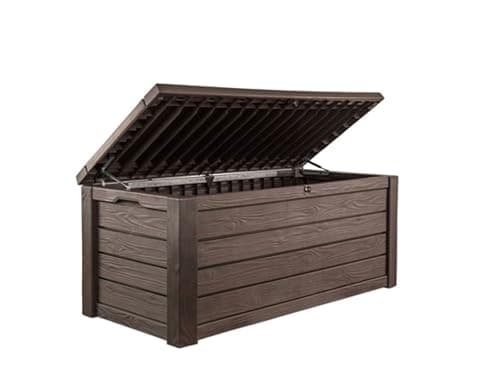
Everything, in one box, with a lid you can sit on
Keter Westwood 150 Gallon Deck Box
Keter
150 gallons of UV-resistant resin that takes 660 lb and locks. It ventilates rather than drains, which is the one thing to understand before you put soaking floats in it.
#ad how this is funded · price as of October 11, 2026
Key specs
- Capacity
- 150 gallons
- External size
- 61 x 28.5 x 25.35 in
- Internal size
- 56 x 24.6 x 22.8 in
- Material
- Steel-reinforced resin, UV- and weather-resistant
- Airflow
- Ventilated design; no drain holes published
- Load
- 660 lb capacity; the lid seats two adults
- Security
- Metal latch takes a padlock; lock not included
- Warranty
- 2 years limited
How it scoresour reading of published specs, not a test result
- Value
- 8.5
Overall 8.5 / 10
What works
- Large enough for loungers, noodles, toys and a cover in one place
- Ventilated, so damp vinyl is not sealed into a warm box
- Doubles as poolside seating rated to 660 lb
- Two-year warranty published on the product page, which the mesh alternatives do not match
What doesn't
- Ventilation is not drainage: wet floats still need drying before they go in
- Five feet long, which is a real piece of furniture on a small patio
- Padlock is extra
- Rigid box shape suits folded floats better than big inflated ones
Skip it if: Storing floats inflated. Large inflatables have to be deflated to fit, which is the correct way to store them anyway but means the pump comes out every time.
What it costs to run: A one-off purchase measured against replacing sun-perished floats every year or two. Our float lifespan guide covers what actually kills them, and most of it is sunlight and being left out wet.
Several seasons: Buy-once. Built and warranted to come back out of the box for a few years, if you store it properly.
Specs from: Keter — Westwood 150 gallon deck box, published specifications and warranty
The direct alternative
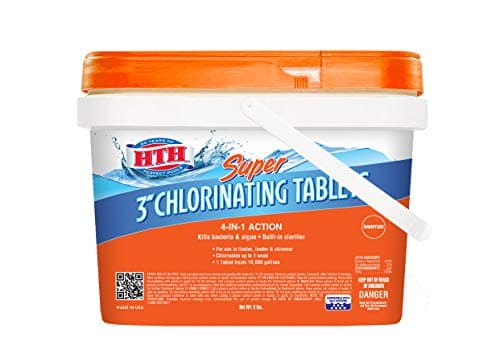
HTH 3-Inch Chlorinating Tablets
HTH
Functionally the same product as any other stabilized trichlor tablet. Buy on price per pound of available chlorine, not on the label.
#ad how this is funded · price as of October 11, 2026
Key specs
- Type
- Stabilized trichlor, 3-inch tablets
- Contains stabilizer
- Yes
- Compare on
- Available chlorine percentage stated on the label
How it scoresour reading of published specs, not a test result
- Value
- 8.5
Overall 8.4 / 10
What works
- Chemically equivalent to competing trichlor tablets — this is a commodity
- Widely available in large buckets, which is the cheaper format
- Long shelf life if the bucket stays sealed and dry
What doesn't
- Same cyanuric acid accumulation as every other trichlor product
- Same downward pH pressure over a season
- Bucket sizes are often larger than a small seasonal pool will use in a year
Skip it if: Being different. If you are comparing trichlor brands you are comparing price, and you should be.
What it costs to run: Cost per season is decided by the available-chlorine percentage on the label and the bucket size, not the brand. Compare those two numbers and buy the cheaper one.
One honest season: The cheapest setup that genuinely works for a season of real swimming. Nothing spare, nothing missing.
The default shock for a vinyl pool
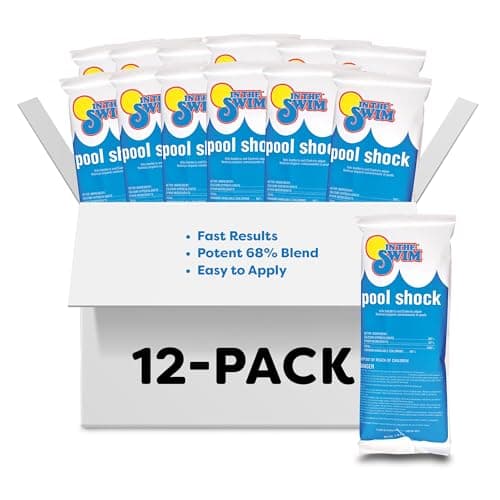
In The Swim Pool Shock, 68% Cal-Hypo, 12 x 1 lb
In The Swim
Sixty-eight percent calcium hypochlorite in pre-measured pound bags, with a published dose and a published re-entry rule. It adds calcium and no stabilizer, which is the right trade for most above-ground pools.
#ad how this is funded · price as of October 11, 2026
Key specs
- Active
- Calcium hypochlorite, 68%
- Available chlorine
- 65% minimum
- Stabilizer
- None — non-stabilized, adds no cyanuric acid
- Calcium
- Yes, it is a calcium-based shock
- Dose
- One 1 lb bag per 10,000 gal gives 5-10 ppm free chlorine in a clean, balanced pool
- Pre-dissolve
- In The Swim says vinyl pools should pre-dissolve in a bucket first
- Swim again
- Not until free chlorine is back to 1-4 ppm
How it scoresour reading of published specs, not a test result
- Value
- 8.5
Overall 8.4 / 10
What works
- Pre-measured 1 lb bags, so dosing a 10,000 gallon pool is one bag and no scale
- Adds no cyanuric acid, which matters because CYA only leaves a pool by dilution
- Published dose and published re-entry level, both on the product page
- The strongest available-chlorine figure of the shocks here at 65% minimum
What doesn't
- Adds calcium every time, which accumulates in hard-water areas
- Undissolved granules can bleach a vinyl liner, hence the pre-dissolve instruction
- Not stabilized, so in strong sun the chlorine it adds burns off quickly
- Twelve pounds of oxidizer needs proper, separated storage
Skip it if: Hard water. If your calcium hardness is already high, a calcium-based shock pushes it further, and our calcium hardness guide explains why that is hard to undo without draining.
What it costs to run: Shock is bought by available chlorine, not by the pound. At 65% available chlorine this delivers more oxidizer per bag than the 54% and 40% products here, which is the comparison to make before price.
One honest season: The cheapest setup that genuinely works for a season of real swimming. Nothing spare, nothing missing.
Specs from: In The Swim — pool shock treatment 1 lb bags, published analysis and dose
The default first test kit
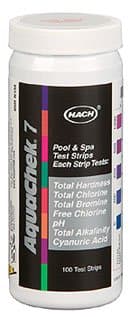
AquaChek Silver 7-Way Test Strips (100 count)
AquaChek
Seven readings in fifteen seconds, including the two that beginners never measure and then fight all summer: total alkalinity and cyanuric acid.
#ad how this is funded · price as of October 11, 2026
Key specs
- Tests
- Free chlorine, total chlorine, bromine, pH, total alkalinity, total hardness, cyanuric acid
- Free chlorine range
- 0-20 ppm
- pH range
- 6.2-8.4
- Total alkalinity range
- 0-240 ppm
- Cyanuric acid range
- 0-300 ppm
- Read time
- 15 seconds
- Count
- 100 strips
How it scoresour reading of published specs, not a test result
- Value
- 9.2
Overall 8.9 / 10
What works
- Covers cyanuric acid, which most cheap strips omit and which is the reason chlorine stops working in a stabilized pool
- pH range spans 6.2-8.4, comfortably bracketing the CDC's recommended 7.0-7.8
- 15 seconds and a color chart printed on the bottle — no separate booklet to lose
- 100 strips is a full season of twice-weekly testing with room to spare
What doesn't
- Strips are a comparison against a printed color chart, so they are directional rather than precise
- Reading them in bright sun is harder than it should be
- The bottle must be kept sealed and dry or the strips degrade quietly
Skip it if: Fine adjustment. If you are chasing a stubborn problem and need a number rather than a color band, a liquid reagent kit is the tool.
What it costs to run: 100 strips at twice-weekly testing covers roughly two seasons for one pool. The real saving is upstream: knowing your alkalinity stops you buying pH adjuster you did not need.
One honest season: The cheapest setup that genuinely works for a season of real swimming. Nothing spare, nothing missing.
Specs from: CDC — home pool and hot tub water treatment and testing
Questions people actually ask
Can pool chemicals be stored over winter?
What pool chemicals should never be stored together?
Do pool test strips expire?
Can you store pool chemicals in the house?
Is it cheaper to keep leftover chemicals or buy fresh in spring?
Sources
Read next
- Closing, covering and opening againWinterizing, covers and spring opening - the four weeks of the year that decide whether you own a pool next summer.
- Where the pump spends the winterManufacturer instructions for draining and storing pumps and filters over winter, the plug conflict between makers, and how pool chemicals should be stored.
- Pool closing kits: buy one the first year, then stopWhat is in a closing kit, whether the bundle premium is justified, and how to buy separately once you know your water.
- How to winterize an above-ground poolThe correct closing sequence, the freeze damage that ends pools, and why a cracked pump housing is entirely preventable.
- Pool shock: what else you are adding decides which one to buyCal-hypo and dichlor shock compared on available chlorine, what each adds to the water for good, published doses and how long before you can swim.
- The best chlorine tablets for an above-ground poolTrichlor tablets compared on available chlorine and stabilizer load, with the season-quantity arithmetic for your pool size.
- What a season of pool chemicals actually adds up toSeason chemical quantities computed from published dosing for four pool volumes, plus the shopping list that is genuinely necessary.
- Your test result is only as good as how you took itThe six common testing errors that produce misleading readings, and how to take a sample that means something.
- What to buy before you open, not halfway throughThe six-item spring shopping list, in the order the opening sequence needs them, plus what to leave until you have a reading.