Floats & Fun
Where the floats go when nobody is swimming
Sun and being left wet are what kill pool floats. Storage is the cheapest intervention available, and the difference between a box that ventilates and one that drains decides whether it works.
Heads up: we earn a commission if you buy through the links on this page, at no extra cost to you. It never decides the ranking — here is how we pick and here is the full disclosure. Prices are checked automatically; last verified October 8, 2026.
Quick picks
Segmented before it is ranked — the right answer depends on which of these you actually are. Tap any row for the full write-up.
Everything in one box
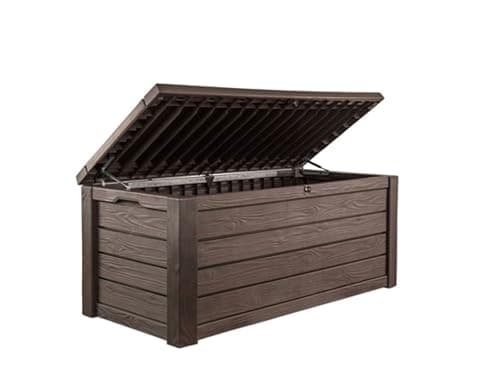
150 gallons of UV-resistant resin rated to 660 lb, lockable, with a published two-year warranty and a lid you can sit on.
| # | Product | Best for | Score | Price |
|---|---|---|---|---|
| 1 | Keter Westwood 150 Gallon Deck Box 150 gallons of UV-resistant resin that takes 660 lb and locks. It ventilates rather than drains, which is the one thing to understand before you put soaking floats in it. | Everything, in one box, with a lid you can sit onSeveral seasons | 8.5out of 10 |
Small patio, or just the toys
Half the footprint and a third of the weight, with the same ventilated resin construction.
| # | Product | Best for | Score | Price |
|---|---|---|---|---|
| 1 | 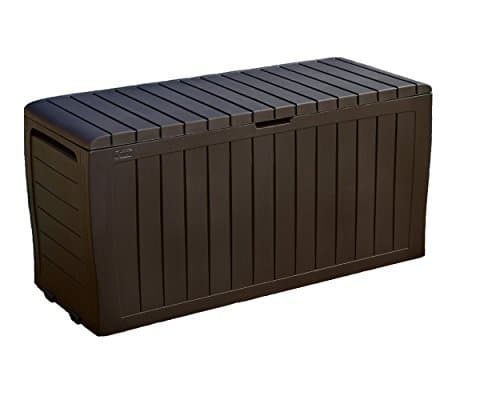 Keter Marvel 71 Gallon Deck Box Half the footprint of the Westwood and a third of the weight, with the same ventilated resin construction. The right size for goggles, dive toys, noodles and a couple of rings. | A small patio, or just the toysSeveral seasons | 8.0out of 10 |
Wet floats, straight out of the water
The only design here that dries rather than seals. Read its warranty before assuming it is built to live outdoors.
| # | Product | Best for | Score | Price |
|---|---|---|---|---|
| 1 | 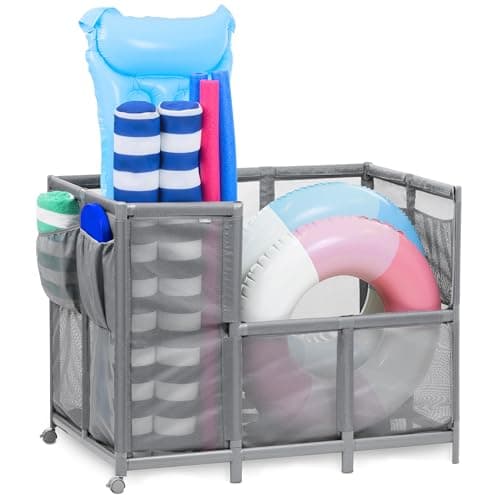 Coast Modern Extra Large Mesh Pool Storage Bin The only design here that suits soaking vinyl: an open mesh bin on locking wheels, 23.6 cubic feet, that drips dry instead of sealing water in. Read the warranty before you assume it is built for the job. | Wet floats, straight out of the poolOne honest season | 7.9out of 10 |
The short version
- Ventilated is not the same as drained. Both resin boxes here ventilate; neither publishes drain holes. Wet floats still need drying before they go in.
- UV is what actually destroys vinyl floats. Testing labs describe UV plus moisture as the combination that drives plasticizer out of PVC.
- Read the warranty on fabric bins. The mesh bin here is warranted six months, explicitly excluding chemical exposure and sun fading — its whole job.
- Floats should be washed, dried and deflated for winter regardless of what you keep them in through the summer.
What storage is actually protecting against
Two things kill pool floats, and neither is punctures. The first is ultraviolet light. Q-Lab, a weathering test-equipment maker, describes how UV degrades the PVC surface, making it easier for plasticizers to mobilize and reach the surface, and calls UV plus moisture the combination that accelerates that process. Plasticizer is what keeps vinyl soft; when it migrates out, the float goes stiff, chalky and brittle, and then splits at a seam.
The second is being stored wet. Intex’s own care guidance for inflatables is to rinse with fresh water, clean with mild soap, and dry thoroughly to prevent mold formation before storage. A float folded away damp grows mildew that does not come off.
Storage addresses both: it gets the floats out of the sun, and — if it is the right kind of storage — lets them dry rather than sealing the water in. Our float lifespan guide goes further into what shortens their life.
The distinction that decides which one you want
Every product in this category is sold as weatherproof storage. Only one of the two designs actually suits something that comes out of the water soaking wet.
Resin deck boxes ventilate. Keter publishes ventilation on both boxes here — the Westwood’s ventilated design is described as helping keep contents dry and fresh — but neither page publishes drain holes. Put a dripping lounger into a sealed resin box and you have made a warm, humid container.
Mesh bins drain and dry. The Coast Modern bin is open mesh on wheels, which is exactly right for floats that come out of the pool between swims. The trade is that mesh keeps nothing out: leaves, rain, grit and sun all reach the contents.
The practical answer for most pools is both, or a sequence: the mesh bin in summer for wet floats between swims, and a resin box for the things that must stay dry — toys, goggles, the solar cover reel handle, chemicals in their own sealed container well away from the toys.
| Product | Capacity | Dries or seals | Load rating | Warranty |
|---|---|---|---|---|
| Keter Westwood | 150 gal | Ventilated, no drain published | 660 lb | 2 years limited |
| Keter Marvel | 71 gal | Ventilated, no drain published | 485 lb seating | Not published on the product page |
| Coast Modern mesh bin | 23.6 cu ft | Open mesh, drains and dries | Not published | 6 months, excluding chemical exposure and sun fading |
Sizing it honestly
Float storage fills faster than people expect, because floats are bulky in exactly the way that defeats boxes. The Westwood’s published internal dimensions are 56 x 24.6 x 22.8 inches; a big lounger folded flat will go in, a large inflatable island will not.
The Marvel at 71 gallons is realistically the toys-and-goggles box: dive sticks, water guns, noodles cut to length, a couple of small rings. Anything lounger-sized needs the larger box or the mesh bin, which at 45.7 by 31.3 by 36 inches is tall enough to take loungers on end without deflating them.
Deflating is the other lever. A pump turns a bulky float into a flat parcel in thirty seconds, which is the real reason our air pump roundup sits next to this one: storage capacity is partly a question of whether you will bother to deflate.
The summer routine that actually extends float life
Rinse the salt or chlorine off
Intex's care guidance is to rinse inflatables with fresh water to remove sand, salt and debris, then clean with mild soap. Chlorine residue left on vinyl is working on it all week.Let them dry before they go away
Not just shaken off - dry. Manufacturer guidance across Intex and Bestway is to dry thoroughly to prevent mold, which is why a mesh bin beats a sealed box in summer.Get them out of direct sun
UV is the main agent of destruction. Shade is doing more for float life than any product in this roundup.Check the valves before storing
A float that deflates overnight usually has a valve that is not fully closed rather than a hole. Check before assuming a puncture and reaching for the patch kit.Deflate and fold for the end of the season
Wash, dry completely, deflate, fold loosely, and store somewhere cool and dry. Our storing floats guide covers the winter routine in full.
What we left out, and why
The rolling mesh carts that dominate search results for this category mostly have no manufacturer page at all — no published capacity, no material, no weight rating, no warranty. One we looked at closely publishes a 400 lb load claim and UV-resistant mesh in its listing copy, and nothing verifiable anywhere else. We have left those out rather than repeat marketing text as specification.
We also left out chemical storage deliberately. Pool chemicals should not live in the same box as pool toys: CDC guidance is to store each chemical separately in a dedicated location, away from incompatible chemicals, below 95°F and protected from getting wet. That is a different container in a different place, and our equipment storage guide covers it.
How we picked
We have not tested this storage. Scores are our reading of published specifications, with credit for publishing dimensions, load ratings and warranty terms. Keter publishes the most and is the most conventional choice; the mesh bin scores highest on the thing that actually preserves floats, which is drying, and lowest on how long it will itself survive outdoors.
Why sunlight is doing more damage than the chlorine
It is worth being specific about the mechanism, because it explains why shade matters more than any product here. Vinyl floats are PVC kept soft by plasticizers. Q-Lab, which makes weathering test equipment, describes how UV degrades the PVC surface, making it easier for plasticizers to mobilize and reach the surface, and identifies UV combined with moisture as the combination that accelerates it.
That is what a stiff, chalky, faded float is: not dirty, but chemically poorer than when it was made. Once the plasticizer has gone the material cracks at the folds, and no repair kit fixes a material problem.
Chlorine and salt residue are a secondary factor, and the guidance is simply to rinse. One float brand recommends rinsing in fresh water and air drying after pool use; Intex’s care guidance for inflatables is to rinse off sand, salt and debris, clean with mild soap, and dry thoroughly before storage.
The end-of-season routine
Wash them, properly
Published guidance is to wash and dry floats before storing, because dirty and damp vinyl is where mildew and pests set up. Mild soap and fresh water is all it asks for.Dry completely, in the sun if necessary
One brand suggests setting inflatables out in the sun for a few hours specifically to dry them. This is the one moment sun exposure is doing you a favor.Deflate fully
Storage guidance is to deflate all the air out and fold. An air pump that reverses turns this from a chore into thirty seconds per float.Fold loosely, not tightly
Intex's guidance for inflatables is to fold loosely to avoid damaging the joints, and not to place heavy objects on top.Store cool, dry and sealed
Airtight containers or vacuum bags are the published recommendation, kept out of direct sunlight because heated air expands and can pop a stored float.
What should not share the box
Poolside storage tends to become general pool storage, and that is where it goes wrong. Pool chemicals should not be in with the toys under any circumstances. CDC guidance is to store chemicals in their original labeled containers, each in a dedicated location, with incompatible chemicals kept apart, below 95°F, out of direct sunlight and protected from getting wet.
A sealed resin box in full afternoon sun is a poor place for an oxidizer on all four counts, and a mesh bin that rain gets into is worse. Chemicals belong in a separate, shaded, dry, ideally locked location — our storage guide covers what that looks like and how long each chemical keeps.
The other thing to keep out is anything with a hard edge. Dive sticks, ladders, brushes and poles stored on top of folded vinyl will find a way through it; the floats want their own space, and the hard gear wants a hook on a wall.
Sizing it before you buy
Measure the largest thing you intend to store, inflated if you plan to store it inflated. The 150 gallon box here publishes internal dimensions of 56 by 24.6 by 22.8 inches, which takes a folded lounger comfortably and a large inflated float not at all. The mesh bin’s 45.7 by 31.3 by 36 inches is tall enough for loungers stood on end.
Then decide honestly whether you will deflate. If the answer is no, buy the tall open bin and accept that the floats will fade faster. If the answer is yes, the resin box is the better long-term home, because it keeps rain, grit and sunlight off vinyl that is already clean and dry.
Storage that is not a box
Two cheaper options deserve a mention, because they solve most of the problem for very little. A shaded corner is the single most effective intervention available: UV is the main agent of destruction, and anything that keeps floats out of direct sun is doing the bulk of the work a storage product is sold for.
The other is a simple hook-and-rail arrangement on a fence or wall. Hung floats drain and dry in the same way a mesh bin allows, take no floor space, and cost the price of a few hooks. The limitation is weather: a hanging float is still out in the rain and the sun, so it suits a covered side of a building rather than an open yard.
Neither replaces a box for the end of the season, when published guidance is clear that floats should be washed, dried, deflated and stored somewhere cool and dry.
The picks, in full
Scores are our own reading of published specifications. They are not test results — we have not tested these products and we do not claim to.
Pick #1 · Everything, in one box, with a lid you can sit on
Keter Westwood 150 Gallon Deck Box
Keter
150 gallons of UV-resistant resin that takes 660 lb and locks. It ventilates rather than drains, which is the one thing to understand before you put soaking floats in it.
#ad how this is funded · price as of October 8, 2026
Key specs
- Capacity
- 150 gallons
- External size
- 61 x 28.5 x 25.35 in
- Internal size
- 56 x 24.6 x 22.8 in
- Material
- Steel-reinforced resin, UV- and weather-resistant
- Airflow
- Ventilated design; no drain holes published
- Load
- 660 lb capacity; the lid seats two adults
- Security
- Metal latch takes a padlock; lock not included
- Warranty
- 2 years limited
How it scoresour reading of published specs, not a test result
- Capacity
- 9.0
- Weatherproofing
- 8.5
- Drying
- 7.0
- Build
- 9.0
- Value
- 8.5
Overall 8.5 / 10
What works
- Large enough for loungers, noodles, toys and a cover in one place
- Ventilated, so damp vinyl is not sealed into a warm box
- Doubles as poolside seating rated to 660 lb
- Two-year warranty published on the product page, which the mesh alternatives do not match
What doesn't
- Ventilation is not drainage: wet floats still need drying before they go in
- Five feet long, which is a real piece of furniture on a small patio
- Padlock is extra
- Rigid box shape suits folded floats better than big inflated ones
Skip it if: Storing floats inflated. Large inflatables have to be deflated to fit, which is the correct way to store them anyway but means the pump comes out every time.
What it costs to run: A one-off purchase measured against replacing sun-perished floats every year or two. Our float lifespan guide covers what actually kills them, and most of it is sunlight and being left out wet.
Several seasons: Buy-once. Built and warranted to come back out of the box for a few years, if you store it properly.
Specs from: Keter — Westwood 150 gallon deck box, published specifications and warranty
Pick #2 · A small patio, or just the toys
Keter Marvel 71 Gallon Deck Box
Keter
Half the footprint of the Westwood and a third of the weight, with the same ventilated resin construction. The right size for goggles, dive toys, noodles and a couple of rings.
#ad how this is funded · price as of October 8, 2026
Key specs
- Capacity
- 71 gallons
- External size
- 46 x 17.7 x 22.4 in
- Internal size
- 45 x 15.7 x 20.1 in
- Material
- UV-resistant resin; stated not to peel, rot, rust or crack
- Airflow
- Built-in ventilation; drain holes not published
- Load
- Seating rated to 485 lb
- Weight
- 15.17 lb
- Warranty
- Not published on the product page; Keter publishes a general two-year limited warranty
How it scoresour reading of published specs, not a test result
- Capacity
- 7.0
- Weatherproofing
- 8.5
- Drying
- 7.0
- Build
- 8.5
- Value
- 8.5
Overall 8.0 / 10
What works
- Fits against a wall or under a window where the big box will not go
- Light enough for one person to move when the patio gets rearranged
- Same UV-resistant resin and ventilation as the larger box
- Still rated as seating, at 485 lb
What doesn't
- 71 gallons fills fast once loungers are involved
- The product page does not publish its own warranty term
- Ventilated rather than drained, like every box here
- Too short for a rolled solar cover or a full-size lounger
Skip it if: Being the only storage. This is the toys-and-goggles box; the loungers and the winter cover need somewhere else to live.
What it costs to run: Cheap, and it removes the main reason floats die early: being left in the sun between swims. That is a float-replacement saving, not a running cost.
Several seasons: Buy-once. Built and warranted to come back out of the box for a few years, if you store it properly.
Specs from: Keter — Marvel 71 gallon deck box, published specifications, Keter — product FAQs, warranty documentation policy
Pick #3 · Wet floats, straight out of the pool
Coast Modern Extra Large Mesh Pool Storage Bin
Coast Modern
The only design here that suits soaking vinyl: an open mesh bin on locking wheels, 23.6 cubic feet, that drips dry instead of sealing water in. Read the warranty before you assume it is built for the job.
#ad how this is funded · price as of October 8, 2026
Key specs
- Capacity
- 23.6 cubic feet
- Size
- 45.7 W x 31.3 D x 36 H in
- Construction
- Mesh sides; all-weather materials, specific fabric not published
- Weather
- Stated rust-proof and weatherproof against sun, chlorine and salt water
- Mobility
- Pre-installed locking wheels
- Storage detail
- Divider for large items and four pockets for small toys
- Warranty
- Six months from delivery, excluding chemical or liquid exposure and sun fading
- Weight capacity
- Not published
How it scoresour reading of published specs, not a test result
- Capacity
- 9.0
- Weatherproofing
- 6.5
- Drying
- 9.5
- Build
- 7.0
- Value
- 7.5
Overall 7.9 / 10
What works
- Open mesh means wet floats dry instead of growing mildew in a sealed box
- Tall enough to take loungers on end without deflating them
- Wheels, so it moves into shade or out of the wind
- Pockets and a divider actually suit the mix of big floats and small toys
What doesn't
- The six-month warranty excludes chemical exposure and sun fading, which describes its entire job
- Neither the fabric nor the weight capacity is published
- Open mesh keeps nothing out — leaves, rain and grit all get in
- Fabric-and-frame construction will not last like a resin box
Skip it if: Winter. This is a summer parking spot for wet floats, not weatherproof storage; the floats should still be washed, dried and put away properly at the end of the season.
What it costs to run: It buys drying, which is the step that decides whether floats come back next year. Our float storage guide covers the routine; this makes the routine easier to keep.
One honest season: The cheapest setup that genuinely works for a season of real swimming. Nothing spare, nothing missing.
Specs from: GoSports / Coast Modern — extra large mesh pool storage bin, published specifications, P&P Imports / GoSports — manufacturer's warranty terms
Questions people actually ask
Should pool floats be stored inflated or deflated?
Does a deck box need drainage for wet floats?
What actually ruins pool floats?
Can I store pool chemicals in the same box as the floats?
How big a box do I need?
Sources
- Keter — Westwood 150 gallon deck box, published specifications and warranty
- Keter — Marvel 71 gallon deck box, published specifications
- GoSports / Coast Modern — extra large mesh pool storage bin, published specifications
- P&P Imports / GoSports — manufacturer's warranty terms
- Q-Lab — accelerating plasticizer migration testing of PVC
- Intex Support — caring for inflatables, cleaning and drying before storage
Read next
- Floats, loungers and the stuff that makes the pool worth havingFloats for adults, toddlers and dogs - ranked on seam and valve construction, which is what actually decides how long they last.
- How to store pool floats so you are not rebuying them in MayThe end-of-season routine for inflatables and foam: drying properly, folding without creasing, and where to keep them so they survive winter.
- How long pool floats last, and why yours did notWhat actually destroys a pool float, the four-step routine that roughly triples its life, and when to patch versus replace.
- The pump decides whether the floats get usedMains, 12V and cordless air pumps compared on published airflow in liters per minute, what each maker rates them for, and which one Intex labels indoor-use only.
- Finding the hole, and making the patch actually holdHow to locate a slow leak, tell a puncture from a failing valve, and patch vinyl so the repair survives the season.
- The best pool toys for a backyard poolWeighted dive toys, foam noodles and games that work in 24 inches of water - and cannot puncture.
- Taking the pool down without ruining itThe take-down sequence for a seasonal pool: draining responsibly, drying completely, folding warm, and storing where rodents are not.