Pool Costs
The pool is seasonal. The hot tub is a standing charge.
Two products for the same backyard with opposite cost shapes. Getting that shape right is more useful than any single number either category publishes.

Heads up: we earn a commission if you buy through the links on this page, at no extra cost to you. It never decides the ranking — here is how we pick and here is the full disclosure. Prices are checked automatically; last verified October 8, 2026.
The short version
- The shapes are opposite. A pool is a large purchase with a four-month running cost; a hot tub is a smaller purchase with a twelve-month one.
- Heating is the whole difference. A pool is heated by the sun and a hot tub is heated by your electricity meter, continuously.
- Volume is not the guide it looks like. A hot tub holds a fraction of a pool’s water and costs far more to keep at temperature.
- The cover is the biggest lever on both — and on a hot tub it is the difference between viable and not.
Two products, two completely different cost shapes
An above-ground pool is bought once, filled once, run for about 120 days and then closed. Our annual cost guide prices that whole shape: the recurring cost is pump electricity, chemicals and water, and for eight months of the year it is approximately zero.
An inflatable hot tub is the other shape. It holds far less water, it costs less to buy, and it is held at temperature continuously — because a hot tub you let go cold takes many hours to bring back, which is the reason nobody does it. Our inflatable hot tub roundup covers the hardware side and makes the same point.
| Above-ground pool | Inflatable hot tub | |
|---|---|---|
| Purchase | The larger of the two | The smaller of the two |
| Water volume | 1,500 - 7,000 gal | Typically 200 - 300 gal |
| Season | About 120 days | All year, by design |
| Main running cost | Pump electricity | Heating, continuously |
| Heat source | The sun, plus a cover | Your electricity meter |
| Water replaced | Once a season | Every few weeks to months |
| Chemistry | Larger volume, slower to move | Small volume, moves fast |
| Off-season cost | Near zero | The same as on-season |
Why the small one costs more to run
It is counterintuitive until you state it properly: you are not paying to heat water, you are paying to keep it hot against the temperature difference with the air, every hour, all year.
A pool at 80°F on an 80°F day is losing almost nothing. A hot tub at 102°F on a 40°F November night is losing heat continuously across a 60-degree gap, and the heater is replacing it continuously. The gap, not the volume, is what the meter is measuring.
That is also why hot tub running cost is so weather-dependent and so hard to quote. Two identical tubs in Arizona and Minnesota do not cost remotely the same to run, and any single national figure is hiding that. Work yours from the unit’s own rated heater draw and the EIA US residential average of 18.34 cents per kWh, the same way our pump electricity guide does it for pumps.
The water and chemistry difference
A pool is filled once a season. Our cost to fill guide prices that at the EPA WaterSense average of $6.06 per 1,000 gallons, and it is a once-a-year line.
A hot tub is refilled several times a year, because 250 gallons at 102°F with people in it is a much harder chemistry problem than 4,000 gallons at 80°F. Less water, more bathers per gallon, and a temperature that accelerates everything. The volumes are small so each refill is cheap, but the testing discipline is considerably tighter — the CDC’s guidance treats home pools and hot tubs together for exactly this reason, and the hot tub is the demanding half of it.
Which one suits which household
Children, summer, and a yard. The pool, comfortably. Our cost per swim guide is built around the fact that a pool’s cost divides across a lot of use in a short window, and children supply that use.
Two adults, all year, a small yard. The hot tub. It is used in November, which a pool is not, and the cost divides across twelve months of actual use rather than four.
Uncertain, first time, tight budget. The pool — specifically the cheapest honest version of it in our cheapest setup guide. The reason is that the downside is bounded: a pool you stop enjoying costs nothing over winter, while a hot tub you stop enjoying keeps drawing power until you deal with it.
The honest summary
Neither is cheap and neither is the trap the other’s marketing suggests. The pool costs more up front and stops costing anything in October. The hot tub costs less up front and never stops. Everything else — volume, chemicals, water — is noise against that one difference.
What to buy
Scores are our own reading of published specifications. They are not test results — we have not tested these products and we do not claim to.
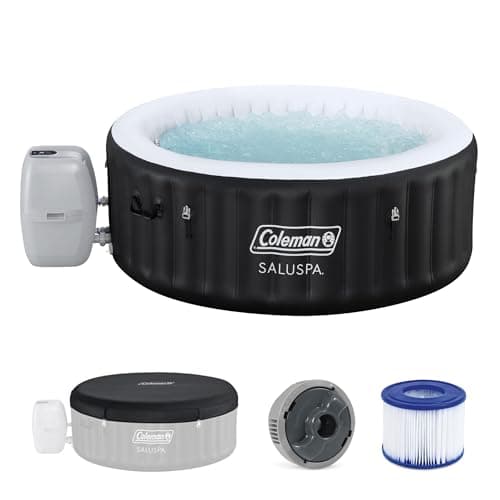
The default inflatable hot tub
Coleman SaluSpa Inflatable Hot Tub
Coleman (Bestway)
The one most people end up with, and reasonably so. Insulated cover and wall are the specs worth paying for, because everything expensive about owning one of these is heat you paid for and then lost.
Key specs
- Capacity
- 4 to 6 people, depending on SKU
- Size
- 71in or 77in round x 28in, per model
- Jets
- 140 AirJets on current models
- Cover
- EnergySense insulated cover included
- Cold weather
- Freeze Shield on current models
- Running cost
- Not published — depends on your rate and ambient temperature
How it scoresour reading of published specs, not a test result
- Build
- 7.5
- Setup
- 9.0
- Upkeep
- 6.5
- Running cost
- 5.5
- Value
- 8.0
Overall 7.6 / 10
What works
- Insulated cover and wall are the features that actually govern the running cost
- No installation, no permit conversation, no groundwork beyond a level base
- Packs away, which matters if the yard has one usable corner
- Widely stocked, so replacement filters and parts are easy to find
What doesn't
- Air jets, not water jets — this is bubbles rather than massage, and people expect the latter
- Heating is slow by design; you plan around it rather than deciding on the day
- Filter cartridges are a frequent consumable at spa bather loads
- Vinyl in constant hot water ages faster than the same vinyl in a pool
Skip it if: Anyone expecting hydrotherapy jets. It is a warm bubbling tub, and that is a different product from a hard-shell spa.
What it costs to run: The purchase is the small number. A hot tub is heated 24/7 rather than seasonally, so the electricity is the real commitment and it is entirely a function of your rate, your cover discipline and your climate. Nobody publishes a national figure and we will not invent one.
Several seasons: Buy-once. Built and warranted to come back out of the box for a few years, if you store it properly.
Specs from: Coleman SaluSpa — current Amazon listing and published specifications
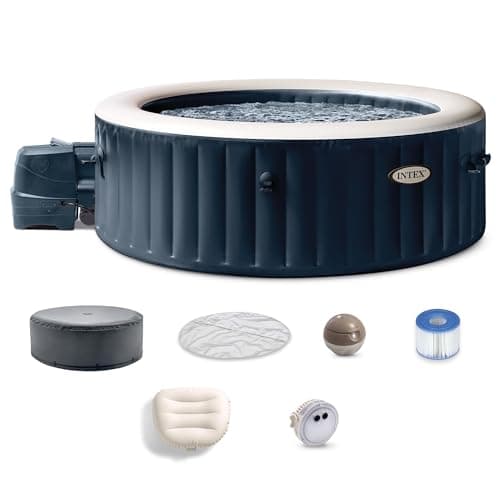
Hard water, and people who already own Intex
Intex PureSpa Inflatable Hot Tub
Intex
The direct alternative, and the built-in hard water treatment is a genuine point of difference rather than a marketing one if your fill water is hard.
#ad how this is funded · price as of October 8, 2026
Key specs
- Capacity
- 4 people (28429EP)
- Size
- 77in round x 28in
- Water treatment
- Built-in hard water treatment system
- Included
- Energy-efficient spa cover, 2 headrests, LED light
- Jets
- Bubble massage — air, not water jets
- Running cost
- Not published
How it scoresour reading of published specs, not a test result
- Build
- 7.5
- Setup
- 9.0
- Upkeep
- 6.5
- Running cost
- 5.5
- Value
- 7.8
Overall 7.5 / 10
What works
- Built-in hard water treatment is a real advantage on hard fill water
- Insulated cover included rather than sold separately
- Shares the Intex accessory ecosystem if you already own an Intex pool
- Headrests and light included, which are usually add-ons elsewhere
What doesn't
- Air bubbles rather than water jets, same as the category
- Four people is a genuine four, not an optimistic one
- Cartridges need changing often at spa temperatures and bather loads
- Wattage is not published, so the running cost cannot be computed before purchase
Skip it if: Cold-climate winter use without serious attention to the cover and the ground under it. These are insulated, not immune.
What it costs to run: Same shape as the rest of the category: the electricity dwarfs the purchase over a year. The one lever you control is whether the cover goes back on every single time.
Several seasons: Buy-once. Built and warranted to come back out of the box for a few years, if you store it properly.
Specs from: Intex PureSpa 28429EP — current Amazon listing and published specifications
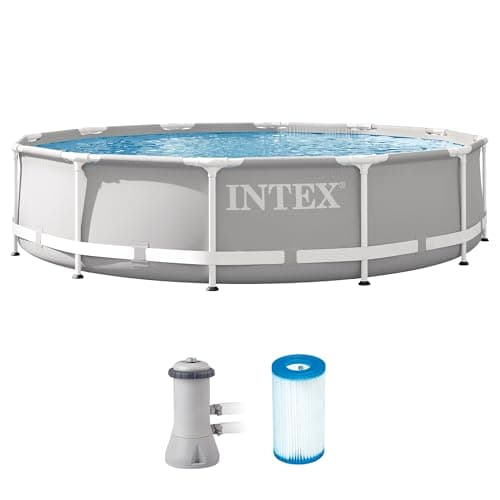
Small yards and first-time owners
Intex Prism Frame Pool Set, 12ft x 30in
Intex
The size most people should buy first and the one most people talk themselves out of. 1,718 gallons is cheap to fill, cheap to treat, and forgiving of every mistake you are about to make.
Key specs
- Water capacity
- 1,718 gallons
- Pump supplied
- Krystal Clear C530 — 530 GPH pump / 475 GPH system
- Frame
- Powder-coated metal, tool-free Easy Lock
- Liner
- 3-ply, puncture resistant
- Manufacturer setup claim
- Ready in 30 minutes
- Pump wattage
- Not published by Intex
How it scoresour reading of published specs, not a test result
- Build
- 7.0
- Setup
- 9.0
- Upkeep
- 9.0
- Running cost
- 9.0
- Value
- 9.0
Overall 8.6 / 10
What works
- A 12-foot circle fits in a yard where a 15 or 18 will not, once you allow three feet of walking space
- 1,718 gallons turns over in about 3.6 hours on the supplied 475 GPH system flow — so a short daily run genuinely filters it
- Cheapest of the frame pools to make a mistake in: a bad chemical week costs a few dollars, not a few tens
- Tool-free assembly is real, not marketing — this is a genuinely one-afternoon job
What doesn't
- 30-inch wall means shallow water and it warms and cools fast
- Small enough that three adults fill it
- The C530 is sized for exactly this pool and nothing bigger, so it does not carry over if you upgrade
Skip it if: Anyone planning to swim rather than sit. This is a cooling-off and playing pool and it is very good at that.
What it costs to run: The cheapest frame pool here to run, and the gap is not small. At the EPA WaterSense average of $6.06 per 1,000 gallons a fill is about $10. Its turnover math — 1,718 gallons at 475 GPH system flow — means roughly 3.6 hours per full turnover, so a 7-8 hour daily run is two full turnovers rather than a partial one.
One honest season: The cheapest setup that genuinely works for a season of real swimming. Nothing spare, nothing missing.
Specs from: Intex — Prism Frame 12' x 30' pool set, Intex — Krystal Clear cartridge filter pumps
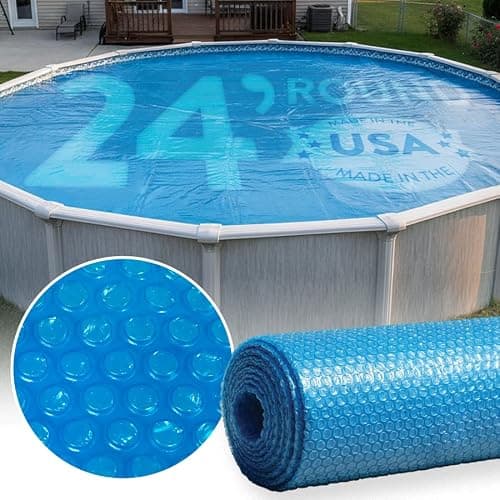
The single highest-return accessory here
Bubble Solar Cover for Above-Ground Pools
Various
It cuts evaporation, and evaporation is simultaneously your water bill, your chemical bill and your heat loss. Nothing else on this site reduces three costs at once.
#ad how this is funded · price as of October 8, 2026
Key specs
- Construction
- Bubble sheet, thickness published in mil
- Thickness
- Higher mil lasts longer — 12 mil and 16 mil are common
- Fit
- Cut to size; buy oversize and trim
- Orientation
- Bubbles face down, toward the water
How it scoresour reading of published specs, not a test result
- Retention
- 9.0
- Durability
- 7.0
- Handling
- 6.0
- Running cost
- 9.8
- Value
- 9.5
Overall 9.0 / 10
What works
- Reduces evaporation, which is the mechanism behind the water, chemical and heat savings all at once
- Cheap relative to everything it saves
- Can be cut to fit any pool shape, so sizing is forgiving
What doesn't
- Awkward to get on and off without a reel, and awkward is how covers end up unused
- Degrades in UV like every vinyl product
- Not a safety cover and will not support weight — this is important
Skip it if: Being a safety barrier. A solar cover looks solid and is not; a child or pet on it goes through and under.
What it costs to run: The one accessory with a clear payback. Every gallon that does not evaporate is a gallon you do not replace at the EPA WaterSense national average of $6.06 per 1,000 gallons, and it is chlorine you do not re-dose. If you buy one thing from this hub, buy this.
Several seasons: Buy-once. Built and warranted to come back out of the box for a few years, if you store it properly.
Specs from: EPA WaterSense — cost per 1,000 gallons
Questions people actually ask
Does a hot tub cost more to run than a pool?
Why does a small hot tub cost more to heat than a large pool?
Which is better for a family with young children?
What most affects a hot tub's running cost?
Sources
Read next
- What a pool actually costs, with the arithmetic shownPurchase, electricity, chemicals, water and replacement parts - added up, sourced, and shown as arithmetic you can redo.
- What an above-ground pool actually costs to run for a yearElectricity, chemicals, water and consumables for a full season - every input sourced, every calculation shown, and every assumption named.
- Heating a pool, priced properlyThe physics of heating a pool turned into dollars, why a cover changes the answer more than the heater does, and when heating is worth it.
- What your pool pump costs to run, in watts and dollarsPool pump electricity computed from watts, hours and the EIA national average rate, with a table you can read your own pump off.
- Cost per swim, and why it is the only number that settles the argumentThe running cost divided by realistic use, worked out for three pool sizes, and why the denominator matters more than the numerator.
- Inflatable hot tubs, judged on the bill rather than the bubblesThe two inflatable hot tubs worth shortlisting, compared on insulation and cover rather than jet count, plus the running cost nobody publishes.
- The best inflatable backyard poolsSoft-side pools compared on published capacity and setup time, plus what actually destroys them and how to slow it down.
- Adding weeks to the season, starting with the cheapest thing firstCover, placement and timing before hardware, plus the kilowatt arithmetic that shows what running an electric heater actually costs.