Floats & Fun
Vinyl or mesh: one floats on the water, the other sits in it
An inflatable lounger keeps you dry on top. A mesh one lets the water through. That single difference decides comfort, lifespan and whether it survives being stored wet.
Heads up: we earn a commission if you buy through the links on this page, at no extra cost to you. It never decides the ranking — here is how we pick and here is the full disclosure. Prices are checked automatically; last verified October 8, 2026.
Quick picks
Segmented before it is ranked — the right answer depends on which of these you actually are. Tap any row for the full write-up.
If you want to stay dry and sit up
Multiple air chambers and a backrest, so one puncture does not sink it. The comfortable option, and the one that punctures.
| # | Product | Best for | Score | Price |
|---|---|---|---|---|
| 1 | 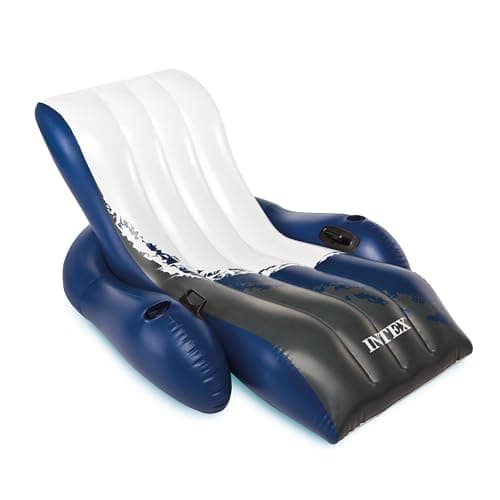 Intex Inflatable Pool Lounge with Backrest A backrest changes an inflatable from something you lie on to something you can actually sit in and hold a drink. That is the whole feature and it is worth the small premium. | One adult, sitting upOne honest season | 7.6out of 10 |
If you want it back next summer
A mesh seat drains and dries, and fails by wear rather than by puncture. Less to go wrong, and far less to store.
| # | Product | Best for | Score | Price |
|---|---|---|---|---|
| 1 | 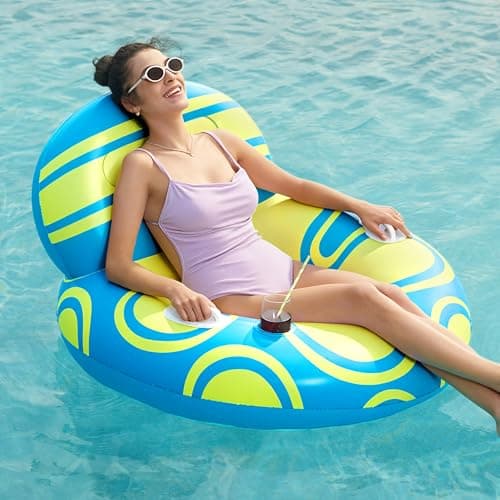 Mesh-Bottom Pool Lounger Chair The mesh seat has almost no inflated volume, which removes the thing that fails on every other float. Outlasts vinyl inflatables by years and costs more up front for exactly that reason. | Lasting more than one summerSeveral seasons | 8.4out of 10 |
If you want to sit in the water, not on it
A quick-dry mesh center with vinyl head and foot inserts, in several positions. It needs real depth to use properly.
| # | Product | Best for | Score | Price |
|---|---|---|---|---|
| 1 | 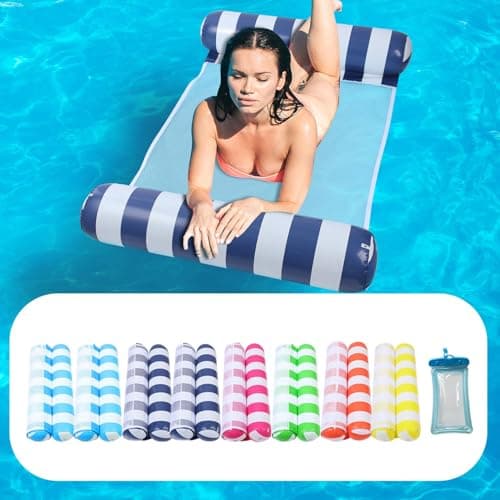 4-in-1 Pool Hammock Float A mesh-centered float that works as a hammock, a saddle, a lounge chair or a drifter. The mesh is the point — you stay in the water, which is cooler and far more stable than lying on top of one. | Sitting in the water rather than on itOne honest season | 8.2out of 10 |
The short version
- They fail differently. Vinyl punctures and perishes; mesh wears at the frame and the seams.
- Mesh dries. That matters more than it sounds, because storing vinyl wet is what grows mildew.
- Vinyl is more comfortable for sunbathing; mesh is more comfortable in heat, because the water reaches you.
- Depth decides the hammock style. The sitting positions hang below you.
The material difference
An inflatable lounger is vinyl with air chambers. The better ones use several chambers so a single puncture does not put you in the water, and add a backrest so you can sit up. It floats you on top of the water, which is the point if you want to stay dry and read something.
A mesh or fabric lounger suspends you in a seat that water passes through, usually on an inflatable or foam frame. You get wet, which in a heatwave is the entire attraction, and the seat drains when you lift it out.
The hammock style sits between the two: a quick-dry mesh center with vinyl inserts at head and foot, convertible between hammock, saddle, chair and drifter positions. Our hammock float roundup covers the format in full.
Which one lasts
Neither material beats the real killer, which is sunlight. Our float lifespan guide covers why UV drives plasticizer out of vinyl until it goes stiff and splits — and a mesh lounger’s inflatable frame is vinyl too.
What mesh does change is the second killer: being stored wet. A mesh seat drains and dries in minutes, while a vinyl lounger holds water in its folds and grows mildew in storage, which our storage guide deals with.
The repair picture differs too. A vinyl puncture is genuinely fixable with a patch kit — our repair guide covers finding the hole. A torn mesh seat or a failed seam usually is not.
| Inflatable vinyl | Mesh / fabric | |
|---|---|---|
| You sit | On top of the water | In the water |
| Comfort | Better for sunbathing and staying dry | Better in heat |
| Fails by | Puncture, then UV perishing | Frame and seam wear |
| Repairable | Yes, with a vinyl patch kit | Rarely |
| Drying | Holds water in folds | Drains in minutes |
| Storage | Deflate, dry and fold | Usually folds without deflating |
The pool-size question
Loungers are large, and an above-ground pool is not. A full-length inflatable lounger in a 12-foot pool leaves room for very little else, which is why our small pool floats roundup exists.
Depth matters for the hammock style specifically: the saddle and chair positions hang below the surface, so in a 30-inch pool your feet are on the floor and the float is doing nothing. That format wants a 48-inch wall or better.
Who should buy which
Inflatable vinyl if you want to lie flat, stay dry and pay the least. Accept that it is a consumable and buy a patch kit at the same time.
Mesh or fabric if you are tired of replacing floats every year, if the pool gets a lot of sun, or if storage is the part of the season you dread.
Hammock if your pool is deep enough and you want to be in the water rather than on it — it is the most comfortable of the three in genuine heat.
Inflating a vinyl lounger without shortening its life
Float manuals are unusually clear about this and almost nobody reads them. Bestway’s instruction is to fill until most of the wrinkles are gone and it feels firm to touch but NOT hard, not to over-inflate, and never to use an air compressor.
The reason is heat. The same manual warns that leaving a float in the sun causes air expansion that can do irreparable damage — so a float inflated hard at nine in the morning is under serious pressure by two in the afternoon. That is why seams fail on hot days rather than busy ones, and it is the single most common way a vinyl lounger dies early.
Our inflating guide covers the technique, and our air pump roundup covers the tool — including the pumps that deflate, which is what makes proper storage realistic.
Valves, and the leak that is not a leak
A lounger that is soft in the morning usually has a valve that is not fully closed rather than a hole. Boston valves — the screw-in type with a separate cap — are the ones worth having, because they seal positively and can be topped up without losing what is already in the chamber.
Multiple chambers matter for the same practical reason: a single puncture in a multi-chamber lounger leaves you floating rather than swimming. Before assuming a puncture, check the valve and check overnight temperature drop, then use the technique in our repair guide to find a real hole.
Buying for the pool you actually have
Measure before buying. A full-length lounger is longer than many above-ground pools are usable, and a hammock float needs depth its saddle position can hang into. In a 30-inch pool both are compromised.
For small pools, seats and rings beat loungers, which our small pool floats roundup covers. For a 52-inch pool, any of the three formats on this page works, and the choice really is about material and storage.
End of season, for each type
This is where the two materials diverge most, and where most floats are actually lost.
A vinyl lounger needs washing, drying completely, deflating and folding loosely. The published guidance across float makers is consistent: rinse off chlorine and salt, dry thoroughly to prevent mold, fold loosely to avoid damaging the seams, and store somewhere cool and dry rather than a hot shed. A pump that reverses turns the deflation step from a chore into thirty seconds.
A mesh lounger is easier: it drains in minutes and usually folds without deflating anything, though any inflatable frame section gets the same treatment as vinyl.
Both die from the same two causes if you skip that routine — stored damp, or stored hot. Our storage guide has the full sequence, and our storage roundup covers where they go between swims during the season, which is the other half of the problem.
The honest recommendation
If you replace floats every year and have made peace with it, buy vinyl and buy a patch kit with it. It is more comfortable to lie on and cheaper to replace.
If being tired of replacing floats is what brought you to this page, buy mesh. It dries, it stores flat, it fails slowly rather than suddenly, and it removes the one job — drying vinyl properly before storage — that most people skip and then pay for in May.
The cheapest way to make either last
Get it out of the sun when nobody is on it. UV is the agent that ends both materials, and a float that spends six hours a day baking on the deck ages several times faster than one that goes into shade between swims.
That is the whole argument for having somewhere to put them, which our storage roundup covers — and it costs nothing at all if the somewhere is simply a shaded corner rather than a product.
What to buy
Scores are our own reading of published specifications. They are not test results — we have not tested these products and we do not claim to.
One adult, sitting up
Intex Inflatable Pool Lounge with Backrest
Intex
A backrest changes an inflatable from something you lie on to something you can actually sit in and hold a drink. That is the whole feature and it is worth the small premium.
#ad how this is funded · price as of October 8, 2026
Key specs
- Material
- Vinyl — gauge published per SKU
- Chambers
- Multiple, so a single puncture does not sink it
- Weight capacity
- Published per SKU by Intex
- Valve
- Check the SKU — Boston valves are the ones worth having
How it scoresour reading of published specs, not a test result
- Material
- 7.0
- Valve
- 7.5
- Capacity
- 8.0
- Storage
- 6.5
- Value
- 8.0
Overall 7.6 / 10
What works
- Backrest makes it usable for more than ten minutes at a time
- Multi-chamber construction means one leak is an inconvenience rather than the end
- Intex publishes weight capacity, which many float brands do not
What doesn't
- Vinyl in direct sun is on a clock no matter what you pay
- Bulky to inflate without a pump
- Larger surface area means more to store and more to dry
Skip it if: Being left inflated on a hot deck between swims, which is exactly what everyone does and exactly what kills it.
One honest season: The cheapest setup that genuinely works for a season of real swimming. Nothing spare, nothing missing.
Lasting more than one summer
Mesh-Bottom Pool Lounger Chair
Various
The mesh seat has almost no inflated volume, which removes the thing that fails on every other float. Outlasts vinyl inflatables by years and costs more up front for exactly that reason.
Key specs
- Construction
- Fabric or mesh seat on an inflatable or foam frame
- Failure mode
- Frame or fabric wear rather than puncture
- Weight capacity
- Published per model
- Drying
- Mesh drains and dries quickly
How it scoresour reading of published specs, not a test result
- Material
- 9.0
- Valve
- 8.5
- Capacity
- 8.0
- Storage
- 6.0
- Value
- 8.5
Overall 8.4 / 10
What works
- Very little inflated volume, so the usual puncture failure mode largely goes away
- Mesh drains and dries, so it does not get stored wet and go moldy
- Genuinely a multi-season purchase in a category of consumables
What doesn't
- Considerably more expensive than a vinyl inflatable
- Sits lower in the water, which some people dislike
- Bulkier to store than a deflated inflatable
Skip it if: A shallow pool. A mesh lounger needs enough depth for the seat to hang in, so it is wrong in a 30-inch pool.
What it costs to run: The arithmetic that justifies it: a $25 vinyl float replaced every summer for four years costs more than one mesh lounger that lasts four. Buy this only if your pool is deep enough to use it.
Several seasons: Buy-once. Built and warranted to come back out of the box for a few years, if you store it properly.
Sitting in the water rather than on it
4-in-1 Pool Hammock Float
Various
A mesh-centered float that works as a hammock, a saddle, a lounge chair or a drifter. The mesh is the point — you stay in the water, which is cooler and far more stable than lying on top of one.
#ad how this is funded · price as of October 8, 2026
Key specs
- Modes
- Hammock, saddle, lounge chair, drifter
- Center
- Quick-dry mesh fabric rather than vinyl
- Inserts
- 12-gauge vinyl headrest and footrest on the better ones
- Size
- Around 55 x 29.5 in on common models
- Capacity
- Up to 300 lb, manufacturer-stated
- Depth needed
- Real depth — the saddle mode hangs below you
How it scoresour reading of published specs, not a test result
- Material
- 8.0
- Valve
- 7.5
- Capacity
- 8.5
- Storage
- 8.0
- Value
- 8.5
Overall 8.2 / 10
What works
- Four genuinely different positions from one float, which is rare in this category
- The mesh center keeps you in the water, so it is usable in real heat
- Far more stable than a flat lounger — much harder to tip out of
- Folds small for a float of this size
What doesn't
- Needs depth. In a 30-inch pool the saddle position touches the floor
- Two or three separate chambers to inflate rather than one
- Mesh collects sunscreen and needs rinsing or it goes gray
- The 300 lb figure is manufacturer-stated and assumes even loading
Skip it if: Shallow pools. This is a 42-inch-and-up float, and in anything shallower most of its four modes stop working.
What it costs to run: No running cost. Rinse the mesh and dry it fully before storing, and it lasts several seasons rather than one.
One honest season: The cheapest setup that genuinely works for a season of real swimming. Nothing spare, nothing missing.
Specs from: Poolmaster 4-in-1 water hammock — Amazon listing
Questions people actually ask
Do mesh pool loungers last longer than inflatable ones?
Why does my inflatable lounger keep going soft?
Which is better in hot weather?
Will a lounger fit in a small above-ground pool?
Read next
- Floats, loungers and the stuff that makes the pool worth havingFloats for adults, toddlers and dogs - ranked on seam and valve construction, which is what actually decides how long they last.
- The best pool loungersMesh chairs versus vinyl mats, the depth each needs, and the four-summer arithmetic that favors mesh.
- The float that keeps you in the water4-in-1 hammock and saddle floats compared with flat loungers on temperature, stability and the water depth they need to work.
- How long pool floats last, and why yours did notWhat actually destroys a pool float, the four-step routine that roughly triples its life, and when to patch versus replace.
- How to store pool floats so you are not rebuying them in MayThe end-of-season routine for inflatables and foam: drying properly, folding without creasing, and where to keep them so they survive winter.
- Finding the hole, and making the patch actually holdHow to locate a slow leak, tell a puncture from a failing valve, and patch vinyl so the repair survives the season.
- The best pool floats for adultsAdult loungers and tubes compared on capacity and seat design, plus the pool depth each one actually needs.