Floats & Fun
The pump decides whether the floats get used
A float that takes ten minutes of lung power gets inflated twice a summer. A float that takes ninety seconds gets used every day. That is the whole argument for owning a pump.
Heads up: we earn a commission if you buy through the links on this page, at no extra cost to you. It never decides the ranking — here is how we pick and here is the full disclosure. Prices are checked automatically; last verified October 8, 2026.
Quick picks
Segmented before it is ranked — the right answer depends on which of these you actually are. Tap any row for the full write-up.
Fastest at a socket
650 liters a minute from mains power, and the pump most float owners should buy. Note the published ten-minute duty cycle and the indoor-use rating.
| # | Product | Best for | Score | Price |
|---|---|---|---|---|
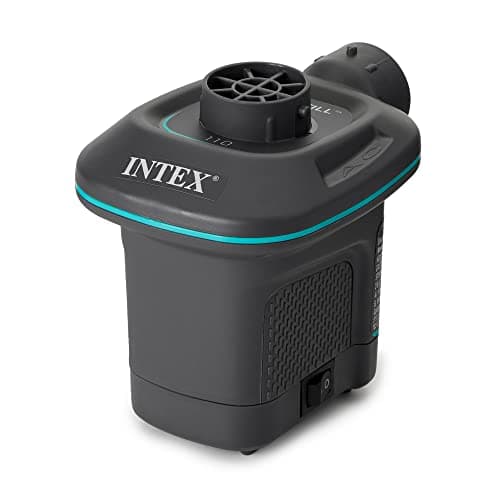
| 1 | Intex Quick-Fill AC Electric Air Pump (66639E) 650 liters a minute from a mains socket, and the pump most float owners should buy. Read the duty cycle before you start on a six-person island: ten minutes on, ten minutes off. | Fastest inflation at a socketSeveral seasons | 8.4out of 10 |
The one rated for outdoors
Identical airflow to the mains pump, running from a car outlet, and the only Intex pump here the maker describes as designed for outdoor use.
| # | Product | Best for | Score | Price |
|---|---|---|---|---|
| 1 | 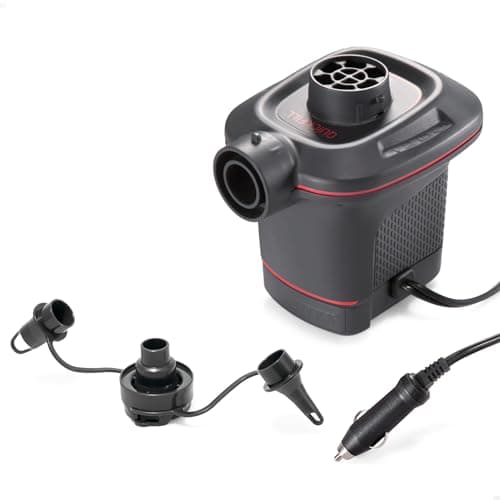 Intex Quick-Fill DC Electric Air Pump (66636E) The same 650 liters a minute as the mains pump, running off a car outlet, and the only Intex pump here the maker describes as designed for outdoor use. | The one Intex actually rates for outdoorsSeveral seasons | 8.3out of 10 |
No socket, no car
Six C cells and under a pound. Slower, and the only one here that goes anywhere without planning.
| # | Product | Best for | Score | Price |
|---|---|---|---|---|
| 1 | 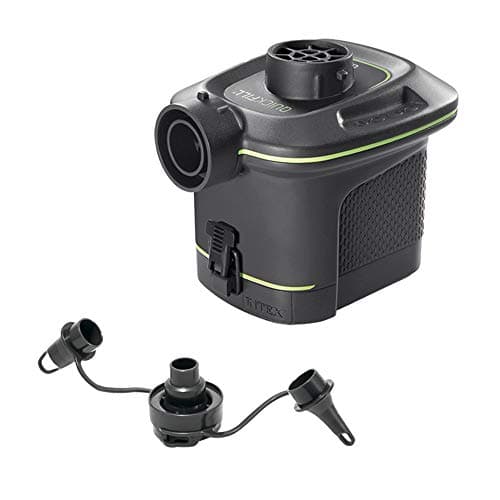 Intex Quick-Fill Battery Air Pump (66638E) Six C cells, 420 liters a minute and under a pound. It is the slowest Intex pump here and the only one that goes anywhere without planning. | No socket, no car, no cableOne honest season | 8.1out of 10 |
Cordless without buying batteries
A 6,000 mAh pack charged from any USB port, with the maker's own honest list of what it is not for.
| # | Product | Best for | Score | Price |
|---|---|---|---|---|
| 1 | 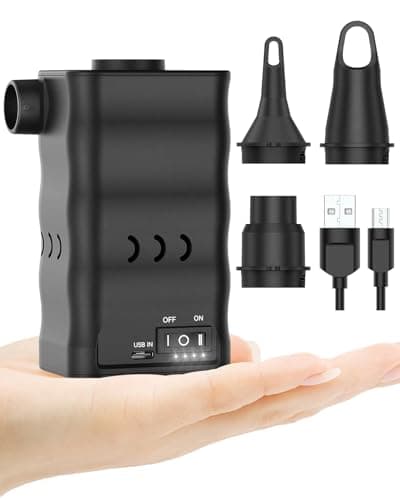 Dr.meter 6000mAh Rechargeable Air Pump A 6,000 mAh cordless pump that charges off any USB port and moves up to 400 liters a minute. The maker is clear about its limits, which is more than most cordless pumps manage. | Cordless without buying batteriesOne honest season | 8.3out of 10 |
Buy once
All-steel, 480 W, a published one-year warranty and no duty-cycle restriction. The only pump here built like a tool.
| # | Product | Best for | Score | Price |
|---|---|---|---|---|
| 1 | 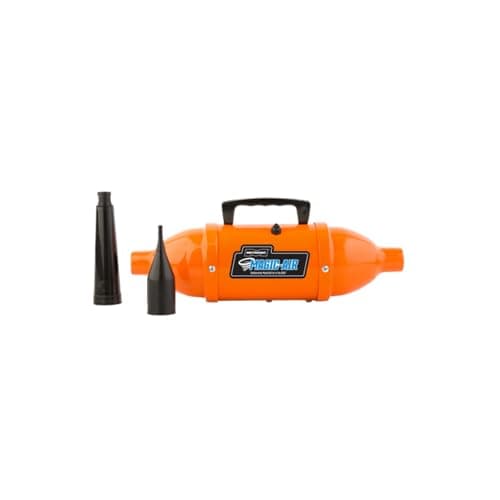 MetroVac MagicAir Electric Inflator/Deflator All-steel, made for continuous use, and the only pump here with a real warranty. MetroVac publishes 51 CFM where retailers claim 70 — believe the manufacturer. | A pump that outlives the poolMore than you need yet | 7.8out of 10 |
The short version
- Airflow is published in liters per minute. 650 L/min for the mains and 12V Intex pumps, 420 for the battery one, up to 400 for the cordless Dr.meter.
- Intex rates its mains pump for indoor household use only and limits it to ten minutes at a time. Its 12V pump is the one described as designed for outdoors.
- Firm, not hard. Bestway’s float manual says to inflate until most wrinkles are gone and it feels firm but NOT hard, and never to use an air compressor.
- Deflation is the underrated feature. Every pump here reverses, and that is what makes end-of-season storage take an afternoon instead of a weekend.
Why the pump matters more than the float
Our float buying guide makes the point that the most common way to waste money on floats is to buy ones nobody uses. Inflation effort is the biggest single reason a float goes unused: a large lounger is several minutes of hard work by mouth, and nobody does that twice before deciding the float is a nuisance.
A pump changes the calculation. Ninety seconds of noise and the float is ready, which is the difference between an item that lives in the garage and one that gets used on a Tuesday evening. It also makes proper storage realistic, because the same pump that inflates in ninety seconds deflates in about thirty, and a float that is stored flat and dry survives the winter.
Reading the specifications
Airflow is the headline, published in liters per minute or CFM. Intex publishes 650 L/min (23.0 CFM) for both its mains and 12V pumps, and 420 L/min (14.8 CFM) for the battery model. Dr.meter publishes up to 400 L/min. MetroVac publishes 51 CFM — and it is worth knowing that retail listings for that pump advertise 70 CFM, where the manufacturer’s own page says 51.
Power draw is published by exactly one maker here. MetroVac states 480 W and 4.0 A. None of the Intex pumps publish wattage, and neither does Dr.meter. Any running cost you see quoted for these pumps was not read off a manufacturer page.
Duty cycle is the specification buyers never look for and then run into. The Intex mains pump’s manual says not to operate it for more than ten minutes at a time, then to unplug and let it cool for at least ten minutes, with a thermal protector built in. On a day when you are inflating six things, that is a real constraint.
| Pump | Airflow | Power | Weight | Published limits |
|---|---|---|---|---|
| Intex 66639E (AC) | 650 L/min (23.0 CFM) | 120V mains | 1.24 lb | Indoor household use only; 10 min on, 10 min off |
| Intex 66636E (12V) | 650 L/min (23.0 CFM) | 12V car outlet | 1.37 lb | Described as designed for outdoor use |
| Intex 66638E (battery) | 420 L/min (14.8 CFM) | 6 C cells, not included | 0.95 lb | Runtime not published |
| Dr.meter 6000mAh | Up to 400 L/min | USB-rechargeable lithium | Not published | Small toys, pools and rafts only |
| MetroVac MagicAir | 51 CFM (maker); 70 CFM (retailers) | 120V, 480 W, 4.0 A | 3 lb | One-year limited warranty |
How much to inflate, according to the people who make floats
Over-inflation is the most common way to destroy a float, and float manuals are unusually clear about it. Bestway’s lounge float manual says to fill the chambers until most of the wrinkles are gone and it feels firm to touch but NOT hard, not to over-inflate, and not to use an air compressor. Intex’s float manuals use the same phrase: firm to the touch but not hard.
The reason is heat. Bestway’s manual warns that leaving a product in the sun for long periods causes air expansion that can do irreparable damage. A float inflated hard at nine in the morning is a float under serious pressure by two in the afternoon, which is why seams fail on hot days rather than busy ones. Our inflating guide covers the technique in more detail.
This is also the argument against the most powerful pump you can find. A 480 W steel inflator will happily take a float past firm and into hard, and no float manual anywhere asks for that.
Choosing by where you will use it
There is a socket near the pool, under cover: the Intex AC pump. Fastest, cheapest, lightest, and the ten-minute duty cycle is only an issue on party days.
The pool is away from the house: the 12V Intex if the car can get close, or the Dr.meter if it cannot. The 12V pump gives full airflow; the cordless one trades some of that for going anywhere.
Floats get inflated weekly: the Dr.meter. No batteries to buy, charged from a phone brick, and the manufacturer is honest that it is for small inflatables, pools and rafts rather than everything.
You own a lot of inflatables, or a big island: the MetroVac. It is the only pump here with steel construction, a published warranty, a published power draw and no duty cycle. It is also several times the price of an Intex pump that does the same job more slowly.
What to check before you buy
Check the valves on the floats you own
Intex pumps ship with three interconnecting nozzles that fit most valve sizes; Dr.meter publishes S, M and L nozzles. A pump that does not fit your valve is a useless pump.Decide where it will be plugged in
If the answer involves an extension lead across a wet deck, choose a 12V or cordless pump instead. The mains Intex pump is rated for indoor use.Check it deflates as well as inflates
All five here do. It is the feature that makes autumn storage quick, and our storing floats guide explains why floats must go away flat and dry.Match the pump to the biggest thing you own
Dr.meter states its pump is not for balloons, basketballs, tires or yoga balls, and is intended for small inflatables. Large islands want the mains or 12V airflow.Stop at firm, not hard
Whatever pump you buy, the float manual's instruction is the same: most wrinkles gone, firm to the touch, never hard, and never an air compressor.
How we picked
We have not tested these pumps. Scores are our reading of published specifications, and three of the five makers publish very little: no wattage from Intex or Dr.meter, no runtime for the battery pump, no warranty term on any Intex pump page we checked. MetroVac publishes the most and contradicts its own retailers on airflow, which is why the manufacturer figure is the one quoted here. We left out a popular cordless pump whose specifications we could not verify on any page the manufacturer controls.
Nozzles, and the reason a pump sits unused in a garage
The most common reason an air pump disappoints is fit. Intex ships three interconnecting nozzles described as fitting most valve sizes; Dr.meter publishes three detachable nozzles in small, medium and large, and is the only maker here to publish actual diameters anywhere. MetroVac supplies two tapered adapters rather than a graded set.
Pool inflatables use at least three valve styles: the large boston-style screw valve on loungers and islands, the small pinch valve on rings and toys, and the flat pop-in valve on cheap floats. A pump with a tapered adapter copes with most of them badly and the boston valve well. A pump with a graded nozzle set copes with all of them.
Check the floats you already own before buying, particularly if the collection includes anything with a screw-in valve and a separate deflation cap. Our inflating guide covers valve types and the technique that stops a float leaking down overnight — which, according to one manufacturer’s own float care page, is far more often an improperly closed valve than a puncture.
Deflation is the half that saves the floats
Every pump here reverses, and that matters more than the inflation speed. Storage guidance from float makers and brands is consistent: deflate fully, wash, dry completely, fold loosely, and store somewhere cool and dry rather than in direct sun. Doing that by hand on a six-foot lounger is the reason it usually does not happen.
It also protects against the failure our lifespan guide describes: vinyl that spends a winter inflated in a hot shed, creasing along the same fold under pressure, finishes the season with a split. A deflated float is under no stress at all.
There is a related warning in the float manuals themselves. Bestway’s lounge float manual instructs owners not to use an air compressor at all, and to leave the float firm but not hard because heat expands the air inside. A powerful pump is a tool for speed, not for pressure, and the target is the same whichever pump you own.
Looking after the pump
These are cheap appliances used a few times a year, and the two things that kill them are heat and damp. Mains pumps have a published duty cycle for a reason — Intex’s manual limits its AC pump to ten minutes at a time with ten minutes to cool, and notes a thermal protector inside.
Cordless pumps add a battery to look after. Lithium cells dislike being stored hot or fully flat, which is exactly what happens to anything kept in a poolside box through August and then forgotten until May. Charge it before it goes away for the winter, and store it indoors with the test kit rather than outdoors with the hoses — our equipment storage guide covers the rest of the close.
Finally, keep it off the ground when it is running beside a pool. Every one of these pumps draws air in, and a pump sitting in a puddle on a wet deck is drawing in water with it.
What we left out
One popular cordless pump was dropped from the picks during research. Its airflow, charge time and dimensions appear only in marketplace listing text, with no manufacturer page to check them against, and the manufacturer site we found did not carry the product at all.
That is a common pattern in this category: pumps are cheap, brands are numerous, and many have no published specification anywhere. Where a maker does publish — Intex, Dr.meter and MetroVac all do — the figures are specific and checkable, and those are the pumps here. If a listing is the only source for a number, treat the number as a claim.
The picks, in full
Scores are our own reading of published specifications. They are not test results — we have not tested these products and we do not claim to.
Pick #1 · Fastest inflation at a socket
Intex Quick-Fill AC Electric Air Pump (66639E)
Intex
650 liters a minute from a mains socket, and the pump most float owners should buy. Read the duty cycle before you start on a six-person island: ten minutes on, ten minutes off.
Key specs
- Airflow
- 650 L/min (23.0 CFM)
- Power
- 120V AC mains
- Deflates
- Yes
- Nozzles
- Three interconnecting nozzles for most valve sizes
- Duty cycle
- Maximum 10 minutes at a time, then 10 minutes to cool
- Weight
- 1.24 lb
- Rating
- Intex labels it for indoor household use only
- Wattage
- Not published
How it scoresour reading of published specs, not a test result
- Airflow
- 9.0
- Power source
- 7.0
- Portability
- 8.0
- Nozzles
- 8.5
- Value
- 9.0
Overall 8.4 / 10
What works
- The fastest cordless-free option here: a large float goes from flat to firm in a couple of minutes
- Deflates as well as inflates, which is what makes autumn storage bearable
- Light enough to carry in one hand and cheap enough to be an impulse buy
- Three nozzles cover the valve sizes on Intex and Bestway floats
What doesn't
- Intex rates it for indoor household use only, which is awkward for a product used beside a pool
- The ten-minute duty cycle interrupts a long inflating session
- Needs an outdoor socket or an extension run to the poolside
- No published wattage or warranty term
Skip it if: Poolside work in the wet. It is a mains appliance rated for indoor use; keep it on a dry surface away from the water, or use the battery or 12V version outside.
What it costs to run: Pennies of electricity a season. The real saving is the floats: over-inflation by lung power is rare, but the pump makes it far more likely that a float gets stored properly deflated rather than left out to cook.
Several seasons: Buy-once. Built and warranted to come back out of the box for a few years, if you store it properly.
Specs from: Intex — Quick-Fill AC electric air pump 23.0 CFM, published specifications, Intex 66639E owner's manual — duty cycle and indoor-use rating
Pick #2 · The one Intex actually rates for outdoors
Intex Quick-Fill DC Electric Air Pump (66636E)
Intex
The same 650 liters a minute as the mains pump, running off a car outlet, and the only Intex pump here the maker describes as designed for outdoor use.
#ad how this is funded · price as of October 8, 2026
Key specs
- Airflow
- 650 L/min (23.0 CFM)
- Power
- 12V DC from a car accessory socket
- Deflates
- Yes
- Nozzles
- Three interconnecting nozzles
- Rating
- Designed for outdoor use; ETL approved
- Weight
- 1.37 lb
- Wattage
- Not published
How it scoresour reading of published specs, not a test result
- Airflow
- 9.0
- Power source
- 7.5
- Portability
- 8.5
- Nozzles
- 8.5
- Value
- 8.0
Overall 8.3 / 10
What works
- Full mains-pump airflow without needing a socket near the pool
- The only pump here Intex describes as designed for outdoor use
- Doubles for camping, boats and car-based trips, which is where the 12V lead earns its keep
- Same three-nozzle set as the AC pump, so it fits the same floats
What doesn't
- Needs a vehicle, or a 12V supply, parked close enough to reach
- Running a car engine to inflate floats is an ugly way to spend fuel
- No published wattage or warranty
- Cable length dictates where inflating happens
Skip it if: Apartment and front-yard use. If the car cannot get near the pool, this pump cannot either, and the battery model is the better answer.
What it costs to run: No running cost worth counting. The case for it over the AC pump is siting, not economics — it removes the extension lead from a wet environment.
Several seasons: Buy-once. Built and warranted to come back out of the box for a few years, if you store it properly.
Specs from: Intex — Quick-Fill DC electric air pump 23.0 CFM, published specifications
Pick #3 · No socket, no car, no cable
Intex Quick-Fill Battery Air Pump (66638E)
Intex
Six C cells, 420 liters a minute and under a pound. It is the slowest Intex pump here and the only one that goes anywhere without planning.
Key specs
- Airflow
- 420 L/min (14.8 CFM)
- Power
- Six C-cell batteries, not included
- Deflates
- Yes
- Nozzles
- Three interconnecting nozzles
- Weight
- 0.95 lb
- Runtime
- Not published
How it scoresour reading of published specs, not a test result
- Airflow
- 7.0
- Power source
- 8.0
- Portability
- 9.5
- Nozzles
- 8.5
- Value
- 8.0
Overall 8.1 / 10
What works
- Genuinely portable — no lead, no socket, no vehicle
- Lightest pump here at under a pound
- Still deflates, which the cheapest manual alternatives do not
- Fine for the float population of an ordinary backyard pool
What doesn't
- Six C cells are an expense and are not supplied
- Roughly two-thirds the airflow of the mains and 12V pumps
- No published runtime, so how many floats per set of batteries is a guess
- Alkaline cells lose output as they drain, so the last float takes longer than the first
Skip it if: Big inflatables. On a large island or a six-person lounger the airflow and the battery drain both start to tell; this is a pump for floats, rings and loungers.
What it costs to run: Batteries are the running cost, and rechargeable C cells remove it. That is the case for the USB-rechargeable alternative if the pump gets used weekly rather than twice a summer.
One honest season: The cheapest setup that genuinely works for a season of real swimming. Nothing spare, nothing missing.
Specs from: Intex — Quick-Fill battery air pump 14.8 CFM, published specifications
Pick #4 · Cordless without buying batteries
Dr.meter 6000mAh Rechargeable Air Pump
Dr.meter
A 6,000 mAh cordless pump that charges off any USB port and moves up to 400 liters a minute. The maker is clear about its limits, which is more than most cordless pumps manage.
Key specs
- Airflow
- Up to 400 L/min
- Battery
- 6,000 mAh lithium, recharged from any 5V USB port
- Deflates
- Yes — two-way inflation and deflation
- Nozzles
- Three detachable nozzles, sizes S, M and L
- Size
- 115 x 63 x 71 mm
- Suitable for
- Small inflatable toys, inflatable pools and rafts
- Not suitable for
- Balloons, basketballs, tires and yoga balls, per the maker
- Runtime
- Not published by the manufacturer
How it scoresour reading of published specs, not a test result
- Airflow
- 7.5
- Power source
- 9.0
- Portability
- 9.0
- Nozzles
- 8.0
- Value
- 8.5
Overall 8.3 / 10
What works
- Cordless with no disposable batteries, charged from the same USB brick as a phone
- The manufacturer states what it is not for, which is unusual honesty in this category
- Small enough to live in a poolside box rather than the garage
- Deflates, so packing up at the end of the season is quick
What doesn't
- Lower airflow than the mains and 12V Intex pumps
- No published runtime or recharge time on the manufacturer page
- A flat battery means waiting, where a mains pump never does
- Lithium cells dislike being stored hot, which is exactly where pool gear lives
Skip it if: Large inflatables. Dr.meter itself limits it to small toys, inflatable pools and rafts, and an inflatable island is outside that list.
What it costs to run: No consumables at all, which over a few seasons is the cheapest of the cordless options. Charge it indoors and store it out of the sun and it will outlast the floats.
One honest season: The cheapest setup that genuinely works for a season of real swimming. Nothing spare, nothing missing.
Specs from: Dr.meter — rechargeable 6000mAh three-nozzle air pump, published specifications
Pick #5 · A pump that outlives the pool
MetroVac MagicAir Electric Inflator/Deflator
MetroVac
All-steel, made for continuous use, and the only pump here with a real warranty. MetroVac publishes 51 CFM where retailers claim 70 — believe the manufacturer.
#ad how this is funded · price as of October 8, 2026
Key specs
- Airflow
- 51 CFM per MetroVac; retailer listings claim 70 CFM
- Motor
- 0.75 peak HP, 120V
- Power draw
- 480 W, 4.0 A — the only pump here that publishes it
- Deflates
- Yes
- Adapters
- Notched inflator adaptor and inflator adaptor
- Cord
- 12 ft, two conductor
- Build
- All-steel construction; 3 lb
- Warranty
- One year limited on unit, motor, parts, switches and cords
How it scoresour reading of published specs, not a test result
- Airflow
- 8.5
- Power source
- 7.5
- Portability
- 7.0
- Nozzles
- 7.0
- Value
- 7.5
Overall 7.8 / 10
What works
- The only pump here with a published warranty and a published power draw
- Steel construction rather than the molded plastic everything else uses
- No duty-cycle restriction published, unlike the Intex mains pump
- A 12 ft cord, which removes one extension lead from a wet area
What doesn't
- Several times the price of an Intex pump that inflates the same floats
- Retailer airflow claims do not match the manufacturer's own figure
- Two tapered adapters rather than a graded nozzle set, so valve fit is less certain
- 480 W is real power draw, where the small pumps are trivial
Skip it if: Being proportionate. For a family with four floats and a ring, this is a lifetime tool bought for a job that a much cheaper pump does adequately.
What it costs to run: 480 W for a few minutes is nothing on a bill. The argument is replacement cost: one steel pump against a plastic one every few seasons.
More than you need yet: Real capability a first-pool family cannot use yet. Buy cheaper and put the difference toward chemicals and a cover.
Specs from: MetroVac — MagicAir electric inflator/deflator, published specifications and warranty
Questions people actually ask
How firm should a pool float be?
Can I use a mains air pump beside the pool?
How long can an electric air pump run continuously?
Do these pumps deflate floats as well?
Is a more powerful pump better?
Sources
- Intex — Quick-Fill AC electric air pump, published specifications
- Intex 66639E owner's manual — duty cycle and indoor-use rating
- MetroVac — MagicAir inflator/deflator, published specifications and warranty
- Bestway — Flex 'n Fold pool lounge float owner's manual (inflation guidance)
- Dr.meter — rechargeable 6000mAh air pump, published specifications
Read next
- Floats, loungers and the stuff that makes the pool worth havingFloats for adults, toddlers and dogs - ranked on seam and valve construction, which is what actually decides how long they last.
- The most common way to break a float is to inflate itHow firm an inflatable should be, why heat changes it, which pump to use for each valve type, and the order to inflate chambers in.
- Where the floats go when nobody is swimmingDeck boxes and mesh bins compared on capacity, drying, published weather resistance and the warranty exclusions that tell you what each one is really built for.
- How long pool floats last, and why yours did notWhat actually destroys a pool float, the four-step routine that roughly triples its life, and when to patch versus replace.
- How to store pool floats so you are not rebuying them in MayThe end-of-season routine for inflatables and foam: drying properly, folding without creasing, and where to keep them so they survive winter.
- Finding the hole, and making the patch actually holdHow to locate a slow leak, tell a puncture from a failing valve, and patch vinyl so the repair survives the season.
- The best pool floatsFloats ranked on material, valve type and published weight capacity - the three specs that decide whether it survives a season.