Floats & Fun
Swim diapers: read the warning printed on the box
A swim diaper contains solids and nothing else, and the maker says so on the pack. Which one to buy comes down to how often the child is in the water, and the break-even is about five weeks.
Heads up: we earn a commission if you buy through the links on this page, at no extra cost to you. It never decides the ranking — here is how we pick and here is the full disclosure. Prices are checked automatically; last verified October 8, 2026.
Quick picks
Segmented before it is ranked — the right answer depends on which of these you actually are. Tap any row for the full write-up.
If the pool is an occasional thing
Sized by weight, published as not swelling in water, stocked everywhere - and carrying the most useful warning in the category on its own pack.
| # | Product | Best for | Score | Price |
|---|---|---|---|---|
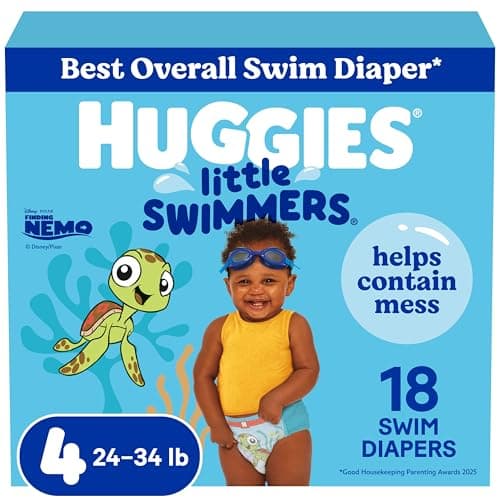
| 1 | Huggies Little Swimmers Disposable Swim Diapers Wood fluff pulp that does not swell in water, sized by weight. The most useful thing on the package is the disclaimer: do not expect swim pants to prevent the transmission of diseases. | The default, and the one with the honest warning on the packA few weekends | 7.3out of 10 |
If the child is in the water most days
One adjustable size on snaps covering 9 months to 3T, two in a pack. The only version of this product whose season arithmetic works.
| # | Product | Best for | Score | Price |
|---|---|---|---|---|
| 1 | 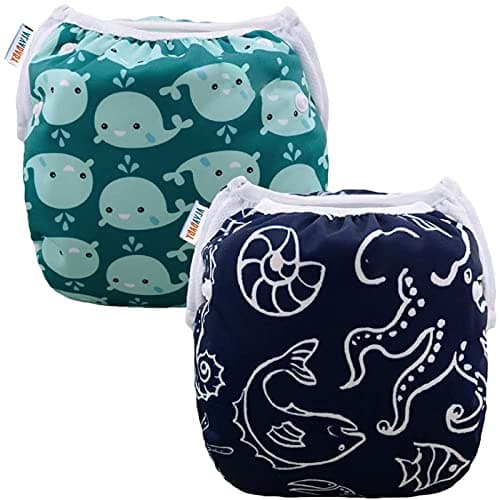 ALVABABY Reusable Swim Diapers, 2-Pack One adjustable size covering 9 months to 3T on snaps, washable, two in a pack. For a child swimming daily this is the only version of this product whose arithmetic works. | A toddler who is in the pool most daysOne honest season | 8.1out of 10 |
If the problem has been leg-opening fit
Fixed sizing by month rather than one-size-adjustable, sold singly. You pay more per diaper for a diaper that actually fits now.
| # | Product | Best for | Score | Price |
|---|---|---|---|---|
| 1 | 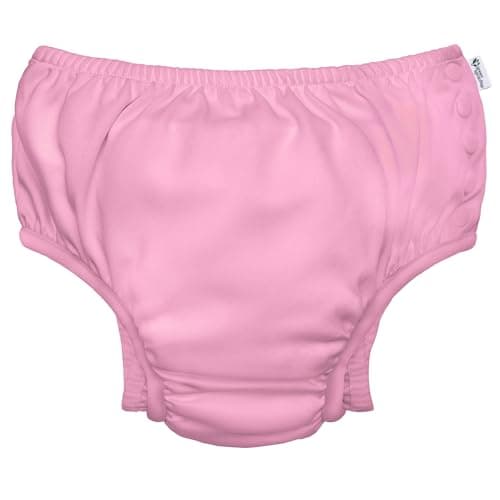 green sprouts Reusable Snap Swim Diaper A single fixed-size snap diaper from a brand that sells by the month rather than by the range. Buying by actual size rather than one-size-adjustable is the trade here. | A single, better-made reusable rather than a packOne honest season | 7.8out of 10 |
The short version
- The pack carries the honest warning. “DO NOT EXPECT SWIM PANTS TO PREVENT THE TRANSMISSION OF DISEASES” is printed by the maker.
- Nothing here absorbs, deliberately. An absorbent diaper in a pool swells and sheds gel into your filter.
- Reusables break even around week five. Daily swimming makes the arithmetic one-sided; a holiday does not.
- The real protection is the CDC routine. Hourly diaper checks, changes away from poolside, a one-minute shower before getting in.
What a swim diaper is for, according to the people who make them
Most product categories require you to read between the lines of the marketing. This one does not, because the manufacturer prints the limitation on the box in capital letters: “DO NOT EXPECT SWIM PANTS TO PREVENT THE TRANSMISSION OF DISEASES.”
That is the most useful sentence in the category, and it reframes the whole purchase. A swim diaper is a containment garment for solids. It buys you the time to notice and get to a bathroom. It is not a filter, it is not a seal, and nothing dissolved is stopped by it — which means diarrhea is not stopped by it, and the CDC’s published advice is simply to stay out of the pool if you have it.
Why none of these absorbs
A regular diaper is engineered to pull liquid into a gel core and hold it. Put one in a pool and it does exactly that with the pool: it swells, gets heavy, sags off the child, and the superabsorbent polymer starts escaping into the water. On a pool with a cartridge filter that gel goes into the cartridge, and it does not rinse out.
Swim diapers solve this by not absorbing. The disposables use a material published as wood fluff pulp and are explicitly made with materials that will not swell in water like a regular diaper. The reusables go further and have no core at all — they are a waterproof outer with elasticated legs, and the containment is entirely about fit.
Published sizing, side by side
| Product | Sizing basis | Published range | Pack | Reusable |
|---|---|---|---|---|
| Huggies Little Swimmers | Weight | Sz 3: 16-26 lb; sz 4: 24-34 lb; sz 5-6: 32 lb+ | Up to 40, 36 and 34 by size | No |
| ALVABABY | One size, snap-adjustable | 9 months to 3T | 2 | Yes |
| green sprouts | Fixed, by month | 12 month and 18 month common | 1 | Yes |
The useful distinction is not reusable against disposable — it is one-size-adjustable against fixed-size. An adjustable diaper covers two years of growth and fits approximately throughout. A fixed size fits properly now and is outgrown. For a product whose only mechanism is a seal at the leg, that is a real trade and not an obvious one.
The cost arithmetic, which is one-sided
Disposable against reusable over one summer
- Disposable, roughly per diaper
- about 50 cents
- A toddler swimming most days of a 90-day summer
- about 90 swims
- Season cost, disposable
- about $45
- Two adjustable reusables
- about $10
$10 ÷ $0.50 per swim = 20 swims to break even
Reusables pay for themselves in about five weeks of regular swimming
The hassle column is the one the arithmetic does not capture. A disposable goes in a bin at the poolside. A reusable goes into your bag wet and has to be washed before the next swim, which is why two is the minimum workable number and why most families with a pool end up owning both — reusables for the yard, a small pack of disposables for anywhere else.
Where swim diapers sit in the rest of the water chemistry
Small children are the highest-impact swimmers a pool has, and not mainly for the reason this page is about. Sunscreen, body oils and general debris from a few toddlers is a real chlorine demand, which our swimmer load page quantifies, and it is why a pool that hosts a children’s afternoon needs a chlorine check that evening rather than on Sunday.
The other page worth reading alongside this one is how long before you can swim after adding chemicals, because the published answer is a chlorine reading rather than a number of hours — and with small children the temptation is to shock the pool and get back in on a guess. The 1-4 ppm range the CDC publishes applies to a toddler exactly as it does to an adult.
What we are not going to tell you
Which one “leaks less”. None of the three publishes a containment claim, a leak rate or any test result, and there is no independent testing of swim diapers that we could find. Fit at the leg opening is the mechanism, fit is child-specific, and anyone ranking these on leakage is ranking them on anecdote.
What we can tell you is what each publishes: weight ranges, pack counts, materials where stated, and in one case a frank warning about what the product does not do. That warning is the reason the disposable leads this page despite being the most expensive per swim. A product that tells you its own limit is a product you can use correctly.
The picks, in full
Scores are our own reading of published specifications. They are not test results — we have not tested these products and we do not claim to.
Pick #1 · The default, and the one with the honest warning on the pack
Huggies Little Swimmers Disposable Swim Diapers
Huggies
Wood fluff pulp that does not swell in water, sized by weight. The most useful thing on the package is the disclaimer: do not expect swim pants to prevent the transmission of diseases.
Key specs
- Sizing
- Size 3 is 16-26 lb, size 4 is 24-34 lb, size 5-6 is 32 lb and up, published
- Absorbent material
- Wood fluff pulp, published
- Swell behavior
- Published as made with materials that will not swell in water like a regular diaper
- Counts
- Published up to 40 per pack at size 3, 36 at size 4, 34 at size 5-6
- On-pack warning
- "DO NOT EXPECT SWIM PANTS TO PREVENT THE TRANSMISSION OF DISEASES", published
- Reusable
- No — single use
How it scoresour reading of published specs, not a test result
- Material
- 7.0
- Valve
- 7.5
- Capacity
- 7.5
- Storage
- 8.5
- Value
- 6.5
Overall 7.3 / 10
What works
- Sized by weight rather than age, which is the only sizing that works for this product
- Does not swell, which is the entire functional difference from a regular diaper
- Stocked everywhere, so a forgotten pack is not the end of the afternoon
- The pack states its own limitation plainly, which is more than most products in this category manage
What doesn't
- Single use, so a summer of daily swimming is a real recurring cost and a bin full of them
- Contains solids, which is all it claims — it is not a barrier to anything dissolved
- No published leak-proof claim; the elastic is the whole seal
- Cost per swim is the highest of the three options here by a wide margin
Skip it if: Doing the thing people assume it does. A swim diaper buys you time to get to a bathroom; the CDC's published advice is to check diapers every hour and change them away from the water.
What it costs to run: Twenty swims at roughly 50 cents each is about $10, and a toddler swimming most days of a 90-day summer is nearer $45 a season. That is the number the reusable options are competing against.
A few weekends: Fine for a heatwave and a toddler. Treat it as consumable, not as a pool — it will not survive a winter in the yard.
Specs from: CDC — what you can do to stay healthy in swimming pools (diaper checks, changing away from poolside)
Pick #2 · A toddler who is in the pool most days
ALVABABY Reusable Swim Diapers, 2-Pack
ALVABABY
One adjustable size covering 9 months to 3T on snaps, washable, two in a pack. For a child swimming daily this is the only version of this product whose arithmetic works.
#ad how this is funded · price as of October 8, 2026
Key specs
- Pack
- 2 diapers, published
- Sizing
- One size, adjustable by snap, published for 9 months to 3T
- Reusable
- Yes — washable, published
- Closure
- Adjustable snaps, published
- Absorbency
- Not published — these are containment, not absorbent, by design
- Material
- Not published in detail on the listing
How it scoresour reading of published specs, not a test result
- Material
- 7.5
- Valve
- 8.0
- Capacity
- 7.5
- Storage
- 8.0
- Value
- 9.0
Overall 8.1 / 10
What works
- One size on snaps covers roughly two years of growth, which is most of the swim-diaper window
- Two in a pack means one on the child and one in the wash, which is the minimum workable number
- Cost per swim falls to almost nothing over a season of daily use
- No absorbent core means nothing to swell and nothing to shed into the water
What doesn't
- Needs washing between every use, and a wet one left in a bag is a problem by evening
- No material or waterproofing spec published, so you cannot compare it with other reusables
- Snap sizing is adjustable but fiddly, and a loose leg opening defeats the whole product
- Two is enough only if you do laundry daily
Skip it if: Travel and day trips. A disposable goes in the bin at the pool; this goes in your bag wet, and that is a genuine reason to own both.
What it costs to run: Two reusables at about $10 against roughly $45 for a season of daily disposables. The break-even is somewhere around the fifth week, which is why this is the right buy for a child with a pool in the yard and the wrong one for a fortnight's holiday.
One honest season: The cheapest setup that genuinely works for a season of real swimming. Nothing spare, nothing missing.
Pick #3 · A single, better-made reusable rather than a pack
green sprouts Reusable Snap Swim Diaper
green sprouts
A single fixed-size snap diaper from a brand that sells by the month rather than by the range. Buying by actual size rather than one-size-adjustable is the trade here.
#ad how this is funded · price as of October 8, 2026
Key specs
- Pack
- 1 diaper, published
- Sizing
- Sold by month — the common sizes are published as 12 month and 18 month
- Closure
- Snap, published
- Reusable
- Yes — washable, published
- Absorbency
- Not published; containment by design
- Material
- Not published in detail on the listing
How it scoresour reading of published specs, not a test result
- Material
- 8.0
- Valve
- 8.5
- Capacity
- 7.0
- Storage
- 8.0
- Value
- 7.0
Overall 7.8 / 10
What works
- Fixed sizing fits properly now instead of approximately for two years, and fit is the whole product
- Snap closure rather than hook-and-loop, which survives chlorine and washing better
- Sold singly, so you can buy one and find out before committing
- From a baby-goods brand rather than a pool brand, which shows in the leg-opening shaping
What doesn't
- Sized by month, so you buy again as the child grows instead of adjusting snaps
- Sold singly at a price close to a two-pack of the adjustable version
- No material or waterproof layer specification published
- One diaper is not a workable inventory for daily swimming
Skip it if: Being the only one you own. A single reusable means a wash between every swim, so this is a second diaper or a better-fitting first one, not a complete answer.
What it costs to run: More per diaper than the adjustable two-pack and it fits a narrower window, so it only makes sense if fit has actually been the problem. If it has, fit is worth paying for: a swim diaper that leaks at the leg is not a swim diaper.
One honest season: The cheapest setup that genuinely works for a season of real swimming. Nothing spare, nothing missing.
Pick #4 · Small children, with adult supervision
Toddler Swim Vest / Puddle Jumper Style Flotation
Various
If you want flotation for a small child, buy something that is genuinely rated for it rather than an inflatable seat. Look for US Coast Guard approval printed on the product, not a picture of a child on the box.
Key specs
- What to check
- US Coast Guard approval statement, printed on the product
- Weight range
- Printed on the label — match it to the child
- Not a substitute for
- Supervision or a barrier
How it scoresour reading of published specs, not a test result
- Material
- 8.0
- Valve
- 8.0
- Capacity
- 8.5
- Storage
- 8.5
- Value
- 8.5
Overall 8.3 / 10
What works
- A Coast Guard-approved device is a fundamentally different product from a pool toy
- Weight-rated, so there is an objective way to check it fits your child
- Frees a child's arms, which an inflatable ring does not
What doesn't
- Not all products marketed for toddlers carry Coast Guard approval — you have to read the label
- Children outgrow the weight range quickly
- Can create false confidence in both child and adult
Skip it if: Replacing supervision. The CPSC's pool safety guidance is built on layers — barriers, supervision and appropriate flotation — and no single item substitutes for the others.
One honest season: The cheapest setup that genuinely works for a season of real swimming. Nothing spare, nothing missing.
Specs from: CPSC — Pool Safely
Pick #5 · Shade first
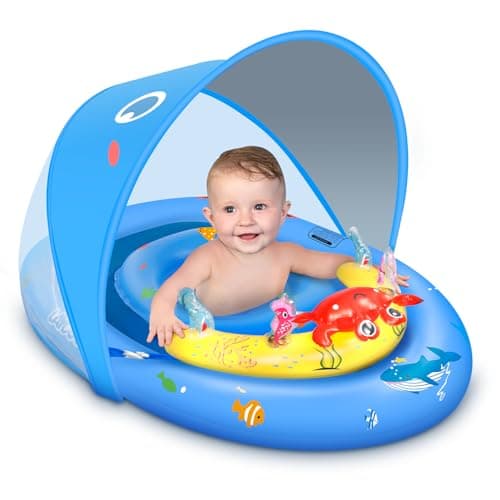
Toddler Pool Float with Canopy
Various
For a toddler in a pool, sun exposure is the more likely problem on any given afternoon. A canopy addresses that. It is comfort equipment, not safety equipment, and the distinction matters.
Key specs
- Type
- Inflatable seat with removable canopy
- Safety rating
- None — this is not a flotation device
- Weight range
- Printed on the product
- Canopy
- Usually removable, often the first part to fail
How it scoresour reading of published specs, not a test result
- Material
- 6.0
- Valve
- 6.5
- Capacity
- 7.0
- Storage
- 8.0
- Value
- 7.0
Overall 6.8 / 10
What works
- Shade is the genuinely useful feature for the age group
- Leg holes keep a small child seated rather than sliding
- Cheap enough to treat as a one-season item, which it is
What doesn't
- Not a life jacket and must never be used as one
- Canopy seams tear well before the float itself does
- Children outgrow it within a single summer
Skip it if: Anything unsupervised, ever. Use it within arm's reach and treat it as furniture rather than safety gear.
A few weekends: Fine for a heatwave and a toddler. Treat it as consumable, not as a pool — it will not survive a winter in the yard.
Specs from: CPSC — Pool Safely
Questions people actually ask
Do swim diapers actually hold anything?
What size swim diaper do I need?
Are reusable swim diapers cheaper?
Why do swim diapers not absorb?
Can you use a regular diaper in a pool?
Sources
Read next
- Floats, loungers and the stuff that makes the pool worth havingFloats for adults, toddlers and dogs - ranked on seam and valve construction, which is what actually decides how long they last.
- Small children and pool water, without the scare storiesThe hygiene practices that actually change the risk with toddlers in a backyard pool, and the ones that do not.
- Toddler pool floats: know which of two products you are buyingThe critical distinction between comfort seats and rated flotation, what to check on the label, and why shade is the underrated feature.
- Swim vests and floaties: the label that separates them from toysHow to tell an approved flotation device from a pool toy, what the weight range on the label means, and why neither replaces supervision.
- The best backyard pools for kidsPools chosen for young children - depth, shade and securability rank above capacity and construction here.
- Bather load: the variable that explains your worst weeksWhy gallons per swimmer is the number that matters, what a busy afternoon costs you in chlorine, and the routine that absorbs it.
- How long before you can swim? The label gives a number, not a timePublished re-entry rules for each pool chemical, read off EPA labels - and why the real answer is a chlorine reading rather than a number of hours.
- Clear water and safe water are two different thingsWhy a pool can look perfect and be unsanitized, why haze is often harmless, and the four readings that answer the question clarity cannot.
- Noodles or a swim vest: only one of them has a label that means anythingFoam noodles against labeled swim vests for young children: what each is actually designed to do, what to check on the label, and why supervision is the real answer.