Floats & Fun
Inflatable islands, and the question of whether it fits
The most fun per dollar in the category and the hardest thing to own. Most of the trouble is decided before you buy, by one measurement.

Heads up: we earn a commission if you buy through the links on this page, at no extra cost to you. It never decides the ranking — here is how we pick and here is the full disclosure. Prices are checked automatically; last verified October 8, 2026.
Quick picks
Segmented before it is ranked — the right answer depends on which of these you actually are. Tap any row for the full write-up.
The multi-person option
A large island seats several people and turns the pool into somewhere you sit rather than swim. Measure first — this is the constraint.
| # | Product | Best for | Score | Price |
|---|---|---|---|---|
| 1 | No image Multi-Person Inflatable Island Four to six seats, a cooler well and cup holders. It is a wonderful object and it does not fit in most of the pools this site is about, which is the thing to establish before buying one. | A lake or a genuinely large poolOne honest season | 7.4out of 10 |
If your pool is under 15 feet
One good single lounger gets more use than an island that fills the pool. This is the honest recommendation for most above-ground owners.
| # | Product | Best for | Score | Price |
|---|---|---|---|---|
| 1 | 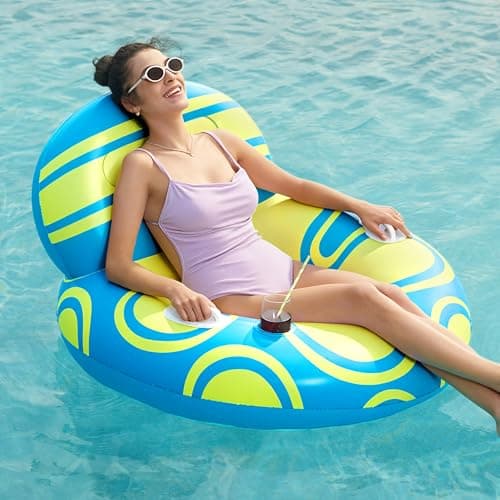 Mesh-Bottom Pool Lounger Chair The mesh seat has almost no inflated volume, which removes the thing that fails on every other float. Outlasts vinyl inflatables by years and costs more up front for exactly that reason. | Lasting more than one summerSeveral seasons | 8.4out of 10 | |
| 2 | 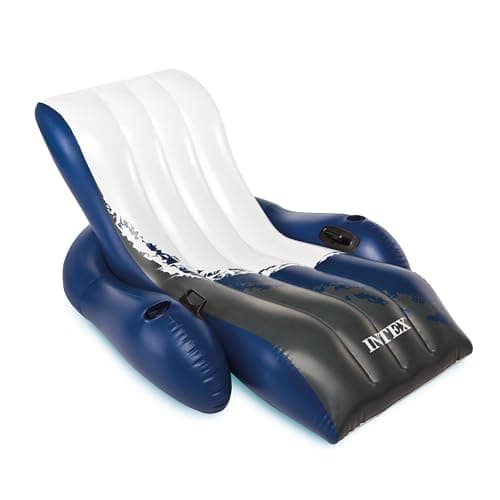 Intex Inflatable Pool Lounge with Backrest A backrest changes an inflatable from something you lie on to something you can actually sit in and hold a drink. That is the whole feature and it is worth the small premium. | One adult, sitting upOne honest season | 7.6out of 10 |
Buy this at the same time
A large multi-chamber float will need a patch eventually, and the kit is worth more than the float when it does.
| # | Product | Best for | Score | Price |
|---|---|---|---|---|
| 1 | 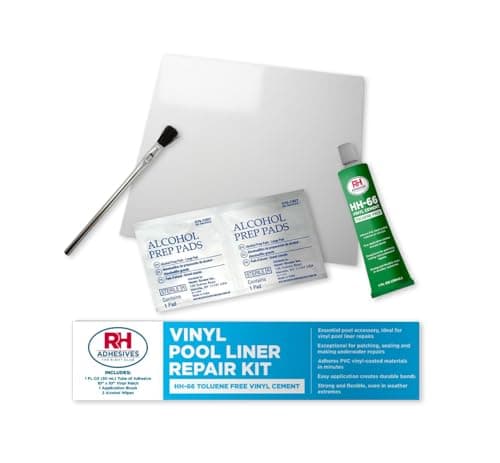 Vinyl Repair Patch Kit A few dollars of adhesive patches that turn most float failures into a ten-minute fix. The reason people replace floats annually is usually that they did not own one of these. | Not throwing away a float over one holeSeveral seasons | 8.5out of 10 |
The short version
- Measure the pool, then subtract. An island needs clearance around it or it is wedged rather than floating.
- Chamber count is the durability spec. One chamber means one leak sinks the whole thing; four means it stays usable.
- An electric pump is not optional at this size. Large islands are a long job by hand and overfilling is the main way they fail.
- Storage is the reason people regret them. Deflated, a big island is still a large, heavy, awkward object.
Start with the measurement, because it decides the purchase
Inflatable islands are designed for lakes and inground pools, where the water is effectively unlimited. Above-ground pools in this category run from about 10 to 18 feet across, and our sizing guide has the volumes: a 12-foot Easy Set holds about 1,485 gallons at its 23-inch fill line, and an 18-foot Ultra XTR about 6,981.
Compare the island’s inflated dimensions against your pool’s internal width and leave real clearance on each side. If the island is more than roughly half the pool’s width, it stops being a float and becomes furniture: it cannot rotate, it blocks the skimmer, and getting on it means climbing over the side rather than swimming to it.
What separates a good island from a cheap one
| Spec | What to look for | Why it matters |
|---|---|---|
| Air chambers | Three or more, independent | One leak leaves the rest usable rather than sinking it |
| Valve type | Boston or screw-type | Fast to fill, fast to empty, holds pressure better than a pinch valve |
| Seam construction | Welded, wide overlap | Seams are the most common failure point on large floats |
| Material weight | Heavier gauge vinyl | Thin vinyl is why cheap islands last one season |
| Handles and grab lines | Multiple, reinforced | This is how people get on; unreinforced handles tear out |
| Weight capacity | Published, per person | Manufacturer stated — treat it as a limit, not a target |
Chamber count is the one to read first. On a single-chamber float any puncture is total failure. On a four-chamber island a slow leak in one section is an inconvenience you patch at the end of the day, which is the difference between a float that lasts several seasons and one that does not. Our lifespan guide covers what actually kills them.
Inflation, where large floats get ruined
A big island is not a by-mouth job. Use an electric pump, inflate in the shade, and stop when the chamber is firm but still gives under a hand — not drum-tight.
The reason is thermal expansion. Air inflated at a cool morning temperature expands as the sun heats it and the float sits in warm water, and a float filled hard in the shade at 9am is under considerably more pressure at 2pm. That is when seams let go. Our inflating guide covers the whole procedure, and it is the most useful five minutes of reading in this hub.
The storage problem
This is the part that decides whether you keep it. A large island deflated is not small — it is a heavy, bulky folded sheet of vinyl that needs to be completely dry before it goes away, because damp vinyl in a dark shed grows mildew that does not come off.
Realistically that means an afternoon of drying, both sides, before it is packed. If you do not have somewhere to do that and somewhere to put the result, an island is the wrong purchase regardless of pool size. Our storage guide has the routine.
Safety, briefly and seriously
Large floats create shade and cover, which means a person underneath one is genuinely hard to see. That is a supervision problem rather than a product problem, and the fix is simple: when small children are in the pool, the island comes out.
The rest is the standard line, and it holds for the biggest float as much as the smallest. None of this is safety equipment. The CPSC treats flotation toys and Coast Guard approved life jackets as separate categories, and an island — which is stable, comfortable and easy to fall asleep on — is exactly the kind of float that invites people to forget it. A proper vest is what a weak swimmer wears, on or off the island.
The picks, in full
Scores are our own reading of published specifications. They are not test results — we have not tested these products and we do not claim to.
Pick #1 · A lake or a genuinely large pool
Multi-Person Inflatable Island
Various
Four to six seats, a cooler well and cup holders. It is a wonderful object and it does not fit in most of the pools this site is about, which is the thing to establish before buying one.
Key specs
- Capacity
- 4 to 6 people, published per model
- Typical footprint
- Published per model — commonly 110in to 145in across
- Features
- Backrests, built-in cooler, cup holders, grab ropes
- Chambers
- Multiple on better models — check before buying
How it scoresour reading of published specs, not a test result
- Material
- 7.5
- Valve
- 8.0
- Capacity
- 9.5
- Storage
- 4.5
- Value
- 7.0
Overall 7.4 / 10
What works
- Genuinely comfortable in a way no single-seat float is
- Multiple chambers on better models mean one puncture is not the end of it
- Cooler well and cup holders are the features people actually use
- Excellent on a lake, where space is not the constraint
What doesn't
- The footprint is the problem — 110 inches across is most of a 12-foot pool
- Big inflatables are slow to inflate and awkward to dry before storage
- Storage volume when deflated is still substantial
- Grounds out in shallow water once loaded, like any deep-seat float
Skip it if: An above-ground pool under about 18 feet. Measure the published footprint against your water surface before buying — it is usually the whole answer.
What it costs to run: A one-off, and the real cost is the space it occupies both in the pool and in the shed. Both are worth checking before the box arrives.
One honest season: The cheapest setup that genuinely works for a season of real swimming. Nothing spare, nothing missing.
Specs from: Intex Blue Tropic 5-person inflatable island — current Amazon listing
Pick #2 · Lasting more than one summer
Mesh-Bottom Pool Lounger Chair
Various
The mesh seat has almost no inflated volume, which removes the thing that fails on every other float. Outlasts vinyl inflatables by years and costs more up front for exactly that reason.
Key specs
- Construction
- Fabric or mesh seat on an inflatable or foam frame
- Failure mode
- Frame or fabric wear rather than puncture
- Weight capacity
- Published per model
- Drying
- Mesh drains and dries quickly
How it scoresour reading of published specs, not a test result
- Material
- 9.0
- Valve
- 8.5
- Capacity
- 8.0
- Storage
- 6.0
- Value
- 8.5
Overall 8.4 / 10
What works
- Very little inflated volume, so the usual puncture failure mode largely goes away
- Mesh drains and dries, so it does not get stored wet and go moldy
- Genuinely a multi-season purchase in a category of consumables
What doesn't
- Considerably more expensive than a vinyl inflatable
- Sits lower in the water, which some people dislike
- Bulkier to store than a deflated inflatable
Skip it if: A shallow pool. A mesh lounger needs enough depth for the seat to hang in, so it is wrong in a 30-inch pool.
What it costs to run: The arithmetic that justifies it: a $25 vinyl float replaced every summer for four years costs more than one mesh lounger that lasts four. Buy this only if your pool is deep enough to use it.
Several seasons: Buy-once. Built and warranted to come back out of the box for a few years, if you store it properly.
Pick #3 · One adult, sitting up
Intex Inflatable Pool Lounge with Backrest
Intex
A backrest changes an inflatable from something you lie on to something you can actually sit in and hold a drink. That is the whole feature and it is worth the small premium.
#ad how this is funded · price as of October 8, 2026
Key specs
- Material
- Vinyl — gauge published per SKU
- Chambers
- Multiple, so a single puncture does not sink it
- Weight capacity
- Published per SKU by Intex
- Valve
- Check the SKU — Boston valves are the ones worth having
How it scoresour reading of published specs, not a test result
- Material
- 7.0
- Valve
- 7.5
- Capacity
- 8.0
- Storage
- 6.5
- Value
- 8.0
Overall 7.6 / 10
What works
- Backrest makes it usable for more than ten minutes at a time
- Multi-chamber construction means one leak is an inconvenience rather than the end
- Intex publishes weight capacity, which many float brands do not
What doesn't
- Vinyl in direct sun is on a clock no matter what you pay
- Bulky to inflate without a pump
- Larger surface area means more to store and more to dry
Skip it if: Being left inflated on a hot deck between swims, which is exactly what everyone does and exactly what kills it.
One honest season: The cheapest setup that genuinely works for a season of real swimming. Nothing spare, nothing missing.
Pick #4 · Not throwing away a float over one hole
Vinyl Repair Patch Kit
Various
A few dollars of adhesive patches that turn most float failures into a ten-minute fix. The reason people replace floats annually is usually that they did not own one of these.
#ad how this is funded · price as of October 8, 2026
Key specs
- Use
- Vinyl floats, liners, air beds
- Requirement
- Surface must be clean and fully dry
- Cure
- Follow the kit — most need hours before re-inflating
How it scoresour reading of published specs, not a test result
- Material
- 8.0
- Valve
- 8.0
- Capacity
- 7.0
- Storage
- 9.5
- Value
- 9.5
Overall 8.5 / 10
What works
- Fixes the dominant failure mode of the entire floats category
- Also patches a pinhole in a pool liner, which is a far more expensive save
- Lasts indefinitely in the shed
What doesn't
- Will not fix a split seam, only a puncture
- Needs a genuinely dry surface, which is inconvenient poolside
- Cheap kits use adhesive that fails after a season in the water
Skip it if: Seam failures and valve leaks. Those are the end of the float and no patch changes that.
What it costs to run: The highest-leverage few dollars in this hub: one saved float pays for it several times over, and one saved liner pays for it a hundred times over.
Several seasons: Buy-once. Built and warranted to come back out of the box for a few years, if you store it properly.
Questions people actually ask
Will an inflatable island fit in an above-ground pool?
How many air chambers should an inflatable island have?
Do I need an electric pump for an inflatable island?
How do you store a large inflatable pool float?
Sources
Read next
- Floats, loungers and the stuff that makes the pool worth havingFloats for adults, toddlers and dogs - ranked on seam and valve construction, which is what actually decides how long they last.
- The best pool loungersMesh chairs versus vinyl mats, the depth each needs, and the four-summer arithmetic that favors mesh.
- The best pool floats for adultsAdult loungers and tubes compared on capacity and seat design, plus the pool depth each one actually needs.
- Kitting out a pool party without buying a garage full of vinylThe float and toy mix that actually works when several people are in the pool at once, and the mistakes that leave you with unused vinyl.
- The most common way to break a float is to inflate itHow firm an inflatable should be, why heat changes it, which pump to use for each valve type, and the order to inflate chambers in.
- How to store pool floats so you are not rebuying them in MayThe end-of-season routine for inflatables and foam: drying properly, folding without creasing, and where to keep them so they survive winter.
- Finding the hole, and making the patch actually holdHow to locate a slow leak, tell a puncture from a failing valve, and patch vinyl so the repair survives the season.
- How long pool floats last, and why yours did notWhat actually destroys a pool float, the four-step routine that roughly triples its life, and when to patch versus replace.
- What size pool your backyard can actually takeThe three-foot rule, the level-ground tolerance, and a table matching yard size to pool size with the running cost attached.